



Table of Contents
Home / Blog / Blockchain
How Blockchain Powers Per Diem Civic Networks: A Complete Guide

by

January 8, 2026

by
January 8, 2026
Across the world, cities are evolving toward systems that emphasize efficiency, transparency, and inclusiveness. This shift has sparked growing interest in digital governance models that reduce friction in citizens’ interactions with public institutions. As governments explore modern solutions, many are evaluating the potential of blockchain in civic systems because of its ability to establish trust, secure data, and streamline operations without relying on centralized oversight.
Per diem civic networks represent a new category of public-sector digital infrastructure. These systems support daily civic functions such as benefits distribution, identity verification, public resource allocation, and community-level participation initiatives. The integration of blockchain in civic frameworks enhances the reliability of these networks by creating tamper-proof records, secure data-sharing mechanisms, and automated workflows. In this guide, we explore how blockchain for civic administration can strengthen transparency, reduce operational inefficiencies, and build trust between institutions and the public.
Transform Your Civic Systems With Secure Blockchain Infrastructure
Ready to modernize public workflows, eliminate fraud, and enhance transparency? Our blockchain consultants help governments and civic organizations build scalable, tamper-proof, and automation-ready systems tailored to real-world needs.
Understanding Per Diem Civic Networks
Per diem civic networks are digital platforms that support recurring administrative activities citizens perform daily. These systems often handle tasks like accessing subsidies, reporting issues, participating in local governance, securely storing personal documents, and receiving public-sector payments.
By digitizing processes that traditionally require manual review and multiple intermediaries, civic networks give residents a more accessible way to interact with their government. When supported by blockchain technology, they also offer a permanent record of actions, reducing errors, losses, or manipulation.
Why Blockchain Fits the Civic Network Model
Blockchain is uniquely suited to strengthen civic systems because it:
- Maintains an immutable record of public activity
- Enables decentralized transaction validation
- Allows secure verification of identity and credentials
- Supports programmable rules through smart contracts
- Enhances transparency for both the public and institutions
- Improves citizen data security and privacy through encryption
These benefits align with the core requirements of digital governance, mainly when an administration aims to reduce fraud, ensure accountability, and improve service delivery.
The Role of Blockchain in Civic Administration
Blockchain for civic administration introduces a new foundation for public-sector digitization. Instead of relying on siloed databases and legacy systems, government agencies can use shared distributed ledgers to coordinate processes among multiple departments.
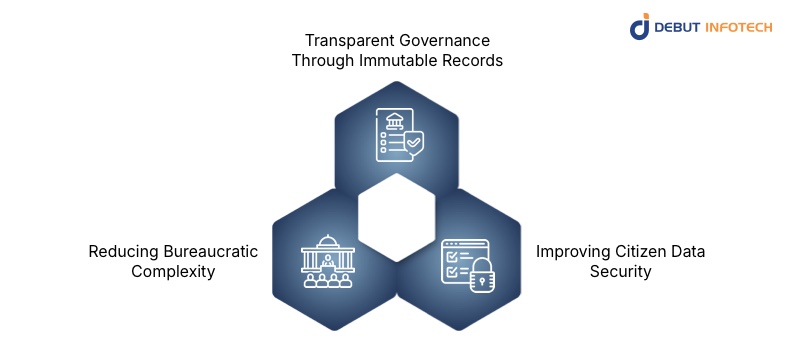
Transparent Governance Through Immutable Records
A common challenge in civic administration is maintaining trustworthy data. Records are often stored in outdated systems with inconsistent audit trails. Blockchain counters this by recording every event in chronological order, creating a tamper-proof record that cannot be altered without detection.
For example, land transfers, identification updates, or benefit allocations remain permanently verifiable. This reduces disputes, strengthens compliance, and builds confidence among citizens.
Reducing Bureaucratic Complexity
Traditional civic processes require multiple approvals and long verification cycles. Smart contracts simplify this by automating rules and workflows. A benefit claim can be automatically validated once eligibility criteria are confirmed. Licensing renewals can be completed instantly once the requirements are met.
This automation reduces administrative burden and shortens the timeline for civic services, enabling faster delivery of public benefits.
Improving Citizen Data Security
Public institutions manage sensitive personal information. Security breaches can undermine trust in government systems. Blockchain introduces encryption, decentralized storage, and access control mechanisms that protect citizen identities from unauthorized access.
With decentralized public systems, even if a single node is compromised, the network remains secure.
Blockchain for Smart Cities: The Future of Urban Infrastructure
Smart cities require interconnected digital systems that coordinate transportation, healthcare, public utilities, payments, and civic participation. Blockchain for smart cities strengthens these systems by providing a reliable foundation for data integrity and interoperability.
- Secure Data Sharing Across Agencies: Smart cities rely on vast datasets to operate efficiently. Blockchain improves collaboration by ensuring all agencies reference the same accurate version of data. This reduces duplication, improves decision-making, and unlocks new possibilities for predictive governance.
- Automated Public Payments and Subsidy Distribution: Per diem programs such as daily stipends, food subsidies, or transport credits can be managed through blockchain wallets and programmable smart contracts. Payments become traceable, reducing fraud and ensuring that funds reach intended beneficiaries.
- Resource Tracking and Infrastructure Auditing: Blockchain for smart cities enables real-time tracking of public resources, including construction materials, municipal assets, and supply chains. This level of transparency strengthens accountability and reduces corruption.
- Citizen Engagement in Urban Decision-Making: Blockchain-backed civic platforms allow citizens to vote, participate in surveys, or raise community concerns. All participation is securely recorded, ensuring that civic tech blockchain processes remain transparent and inclusive.
Government Blockchain Solutions for Per Diem Networks
Governments looking to integrate blockchain must consider solutions that align with regulatory frameworks, data policies, and operational needs. Debut Infotech provides blockchain development services customized for government use cases.
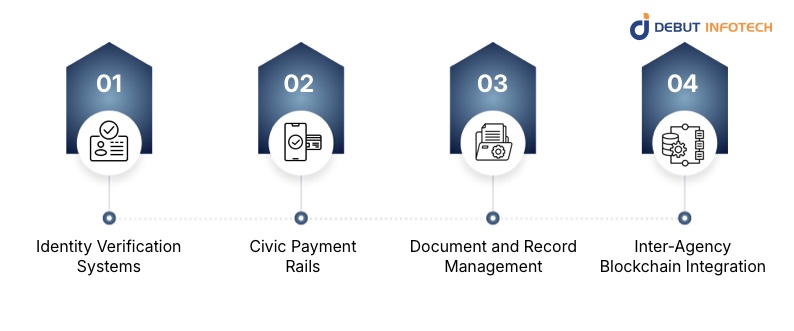
Identity Verification Systems
A decentralized identity (DID) system lets citizens securely store and present identity documents with complete control over who accesses their data. Verified identity records reduce fraud and speed up civic transactions.
Civic Payment Rails
Governments can issue digital tokens that represent public funds, vouchers, subsidies, or service credits. These systems provide:
- Instant fund transfers
- Transparent audit trails
- Reduced administrative costs
- Programmable spending rules
Document and Record Management
Whether for licenses, permits, certificates, or property documents, blockchain ensures that civic data remains authentic and traceable.
Inter-Agency Blockchain Integration
Multiple agencies can operate on shared blockchain infrastructure to maintain synchronized civic records. This reduces processing gaps and improves workflow efficiency.
Per Diem Tokenization: A New Civic Economic Model
Tokenization allows blockchain in government to convert civic value units (such as allowances, credits, or public-service payments) into digital assets stored on blockchain platforms. These tokens can be exchanged, redeemed, or tracked within civic ecosystems.
Why Tokenization Works for Civic Networks
Tokenized systems offer:
- Immediate settlement
- Fraud-proof validation
- Transparent fund distribution
- Better budgeting and financial oversight
Governments can also issue time-based tokens that must be redeemed within a specific period, ensuring resources are used appropriately.
How Blockchain Ecosystem Protocols Strengthen Civic Infrastructure
Blockchain ecosystem protocols support the foundational logic behind decentralized civic tech blockchain systems. These include consensus mechanisms, smart contract standards, cross-chain communication protocols, and security layers.
- Consensus Mechanisms for Reliable Governance: Proof of Stake (PoS), Delegated Proof of Stake (DPoS), and other modern consensus models provide energy-efficient, secure validation for civic transactions.
- Smart Contract Standards: These ensure that automated code follows standardized rules, improving compatibility and reducing development costs.
- Cross-Chain Integration: Government systems often rely on multiple technologies. Cross-chain protocols enable interoperability among different blockchain platforms, legacy systems, and civic applications.
Integrating Enterprise Blockchain Into Civic Infrastructure
Bringing blockchain into civic systems requires more than just installing digital ledgers. It demands a strategic integration process that aligns public-sector goals with enterprise-grade blockchain capabilities. Government agencies must ensure interoperability with existing tools, such as payroll systems, resource management platforms, public registries, and compliance databases. Enterprise blockchain enhances trust and reliability while creating unified workflows that reduce redundancy and operational friction.
When city administrations engage enterprise blockchain development companies, they gain access to robust architecture, automated compliance modules, secure APIs, and cross-platform compatibility. This ensures the per diem network can interact smoothly with procurement systems, attendance verification portals, contractor platforms, and digital identity frameworks. Over time, blockchain becomes the connective tissue linking grants, service delivery, work validation, and funding cycles across departments.
Debut Infotech supports this transition through end-to-end blockchain integration, modernizing civic workflows for better transparency and system-wide efficiency.
How Blockchain Improves Civic Transparency and Trust
One of the biggest challenges in public-sector administration is maintaining trust. Citizens expect transparency in the use of funds, service delivery, grant disbursement, and resource allocation. Traditional systems often fall short due to slow reporting, fragmented databases, and human error.
Blockchain directly addresses these challenges by supplying:
- A Tamper-Proof Ledger for Public Transactions: Civic payments, per diem allocations, and budget expenditures are recorded on immutable distributed ledgers. This prevents unauthorized edits and makes fraudulent manipulations nearly impossible.
- Real-Time Visibility and Public Auditing: Government departments, auditors, and even citizens (where appropriate) can verify records instantly. This reduces the administrative burden associated with reporting and auditing cycles.
- Clear Accountability Across Departments: Blockchain eliminates opaque handovers between agencies by creating synchronized data trails. Every action—allocation, approval, receipt, or reconciliation—is time-stamped and permanently stored.
- Better Citizen Confidence: Transparent governance builds public trust. Citizens feel more confident when they see how funds are used, how services are delivered, and how civic networks operate behind the scenes.
By using blockchain for civic administration, cities can transform their digital governance models into systems that are clear, secure, and aligned with global transparency standards.
Strengthening Long-Term Sustainability in Civic Networks Through Blockchain
For per diem civic networks to remain effective, they must withstand increasing workloads, evolving regulations, and shifting public expectations. Blockchain supports long-term sustainability by creating systems that are predictable, traceable, and built on standardized digital governance frameworks. Unlike traditional civic databases that require constant manual supervision, decentralized public systems minimize operational burden by ensuring data flows remain consistent and verifiable across all participating government entities.
Blockchain-enabled sustainability also extends to inter-department coordination. Many civic challenges emerge from fragmentation between agencies, where data sits in isolated silos and workflows vary by department. With an integrated ledger, transportation divisions, welfare programs, public works teams, and budgeting offices can all rely on synchronized records. This eliminates misunderstandings, reduces duplicate expenses, and ensures that per diem distributions comply with regulatory guidelines.
Another long-term benefit is predictive accountability. Through blockchain analytics, city administrations can monitor spending patterns, detect spikes in per diem payouts, and identify inefficiencies before they become significant issues. Smart contracts can also automatically enforce spending limits or alert administrators when usage deviates from approved civic frameworks. These features create a more disciplined ecosystem where civic managers can plan budgets more accurately and safeguard public resources.
Finally, sustainability is strengthened by citizen participation. As more residents gain access to blockchain-enabled civic tools, they develop higher expectations for transparency and efficiency. This encourages public agencies to maintain accountability and continuously improve their digital infrastructure. Over time, the civic network matures into a self-reinforcing system where transparency drives trust, trust drives participation, and participation drives better governance.
Automating Per Diem Payments Through Blockchain Networks
Per diem systems are core to many civic operations, especially in municipalities where workers, contractors, researchers, volunteers, and public-service teams conduct field activities. Traditional per diem structures often suffer from delays, disputes, duplicate claims, and inconsistent reimbursement workflows.
Blockchain reshapes this process by introducing automation, precision, and accountability.
Smart Contracts for Rules-Based Disbursement
Per diem payouts are automated based on predefined parameters, such as:
- attendance
- distance covered
- location-based verification
- task completion
- approved activity logs
Payments are executed without manual review unless flagged by the system.
Geo-Validation Through Blockchain + IoT
By integrating blockchain with mobile apps and IoT sensors, cities can verify that field teams were present in required locations before funds are released.
Instant Reconciliation
No need for follow-up emails, manual forms, or department approvals. Transactions settle instantly with complete documentation.
Fraud Reduction
Immutable records prevent duplicate claims or alteration of time logs. Every payout is traceable and verifiable.
Multi-Department Coordination
Blockchain platforms help synchronize data across teams—health, sanitation, inspection, transportation, public safety—reducing coordination gaps.
This digital structure enables per diem civic networks to function with greater accuracy, reliability, and fairness.
Blockchain Development Cost Considerations for Civic Networks
Government agencies exploring blockchain adoption must understand the associated costs. While blockchain reduces long-term operational spending, initial development budgets vary depending on project scope.
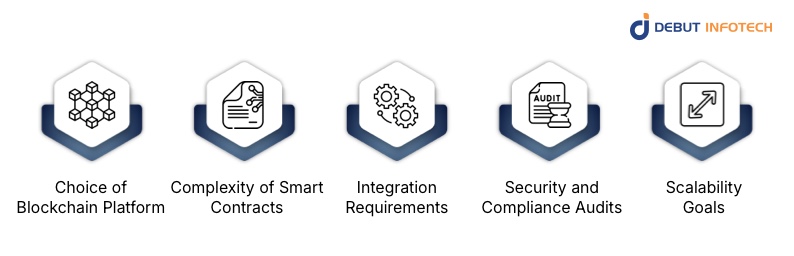
Key elements influencing blockchain development cost include:
1. Choice of Blockchain Platform: Public, private, and consortium blockchains have different fee structures and governance models. Platforms like Hyperledger, Polygon, Solana, Ethereum, or custom enterprise networks each have unique cost profiles.
2. Complexity of Smart Contracts: Per diem automation, workflow verification, identity management, and cross-department synchronization require advanced scripting.
3. Integration Requirements: Linking blockchain to legacy databases, payroll systems, HR tools, and civic workflow platforms increases engineering depth.
4. Security and Compliance Audits: Government-grade cybersecurity standards require rigorous testing and validation, adding to development timelines and cost.
5. Scalability Goals: Cities anticipating large user bases must invest in architecture equipped for high throughput and long-term growth.
Debut Infotech helps civic organizations perform early-stage cost modeling, ensuring clarity and predictable budgeting.
Future Vision: Blockchain-Driven Civic Networks at Scale
Blockchain’s impact on civic systems extends far beyond per diem management. As digital governance grows, decentralized infrastructure will form the backbone of transparent, efficient, and citizen-centric cities.
Blockchain-enabled civic networks could support:
- participatory decision-making
- community-driven budgeting
- transparent public procurement
- secure citizen identity systems
- decentralized public service platforms
- real-time disaster response coordination
Cities that embrace enterprise blockchain today are positioning themselves for a future where data flows seamlessly, public trust is strengthened, and administration becomes more intelligent and resilient.
Debut Infotech is committed to supporting municipalities worldwide as they transition to next-generation digital governance models.
Build a Secure, Scalable Per Diem Civic Network
Ready to integrate blockchain into your civic infrastructure? Our experts design future-ready, compliant, and efficient public-sector systems tailored to your needs.
Conclusion
Blockchain in civic systems is no longer experimental; it is becoming a foundational technology for transparent governance, automated public services, and secure civic administration. For per diem civic networks, blockchain offers specific advantages: automated disbursements, tamper-proof verification, reduced administrative hurdles, and clear auditability. These benefits improve trust between citizens and governing bodies while creating operational efficiencies previously impossible with traditional systems.
As governments worldwide embrace digital transformation, blockchain-enabled civic tools will be critical in shaping the future of public-sector innovation. With an enterprise blockchain development company like Debut Infotech, civic organizations can build resilient infrastructure, modernize their workflows, and deliver transparent, citizen-focused solutions at scale.
Frequently Asked Questions (FAQs)
Q. What does “per diem civic network” mean?
A. A per diem civic network is a digital system used by governments or civic institutions to manage daily allowances, reimbursements, or micro-payments for public workers. Blockchain helps automate and securely track these payments.
Q. Why is blockchain necessary for civic administration?
A. Blockchain introduces transparency, tamper-proof records, and automated workflows. This reduces fraud, speeds up reimbursements, strengthens financial accountability, and builds trust between citizens and government bodies.
Q. How does blockchain improve payment transparency in government programs?
A. Blockchain records every transaction on an immutable ledger. This allows auditors, agencies, and authorized participants to verify payments without manual reconciliation or manipulation, ensuring transparent governance.
Q. Can blockchain be used for public worker per diem payouts?
A. Yes. Smart contracts can automate per diem calculations, trigger payments when criteria are met, and prevent duplicate or fraudulent claims. This makes blockchain ideal for managing daily civic payments.
Q. What are the main benefits of blockchain in civic systems?
A. Key benefits include reduced paperwork, faster approvals, improved data security, decentralized verification, automated financial processes, and better public sector digitization.
Q. How much does it cost to implement blockchain for civic applications?
A. Blockchain development cost varies based on the scope, number of integrations, network choice, smart contract complexity, and deployment model. Government blockchain solutions usually require custom architecture, compliance layers, and long-term maintenance.
Q. Can existing government systems integrate with blockchain?
A. Yes. Modern blockchain ecosystem protocols allow integration with legacy databases, ERP systems, payment gateways, and city management platforms. Enterprise blockchain development companies like Debut Infotech specialize in bridging traditional systems with decentralized public frameworks.
Our Latest Insights


Leave a Comment