



Table of Contents
Home / Blog / Tokenization
Build and Scale Your Real Estate Tokenization Platform on the XRP Ledger

by

December 31, 2025
by
December 31, 2025
Blockchain technology has made a significant contribution to the digital transformation of the real estate industry. Real estate tokenization is one of the most promising new ideas that is helping to bring about this change. It is the process of turning physical real estate assets into digital tokens that can be bought, sold, or traded on blockchain platforms. The XRP Ledger (XRPL) is one of the most robust blockchain infrastructures for businesses seeking to develop tokenization solutions that can scale, operate efficiently, and reduce costs.
The XRP Ledger is well-suited for large-scale financial applications, such as Real World Asset tokenization, due to its fast transactions, low fees, and environmentally friendly design. As the global market experiences a rise in XRP Ledger tokenization growth, innovative companies are exploring how to establish and expand their real estate tokenization platforms on XRPL. In this article, we’ll discuss how the XRP Ledger enables tokenization, its benefits for real estate, the process of building a platform like this, and how companies like Debut Infotech can help businesses bring their ideas to life.
Ready to Transform Real Estate with Blockchain?
Launch your real estate tokenization platform on the XRP Ledger with Debut Infotech. Our experts help you design, develop, and deploy scalable tokenized asset ecosystems.
Understanding Real Estate Tokenization
Real estate tokenization is the process of deploying digital tokens on a blockchain to represent ownership of a physical asset, such as a home, hotel, or business complex. Each token represents a small portion of ownership or interest in the underlying asset. This makes fractional property investment possible.
This digital representation brings several benefits to the table:
- Liquidity: tokenized properties can be easily traded on blockchain-based marketplaces.
- Accessibility: Investors from around the world can buy fractions of high-value real estate.
- Transparency: Transactions are immutable and recorded on a public ledger.
- Efficiency: Middlemen and paperwork are minimised, resulting in lower transaction times and costs.
When integrated with the XRP Ledger, this process becomes even more streamlined due to XRPL’s scalability, security, and built-in tokenization capabilities.
The XRP Ledger: A Foundation for Tokenization

The XRP Ledger is a decentralized, open-source blockchain designed for fast and secure asset transfers. Originally built to facilitate global payments, its efficiency and transaction speed have positioned it as a key infrastructure for tokenization platforms.
Here’s why XRPL is an ideal base for real estate tokenization:
- Speed and Cost Efficiency: XRP Ledger can handle up to 1,500 transactions per second with transaction fees averaging just fractions of a cent. This makes it highly suitable for real estate marketplaces that require high-volume microtransactions.
- Native Tokenization Support: Unlike other blockchains that rely on smart contracts for token creation, XRPL includes built-in token issuance functionality, reducing development complexity and security risks.
- Energy Efficiency: The XRP Ledger uses a consensus protocol that consumes far less energy than Proof-of-Work chains, aligning with global sustainability goals—an essential factor for ESG-compliant real estate tokenization companies.
- Liquidity and Interoperability: XRPL’s Decentralized Exchange (DEX) supports cross-asset trading, allowing seamless liquidity between fiat, crypto, and tokenized assets. This is especially relevant for tokenized real estate markets seeking to unlock real estate liquidity.
- Regulatory Adaptability: Through ongoing collaborations and enterprise partnerships, XRPL’s architecture supports compliance-ready tokenization of real-world assets, providing businesses with the flexibility to operate within existing financial laws.
The Growing Impact of XRP Ledger Tokenization
The global shift toward tokenized assets has placed the XRP Ledger at the center of innovation. According to industry trends, the surge in XRP Ledger tokenization has been fueled by demand for cost-effective, interoperable, and eco-friendly networks.
XRP in Real Estate Tokenization
XRP real estate payment solutions are gaining popularity across regions, such as Dubai, where blockchain adoption is accelerating. The XRP Dubai real estate tokenization trend reflects how developers and investors are utilising blockchain to unlock liquidity and streamline transactions. tokenized real estate models based on XRPL enable property owners to divide high-value assets into asset-backed tokens, allowing investors to buy, sell, and trade them globally with minimal friction.
Advantages of Building Real Estate Tokenization Platforms on XRP Ledger
Choosing the XRP Ledger for your tokenization strategy provides distinct advantages for both businesses and investors.
1. Fractional Ownership and Global Reach: XRPL enables property owners to tokenize real estate commodities, dividing large assets into smaller fractions that can be sold to investors worldwide. This democratizes real estate investment, allowing participation from both retail and institutional investors.
2. Near-Instant Settlement Times: Traditional real estate transactions can take days or even weeks to settle due to verification and banking delays. With XRPL, transactions confirm in 3 to 5 seconds, ensuring a seamless and transparent exchange.
3. Enhanced Transparency and Security: Every transaction is recorded immutably, eliminating the risks of fraud or double ownership. This transparency builds investor confidence—an essential factor in real estate crowdfunding and tokenized securities.
4. Cost-Effective Operations: Compared to Ethereum and other blockchains, XRPL’s operational costs are significantly lower. This enables tokenization companies and developers to maintain high performance without the burden of gas fees, ultimately reducing the cost of developing tokenization platforms.
5. Interoperability and Cross-Chain Functionality: Through its robust interoperability features, XRP Ledger allows tokenized assets to interact with other blockchains. This cross-chain compatibility is a game-changer for Real-World Asset tokenization, connecting tokenized real estate to decentralized finance (DeFi) ecosystems.
XRP Ledger vs Ethereum: Which Is Better for Real Estate Tokenization?
When building a real estate tokenization platform, selecting the right blockchain network has a direct impact on cost, scalability, and efficiency. Both the XRP Ledger (XRPL) and Ethereum are leading players in the space, but they differ significantly in their technical design and capabilities. The table below highlights a side-by-side comparison to help you make an informed decision:
| Feature | XRP Ledger (XRPL) | Ethereum |
| Transaction Speed | 3–5 seconds per transaction | 15–60 seconds depending on network congestion |
| Transaction Fees | Extremely low (fractions of a cent) | Can be high depending on gas prices |
| Consensus Mechanism | Federated Consensus Protocol (energy-efficient) | Proof-of-Stake (Ethereum 2.0) |
| Scalability | Up to 1,500 transactions per second (TPS) | Around 30 TPS (without Layer-2 scaling) |
| Built-in Tokenization | Native token issuance, no smart contract required | Requires smart contracts for token creation |
| Smart Contract Integration | Optional via sidechains and APIs | Integral part of Ethereum ecosystem |
| Environmental Impact | Low energy consumption, eco-friendly | Higher energy footprint despite upgrades |
| Development Cost | Lower overall DEX and tokenization cost | Higher due to gas and contract complexity |
| Ideal Use Case | Real-world asset tokenization, payments, cross-border transactions | DeFi, NFTs, complex smart contract ecosystems |
| Maturity & Community Support | Backed by Ripple and enterprise partners | Extensive developer community and ecosystem |
How Real Estate Tokenization Works on the XRP Ledger
To understand the process of real estate tokenization, it is helpful to break it down into key phases that define the transformation of property into tradable digital assets.
1. Asset Selection and Legal Structuring
The process begins by identifying suitable properties—commercial, residential, or industrial—to tokenize. Legal experts then define ownership rights, investor terms, and regulatory frameworks, ensuring compliance with regional property and securities laws.
2. Token Creation and Distribution
On the XRP Ledger, developers can easily issue digital tokens that represent ownership shares. These asset-backed tokens can then be distributed to investors through a white label tokenization platform or custom-built marketplace.
3. Smart Contracts in Real Estate
Smart contracts automate essential workflows, such as investor onboarding, dividend distribution, and ownership transfer. They enforce the terms of real estate agreements securely and transparently, minimizing manual intervention.
4. Listing and Trading
Tokens are listed on XRPL-compatible exchanges or marketplaces. This enables investors to trade tokenized real estate assets directly, thereby improving liquidity and providing faster access to capital for developers.
5. Settlement and Recordkeeping
All transactions are permanently recorded on the blockchain. This immutable ledger ensures that ownership transfers and payments are verifiable and auditable in real time.
Key Benefits of Tokenizing Real Estate on XRPL
1. Improved Liquidity: Traditionally, real estate is an illiquid asset—difficult to sell quickly without significant losses. Tokenization transforms this by allowing fractional trading, thus providing immediate liquidity for property owners and investors alike.
2. Streamlined Compliance: With smart contracts and built-in features for KYC/AML verification, XRPL simplifies compliance and reporting. This ensures the platform adheres to evolving regulatory requirements while maintaining user trust.
3. Reduced Entry Barriers: Investors no longer need to buy entire properties; they can purchase fractional tokens at lower costs. This democratizes access to global real estate markets, making them more inclusive and diverse.
4. Programmable Financial Products: XRPL’s flexibility supports advanced Tokenization Strategies, including automated rental payouts, staking incentives, or even integration with DeFi staking platforms for yield generation.
5. Cross-Border Investment Made Simple: Through its low-cost, high-speed network, XRPL eliminates traditional cross-border banking barriers. Investors can now engage in real estate deals across continents using blockchain-powered settlement systems.
Building Your Real Estate Tokenization Platform: Step-by-Step
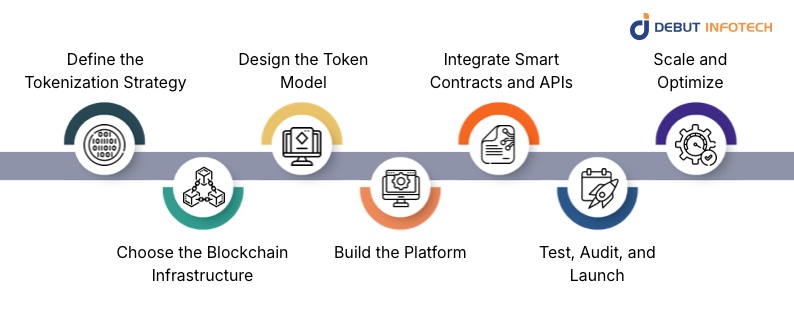
Developing a robust real estate tokenization platform on the XRP Ledger involves a systematic approach that balances technology, regulation, and business goals.
Step 1: Define the Tokenization Strategy
Outline your objectives—whether you’re targeting real estate crowdfunding, fractional investment, or property-backed loans. Identify the asset classes and investor profiles to build a clear roadmap.
Step 2: Choose the Blockchain Infrastructure
The XRP Ledger provides built-in features for token creation, making it ideal for scalable and low-cost operations. Businesses can either develop from scratch or collaborate with a real estate tokenization company such as Debut Infotech to accelerate their deployment.
Step 3: Design the Token Model
Decide on the type of token (utility, security, or governance) and the level of asset representation. Smart contract developers will define supply mechanics, profit-sharing structures, and compliance parameters.
Step 4: Build the Platform
Develop front-end and back-end systems for property listing, token management, and investor dashboards. Integration with digital wallets, KYC modules, and payment gateways ensures user accessibility and regulatory alignment.
Step 5: Integrate Smart Contracts and APIs
Integrate smart contracts in real estate workflows for automated operations. APIs connect the platform to payment launchpad gateways and tokenization platforms, streamlining the investor experience.
Step 6: Test, Audit, and Launch
Comprehensive audits validate the system’s functionality and security. After approval, the platform is deployed on the XRP Ledger and made accessible to investors globally.
Step 7: Scale and Optimize
Once launched, continuous monitoring, analytics, and upgrades ensure scalability. As market demand grows, features like cross-chain integration or secondary market trading can be introduced.
Why Choose Debut Infotech for XRP Ledger Tokenization Development
Debut Infotech is a leading asset tokenization development company specializing in blockchain-powered solutions for real estate and financial ecosystems. With years of experience across enterprise blockchain development, smart contract integration, and white label tokenization platforms, the company helps enterprises create scalable, compliant, and investor-friendly products.
Debut Infotech’s team of experts can:
- Design customized Tokenization as a Service (TaaS) solutions.
- Integrate XRPL-based payment and liquidity systems.
- Ensure full compliance with global real estate and securities regulations.
- Deliver cost-efficient deployment without compromising scalability or performance.
By partnering with Debut Infotech, enterprises gain access to a trusted real estate tokenization company capable of guiding them from concept to post-launch optimization.
The Future of XRP Ledger Tokenization in Real Estate
The combination of blockchain innovation and property investment is ushering in a new era for asset ownership. With the XRP Ledger tokenization surge, the global real estate industry is evolving into a liquid, accessible, and transparent marketplace.
Looking ahead, XRPL’s interoperability and efficiency are likely to expand beyond real estate into tokenizing other tangible assets, such as art, gold, and commodities. As technology matures, tokenized securities and decentralized investment models will continue to integrate with traditional finance, bridging the gap between Web2 and Web3 economies.
Start Your Tokenization Journey Today!
Unlock liquidity, transparency, and investor trust with XRP Ledger-based solutions. Contact Debut Infotech to request a free consultation and explore tailored blockchain development strategies.
Conclusion
The XRP Ledger has proven to be more than just a payment network—it’s a robust foundation for the future of digital asset management and real estate tokenization. By enabling instant settlements, fractional ownership, and global participation, it is redefining how people buy, sell, and invest in property.
For organizations looking to enter this transformative space, collaborating with an experienced partner like Debut Infotech ensures not only technical excellence but also compliance, security, and scalability. As the demand for tokenization of real world assets continues to grow, businesses that act now will be the pioneers of tomorrow’s decentralized real estate ecosystem.
Frequently Asked Questions
Q. What is the XRP Ledger, and why is it suitable for real estate tokenization?
The XRP Ledger (XRPL) is a decentralized, open-source blockchain known for its high transaction speed, low cost, and built-in support for token issuance. It’s ideal for real estate tokenization because it allows seamless creation and management of digital assets while ensuring transparency and compliance.
Q. How does the XRP Ledger enable fractional property investment?
XRPL enables property assets to be divided into digital tokens, each representing a fractional share of ownership. Investors can buy, sell, or trade these tokens globally, creating new opportunities for fractional property investment and enhanced liquidity.
Q. What are the benefits of using smart contracts in real estate tokenization?
Smart contracts in real estate automate critical workflows such as investor onboarding, payment distribution, and ownership transfers. This reduces administrative overhead, eliminates intermediaries, and ensures secure and transparent execution of property-related agreements.
Q. What factors influence the cost of developing a real estate tokenization platform on XRPL?
The development cost depends on several factors—such as platform complexity, smart contract integration, regulatory compliance, and UI/UX design. Working with an experienced real estate tokenization company like Debut Infotech ensures cost-efficiency and faster time-to-market.
Q. How does XRP Ledger compare to Ethereum for tokenized real estate projects?
While both are capable, XRP Ledger offers faster transactions, lower fees, and built-in tokenization features. Ethereum, on the other hand, provides greater flexibility for complex smart contract ecosystems. For property-focused tokenization, XRPL’s architecture is typically more cost-effective and scalable.
Q. Can tokenized properties on XRPL comply with regulatory frameworks?
Yes. XRPL’s architecture supports compliance-ready tokenization of real world assets. Developers can integrate KYC/AML modules and regulatory smart contracts to ensure adherence to securities and real estate investment regulations.
Q. Why choose Debut Infotech for XRP Ledger-based real estate tokenization development?
Debut Infotech specializes in Tokenization as a Service (TaaS) and enterprise blockchain development. Their team offers end-to-end solutions—from conceptualization and smart contract development to deployment and post-launch support—ensuring a secure, scalable, and investor-friendly platform.
Our Latest Insights


Leave a Comment