



Table of Contents
SaaS AI Agents Explained: How Intelligent Automation Is Redefining the Future of SaaS

by

November 23, 2025

by
November 23, 2025
Today’s SaaS users expect more than just another app that stores information, they want intelligent platforms that can think, act, and adapt to their needs. And that is where SaaS AI agents come in. These systems do not react to commands, they predict user behavior and complete the work of complex tasks and constantly learn as they interact with the user in order to provide smarter, more personal experiences.
The State of AI 2025 report by McKinsey confirms that more than 75% of organizations currently apply AI in any one of their business functions, and that intelligent automation is increasingly becoming the norm, not the exception.
Nevertheless, as most SaaS teams know, the question of whether to use AI is not the problem, but rather how to implement AI successfully to support current systems and not overwhelm developers.
That’s what this guide is all about. We will explain the practical steps to implementing AI agents into your SaaS platform, selecting the most appropriate frameworks to work with, streamlining the processes, and provide actual examples of businesses who have already made it work. By the end, you’ll understand not just the why, but the how of bringing intelligent automation to your SaaS ecosystem.
Without further ado, let’s delve in!
What Are AI Agents (and Why They Matter for SaaS)?
To begin with the fundamentals, AI agents are the brains behind the current SaaS platforms. They are smart systems and are able to think, reason and act independently of your software. At a more basic level, they do not simply follow rules, they reason and act dynamically in response to what is going on within your app.
In contrast to the old-fashioned chatbots who have to wait until the user issues a command, AI agents are proactive. They are able to take charge, give recommendations, and even accomplish tasks without necessarily involving human participation. Consider a billing SaaS system, where unpaid bills are automatically identified and clients are sent friendly notifications automatically, with no programmer involvement, and without waiting to receive a notification. That is where the distinction between automation and real intelligence lies.
The beauty of using AI agent SaaS solutions lies in what they bring to the table:
- Human-like personalization: AI agents understand the behavior of users and make recommendations or responses based on their needs.
- Reduced manual efforts: Processes that are repetitive and time-intensive are automated, leaving teams to concentrate on expansion.
- Faster decision-making: In real time, these systems analyze data trends, providing insight and predictive behavioral information that humans can fail to notice.
Simply put, AI agents are making SaaS less of a reactive system and more of a learning platform that knows what users want, which is the basis of the next generation of intelligent software experiences.
Turn operational tasks into your next growth engine!
Explore our SaaS AI Agents solutions designed to automate workflows, slash costs, and drive revenue. See the platform in action.
Key Benefits of Integrating AI Agents into SaaS
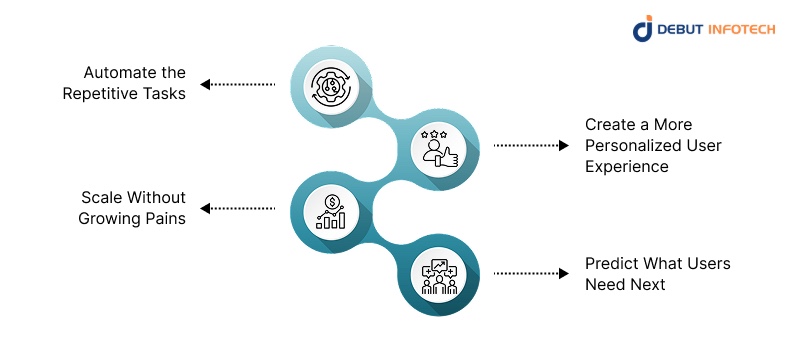
The addition of AI agents to your SaaS platform is not merely a technological upgrade, but a smarter business approach to developing, growing, and maintaining your product in the increasingly digitalized fast-paced world. With Generative AI SaaS development, platforms will be able to automate, enhance user satisfaction and find opportunities that are not always evident in traditional systems. Here are some of its key benefits:
1. Automate the Repetitive Tasks
No one would wish to see their team become engrossed in routine work such as ticket sorting or generating reports. Those tedious operations can be replaced by AI agents, and more creative and strategic work can be performed by your people. This automation does not only enhance efficiency but also reduces the operating costs in the long term.
2. Create a More Personalized User Experience
Personalization is the new standard in SaaS. AI agents process behavior and preferences to provide context-based recommendations and quick responses in seconds while personalizing each interaction. A great example is Notion’s integration of AI assistants in 2024, which helped users organize notes, generate ideas, and automate planning. The result? A 20% increase in the number of users due to a smoother, more personalized experience.
3. Scale Without Growing Pains
The bigger the user base you have, the larger the capacity of your system should be, not your operational overhead. With minimum human efforts, AI agents can manage 10x more users and provide consistent performance even when demand peaks. This sort of scalability ensures your platform is fast, reliable, and cost-effective.
4. Predict What Users Need Next
AI is not a reactive technology, it is a predictive one. Using predictive analytics, your SaaS product will be able to anticipate churn, identify upsell opportunities, and suggest the appropriate features at the appropriate moment. Such proactive intelligence enables you to be one step ahead of the user needs and market dynamics.
Step-by-Step Process: How to Integrate AI Agents into a SaaS Platform

AI agents are transforming the game of SaaS development companies, not only by automating it, but also making products smarter and more intuitive. Think about your platform being able to predict the needs of users, or doing complicated processes automatically. That is the strength of agentic SaaS. The following is a step-by-step process of how you can bring that intelligence to your own SaaS platform:
Step 1: Define Core Use Cases
Begin by defining the area intelligence is going to have the most significant impact on your workflow. Go beyond automation, be value-oriented.
As an example, an AI agent can be employed within a CRM SaaS platform to autonomously score leads, make personalized follow-ups or forecast prospects with the highest chance of conversion. The trick is to focus on the areas that absorb the time of your team in decision-making or repetitive activities.
Once you match the AI agents with actual business pain, it becomes easier to adopt and the ROI can be measured.
Step 2: Choose the Right AI Framework or API
The next step is to select the AI tools that drive your AI agents. You have options of frameworks and APIs, such as OpenAI, Anthropic Claude, LangChain, or just train your own large language model (LLM).
Before committing, put into consideration these important factors:
- Scalability: Can it grow with your platform?
- Latency: How fast can it respond in real time?
- Cost efficiency: Will it scale without breaking your budget?
- Integration flexibility: Can it connect easily with your existing tech stack?
What differentiates great performances of AI agent SaaS platforms and those that do not scale depends on a strong technical core.
Step 3: Prepare Your Data Pipeline
Your AI agent is only as intelligent as the information it is taught. Start by sorting and naming your data appropriately so as to eliminate discrepancies.
Make sure that any data processing is regulated by the rules like GDPR, this is particularly critical in case your SaaS application handles personal or financial data.
To improve performance, you might want to use vector databases such as Pinecone or Weaviate. These will also provide semantic search functionality where your AI agents would be able to comprehend context rather than merely matching keywords.
Step 4: Build the Agent Layer
This is where intelligence comes alive. The agent layer is the one that deals with decision-making, task organization as well as memory, enabling your system to learn during each interaction.
These intelligent workflows can be structured with the help of frameworks such as LangGraph or AutoGPT. Integrate webhooks to allow your AI agents to interact with external systems like sending automated messages, updating CRMs, or triggering internal alerts without manual input.
This layer is basically what makes your SaaS an agentic experience; tasks are executed wisely in the background and users are oriented on results.
Step 5: Test and Deploy
When you are ready to launch your AI agents to the market, test them under real world conditions to be sure they are reliable. Run A/B tests to compare performance, and establish continuous monitoring systems to be able to track the responses, detect errors and fine-tune behavior as time goes on.
Keep in mind that integration is not a one-day thing, it is a process of continuous improvement. Constant feedback loops ensure that your system is dynamic and responsive to the requirements of the users.
Real-World Case Studies of SaaS Companies Using AI Agents
Seeing how top SaaS platforms use AI agents in real life makes it easier to understand what’s truly possible. Let’s look at two standout examples.
monday.com teamed up with Ada to build an AI agent that could handle customer interactions around the clock. The result was remarkable as they cut agent handle time by 42%, achieved a 40–45% automation rate, and still maintained an impressive 64% customer satisfaction score.
That is an obvious victory; more prompt answers, satisfied clients, and human operators who can devote their time to more complicated problems, rather than repetitive queries.
Meanwhile, HubSpot followed another path. They personalized and reached out to people via email, automating their marketing processes and integrating AI into them. The payoff? An 82% jump in email conversions and up to 50% higher click-through rates. It’s proof that AI isn’t just about saving time, it’s about building smarter, data-driven systems that directly improve business outcomes.
The stories depict what occurs when companies do not just experiment but actually build AI agents into their SaaS products. The distinction is in strategy, applying AI where it can be of actual value instead of pushing it into every part of the platform.
Ready to build AI Agents that work for you?
Let’s create a custom SaaS AI solution for your business. From strategy to deployment, we handle it all.
Endnote
The idea of integrating SaaS AI Agents is more than staying on par with innovation, it is about providing smarter, more responsive experiences to your users. When properly applied, AI agents do not substitute humans, but rather empower them. They can process repetitive tasks, have faster data analysis, and assist your SaaS platform in providing value at scale without tying up your staff to do so, leaving them to work on creativity and strategy.
The smartest approach? Start small. Automate one workflow, measure the impact, and then scale with confidence. Each enhancement will make your SaaS proactive instead of reactive, the one that is genuinely able to predict the needs of users.
At Debut Infotech, a leading custom AI Agent Development Company, we specialize in helping SaaS businesses bring this vision to life. Our professionals build intelligent agents, which learn, adapt and produce business outcomes that can be measured, starting with strategy and model integration, to the end-to-end deployment.
Frequently Asked Questions (FAQs)
Q. What Is an AI SaaS?
AI SaaS, or Artificial Intelligence Software as a Service, refers to cloud-based solutions that use AI to deliver smart features and automation. These tools are hosted and managed online, so businesses don’t need to invest heavily in servers, infrastructure, or specialized in-house talent. Instead, they can easily access and scale AI capabilities as their needs grow.
Q. How AI Agents Will Disrupt SaaS in 2025
AI agents are set to reshape the Software as a Service (SaaS) industry in 2025.
Instead of static tools, SaaS platforms will evolve into autonomous, outcome-driven systems. These AI agents won’t just help users, they’ll act for them.
By functioning like digital employees, AI agents will automate and execute entire workflows on their own. This shift could even make many traditional user interfaces unnecessary, changing how we interact with software altogether.
Q. Can AI Agents Replace SaaS?
No, AI agents aren’t here to replace SaaS. Instead, they’re adding a powerful new layer of automation that changes how users interact with software and get value from it.
Rather than replacing traditional SaaS models, AI agents enhance them with the integration of AI models to automate repetitive workflows, improve personalization, and make everyday tasks faster and more intuitive. In short, AI agents are helping SaaS evolve, not disappear.
Our Latest Insights



Leave a Comment