



Table of Contents
Generative AI for Creative Work: Balancing Human Imagination with Machine Intelligence

by

December 11, 2025

by
December 11, 2025
Introduction
Creativity is no longer what it was and that is good. Artists, writers and designers who have creative work to do are discovering absolutely new methods of realizing ideas with generative AI for creative work. A recent Adobe survey shows that over 80% of creative professionals currently utilize AI tools and 74% of them state that AI tools assist them to work quicker and more effectively.
This change is not only time-saving but it is also a change to broaden the possibilities. AI is assisting creators in overcoming creative blockers, trying new risky ideas, and developing their ideas more precisely, which previously would have required hours of manual labor. Be it crafting images, writing music or copy, generative AI is no longer a creative tool, but a potential collaborator.
However, the question that continues to arise as we rely on technology to create inspiration is, how do we balance the power of AI and the genuineness of human creativity?
This blog will cover the ways AI is changing the creative process, opportunities it is giving, and challenges that come along with this new exciting collaboration between machines and humans.
The Growing Role of Generative AI in Modern Creative Workflows
Creativity is no longer just human, it’s becoming a collaboration between people and machines. In fact, a recent report shows that 63% of creative firms say AI has already helped reduce content-production costs.
In all areas, such as advertising or game design, generative AI creative work is becoming faster. Designers can now create dozens of layout ideas within minutes with the help of AI. Producers of music are experimenting with AI-based soundscapes. AI-generated images are being used to personalize campaigns by advertising teams.
However, it is not about how machines are going to replace creators. It’s about creators working with machines. By transferring tedious work to AI, humans free up time to engage in actual creativity to tell stories, develop visual language, and connect with audiences on an emotional level.
This change is a point of transition. Creative work is not being streamlined, but becoming more imaginative, experimental, more inclusive.
Turn creative blocks into your next breakthrough.
We build custom AI tools that generate stunning visuals, compelling copy, and innovative concepts to give your brand a powerful edge.
Key Ways Generative AI Is Transforming Creative Work
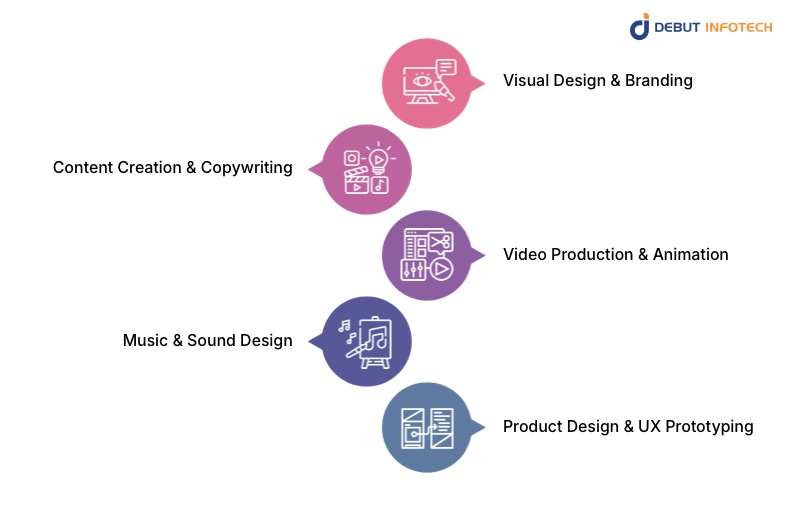
The creative world is undergoing a serious upgrade. Previously, it might have taken hours or even some days to occur, but now, with the help of AI and the future of creative work, it can take minutes. Generative tools are transforming the creative thinking, planning, and production, whether it is writing and design or video production and UX prototyping.
1. Visual Design & Branding
Designers do not have to wait until they get the right spark of inspiration anymore, AI-based generative tools such as Midjourney, DALL·E 3, and Adobe Firefly can produce gorgeous ideas in real-time. But even with all that speed, human judgment remains irreplaceable, the emotional storytelling behind a brand still depends on a designer’s instinct and experience.
2. Content Creation & Copywriting
Generative AI has turned writing from a solo act into a creative partnership. Whether you’re drafting blogs, marketing copy, or social captions, AI can help you brainstorm angles, polish tone, and even suggest catchy headlines. The best part? Pairing AI outputs with human editing can boost productivity by nearly 40%, according to Harvard Business Review. It’s not about automation, it’s about amplification.
3. Video Production & Animation
Video tools that are AI-driven are transforming the way stories are told. Starting with the creation of scenes up to the final edits, these technologies assist creators in concentrating on the storytelling instead of spending time with the production process. What used to require weeks to do, now can be done in days, and with much less burden on budgets or staff.
4. Music & Sound Design
Generative AI is occupying the role of an invisible partner in the music industry. Apps such as Mubert and Suno create distinctive tunes or soundscapes in seconds, allowing their creators to experiment without thinking about their copyright challenges or time in the studio. It is providing small creators with the same audio flexibility previously enjoyed by large-budget productions.
5. Product Design & UX Prototyping
Designers do not have to create wireframes manually. Figma AI and Uizard give you the chance to give your idea a description in words and immediately see it brought to life as a functional prototype. The new workflow assists teams to move through more rapidly, receive feedback sooner and align stakeholders with less difficulty.
How Generative AI Empowers Creative Teams

1. Faster Brainstorming and Ideation
Creative blocks are not new, however, AI is aiding in their dissolution. Designers, marketers and writers can create mood boards, content outlines or headline variations at the press of a few buttons. ChatGPT, Midjournal and Adobe Firefly among other tools are transforming initial concepts into written or visual prototypes that generate new directions. It is never about substituting inspiration but about speeding it up.
2. Smarter Content Creation and Editing
Generative AI models now have the possibility to generate copy, video scripts, and even elaborate visual scenes to enable teams to work with more rapid iterations than before. As an illustration, marketing teams rely on AI to write the concept of ads that can be improved in the future, and video editors can count on AI to automatically cut reels or adjust captions. This automation takes care of the busy work hence humans are able to concentrate on creativity and storytelling.
3. Personalization at Scale
All brands desire personalized content and AI is making it happen. Through analysing demographics, generative AI is able to use these insights to create visuals, tones and messages that are relevant to individual demographics. Think of it as having a creative assistant who knows your audience both in and out, and is communicating the content that will cut across channels without adding to the workload.
4. Seamless Collaboration Across Teams
Communication at work can stagnate the creative stream in global or hybrid workplaces. AI tools are a new form of bridging- summarising brainstorming, revisions, or voice notes, which are turned into viable project outlines. Such assistance makes sure that ideas will not be lost and teams will not get disoriented, even when they are on different continents.
5. Redefining the Role of the Creator
Perhaps, the most significant transformation is possibly the way creative professionals are seeing their roles. They are not doing repetitive tasks anymore, they are turning into creative directors, directing artificial intelligence systems, refining them, and making them heartfelt, contextual, and brand-specific. It is a transformation of hand creation to guidance creation.
Challenges and Considerations for Implementing AI
Although AI for creative work sounds exciting, it is not always as easy as the flip of the switch to implement. Below the hype and technology are actual challenges that creators and organizations have to think about carefully. Some of these challenges include:
1. Ethical Implications of AI in Decision-Making
The introduction of AI into the creative process, where AI determines which designs succeed and which music is more popular, casts ethical questions. What can we do to make sure that the AI systems will make unbiased decisions without strengthening the bias in culture or society? Designers need to be efficient and, at the same time, considerate of humans by ensuring that human values are central in all their decisions.
Related Read: Impact of AI on Data-driven Decision-making
2. Bias in AI
AI models learn from data, and data isn’t always neutral. When biased information is fed in, biased results are produced. To artists and marketers who are applying AI to produce ideas or content, that might equate to unintended stereotypes or unjust representations. The inclusion of AI creativity is achieved through regular audits, a variety of datasets, and human control.
3. AI Integration
The integration of AI into current creative processes might resemble the process of mastering a new tool, it requires time and experience. To ensure that technology does not hinder and in fact supports their work, teams require strategies, training, and collaboration of the tech experts and creatives.
4. Transparency and Accountability
When an AI system is creating a campaign idea or visual, the decision-makers would prefer to know the reasoning behind them. Transparent algorithms and explainable insights build trust and allow human creators to refine outputs responsibly.
5. Software Malfunctions
Even highly developed AI applications may give us mistakes or unintended results. A safeguard such as human verification and fail-safe measures is useful in avoiding embarrassing mistakes, and keeps the quality of creativity in check.
Future of Creative Work in the Age of AI
The creative world has never developed as fast as it is developing now, and AI is at the very heart of it. We are also seeing the emergence of the new generation of professionals, the AI-augmented creatives. These are designers, writers and artists who are not in competition with technology but rather working with it.
In industries, employers are currently recruiting positions that never existed less than a few years ago such as prompt engineers, AI creative directors, and even generative AI consultants. These experts are familiar with how to collaborate with state-of-the-art generative AI to assist teams in creating ideas, visuals, and campaigns that merge instincts of the human being with machine precision.
While exact numbers vary, industry-analysts estimate that up to 70% of creative workflows could integrate generative AI by around 2030. It does not imply that creators will lose their human touch, it is that creators will possess better processes to convey themselves, and mechanize the repetitive tasks and concentrate on what is important first, imagination and narration.
Nevertheless, with the ongoing AI developments, one thing becomes obvious, the constant learning and ethical application are necessary. Creatives that remain inquisitive, experiment in a responsible way, and know how to handle AI will be the pioneers in the next wave of digital innovation.
Ready to redefine your creative work with AI?
Let’s build a custom generative AI solution for your brand. From art to narratives, unlock a new dimension of creative potential.
Conclusion
Generative AI in creative work is not about removing human creators in the limelight but providing them with a set of new tools to shine even more brightly. AI is making imaginations come to life at the speed of light, whether it is a designer testing out new ideas or a narrator creating new creative blocks.
The future of creativity will belong to those who embrace this collaboration between human emotion and machine intelligence. And at Debut Infotech, we’re helping creators and organizations lead that future. As a trusted Generative AI development company, we build intelligent solutions that empower teams to create, innovate, and inspire, without limits.
Because when creativity meets cutting-edge AI, the results aren’t just impressive, they’re transformative.
Frequently Asked Questions (FAQs)
Q. Can generative AI create content?
A. Yes, it can and it does it fast. Using Generative AI (GenAI), new contents can be generated in a few minutes rather than hours.
Be it creating internal training, external marketing, or e-commerce training resources, an artificial intelligence-based writing software based on proven learning principles can assist you.
It ensures your content is not only quick to produce but also accurate, engaging, and tailored to different audiences.
Q. How to Use AI for Content Creation
A. AI-powered content creation is simple when you follow a few clear steps:
Start with a goal. Decide what you want to create, an article, a visual, or a social media post.
Use a prompt. Give your AI tool clear instructions to generate an initial draft or idea.
Refine the result. Review, edit, and fact-check the AI-generated content to make sure it’s accurate and on-brand.
Add your voice. Bring in your personal insights or creative touch to make the content feel human and authentic.
You can use this process for writing, designing visuals, or repurposing content across multiple platforms. The key is to let AI handle the heavy lifting while you focus on creativity and strategy.
Q. What is the 30% Rule in AI?
A. The 30% Rule is an easy definition of how human beings can collaborate with AI effectively. It implies that AI does the majority of the repetitive or routine jobs, approximately 70% of the labor.
The other 30%, which involves creativity, judgment, and ethical decisions, is however concerned with human beings.
This balance ensures that AI supports people rather than replaces them, combining machine efficiency with human insight.
Our Latest Insights

Leave a Comment