



Table of Contents
How Generative AI in Edge Computing Is Powering the Next Wave of Intelligent Systems

by

December 31, 2025

by
December 31, 2025
Introduction
Generative AI has already developed over the last few years as one of the niche innovations to become a central component of the next-generation intelligent systems. Unlike the conventional models that merely detect or classify, generative AI can generate a new insight and output based on learned patterns, it opens the potential to unlock smarter automation and quicker decision-making in any industry.
With the continued development of these models, the place of their operation is beginning to change. What once depended on large cloud environments is now moving closer to the point of action. Generative AI in edge computing enables devices to process, generate, and respond instantly using optimized Small Language Models (SLMs) like Gemma, Phi, and Mistral, along with techniques such as quantization, on-device transformer inference, and federated learning on NPUs, TPUs, and GPUs.
In this article, we explore how GenAI at the edge is reshaping real-time intelligence and why it’s becoming essential for latency-sensitive, high-performance environments.
Why Generative AI Is Moving to the Edge
If you’ve ever wondered what edge computing is and why it suddenly matters so much, the answer lies in how today’s industries are evolving. As industry 4.0 advances, companies require AI capable of thinking and acting immediately, not several seconds after the information has been relayed to the cloud, and back.
Cloud prices are increasing, and when companies are using AI workloads that are large-scale, it adds up. Combine that with more stringent privacy policies and it becomes understandable why over-reliance on cloud-based AI is becoming less feasible.
Meanwhile, edge devices per se are receiving a significant upgrade. The Qualcomm AI Hub, Apple Neural Engine and NVIDIA Jetson all now feature integrated accelerators that allow executing powerful models directly on devices, not only possible, but also effective. These new chips also provide better performance with less power consumption, which translates into smoother real-time processing without consuming energy or budget.
All this is driving Generative AI nearer to the point of data creation. The result? More rapid decision making, better privacy, reduced cost, and smarter systems with the capability of driving the next generation of automation and real-time intelligence.
Unlock real-time generative AI, right at the edge.
Debut Infotech builds intelligent systems that process data instantly, reduce latency, and operate offline. Discover the future of decentralized AI.
Real-World Use Cases of Generative AI in Edge Computing
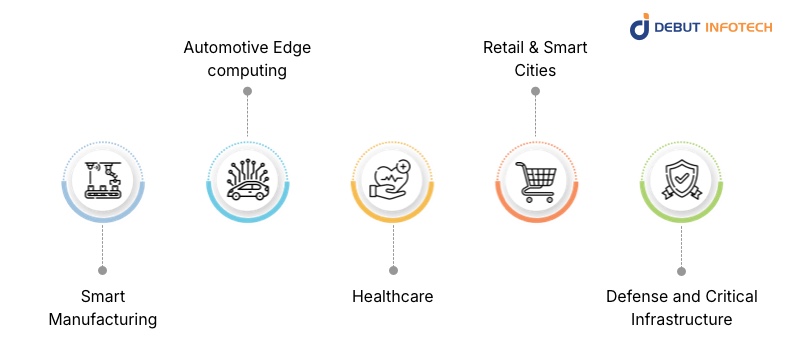
Edge computing with generative AI is no longer discussed as something in the future. It is already assisting industries to be more responsive, make more intelligent choices and even operate sensitive information on-site without depending on the cloud. Let’s look at how it’s transforming some key sectors.
1. Smart Manufacturing
Generative AI on the edge devices in present-day factories enables machines to see and act immediately. It is possible to identify defects on the spot even on a microscopic level without submitting images to the cloud. Machines are also able to forecast the next probable failure of equipment by analyzing sensor data locally, which minimizes downtime and expenses. A very good example of this is Foxconn, where edge-GPT vision models are used to detect minute defects on assembly lines and thereby achieve greater quality and eliminate the time lost in cloud-computing.
2. Automotive Edge computing
Edge AI solutions are extremely beneficial to the automotive industry. Generative AI allows vehicles to access massive inputs of sensor information in real time, which is a critical requirement to safety and performance. This technology is used by the Advanced Driver Assistance Systems that offer instant alerts and guidance, or by the vehicle-to-everything systems that enable cars to communicate with each other and the surrounding infrastructure, and respond instantly to environmental changes. Tesla has been the first to implement this technique, which operates on-vehicle inference using generative AI models, enabling their autonomous as well as semi-autonomous systems to perceive and act appropriately to the road conditions without having to rely on cloud input.
3. Healthcare
Generative AI on the edge in healthcare is used to bring intelligence to patients without exposing sensitive information. Smart monitors and wearable devices are able to process health data in real-time and provide on-device diagnostic data and notifications when vital signs suggest there is a problem. This real time processing will save important minutes during an emergency. Naturally, any of such systems has to adhere to privacy and security legislation such as HIPAA, GDPR, or ISO/IEC 27001 to guarantee that patient data stays secure.
4. Retail & Smart Cities
Edge-based generative AI assists the retailers and urban planners to make more accurate and faster decisions. Foot traffic in stores or in open areas can be examined in real time with cameras and sensors which allow optimization of the layout and staffing. It can also be used to immediately identify abnormal activity or a security threat, enhance loss prevention, and security due to the same technology. Local processing of this information saves businesses and cities time and enables them to have a better control of sensitive data.
5. Defense and Critical Infrastructure
In defense and critical infrastructure, speed and reliability are everything. Edge AI-powered drones can navigate complicated situations on their own, and adjust to obstacles and make tactical choices in real-time. Likewise, power grids, transportation centers and other critical infrastructure are able to identify threats and anomalies in real time, reacting instantly without the need to be connected to the cloud. This generative AI and edge computing combination will improve the safety and efficiency of operations.
Key Benefits of Running Generative AI on the Edge
Here’s why more companies are adopting edge AI solutions and how it benefits real-world operations:
1. Lightning-fast reactions: With AI implemented directly on the device, it does not have to wait to be served by cloud servers. This implies that autonomous vehicles are able to make decisions in a split second, factory robots are able to identify anomalies in real time, and wearable health devices can not only inform their users about an anomaly but also do this almost instantly. Real-time insights will actually save money, time, and even lives.
2. Privacy you can trust: Data remains on the device and this is important to sectors such as healthcare and finance. The health metrics of patients, the sensitive financial operations, or the personal user data do not have to get out of your network, which minimizes the chances of breaches and adheres to the rigorous procedures, such as the HIPAA or the GDPR.
3. Cost-efficient innovation: Depending less on cloud computing will result in considerable savings in bandwidth and server expenses. Firms can divert such resources to research and development as well as increasing AI capabilities, which makes edge AI a smarter investment compared to sending everything to the cloud.
4. Effortless scaling: Edge architecture that is decentralized enables companies to add additional devices, sensors, or cameras without causing bottlenecks in the system. Scaling is made easier and more predictable whether it is a factory floor, a park of delivery drones, or smart traffic lights in a city.
5. Reliable offline performance: Not all locations are well connected to the internet. Edge AI makes sure that devices continue to operate and make intelligent decisions, even during network outages- it is ideal in remote healthcare clinics, rural logistics hubs, or industrial locations that are very far off network coverage.
6. Consistent system uptime: Edge devices can minimize the possibilities of downtime due to network failure or the problem of the cloud server because the processing of the information is locally performed. Essential processes such as automated production lines, self-driving cars, or emergency response systems can continue running without any interruptions.
Challenges and Limitations of Generative AI in Edge Computing
Generative AI frameworks at the edge are impressively powerful, but it doesn’t mean that they are without their challenge, and the reality is that many articles have glossed over the actual issues.Let’s break them down so you can see what it really takes to make this technology work in the real world.
1. Compute Limitations
Edge devices are extraordinary, though they are not a supercomputer. The small memory (RAM) and processing power imply you have to trade-off speed and accuracy quite frequently. The quantization of models can make them run with lower speed, though at the expense of precision.
2. Model Optimization Complexity
The ability to get generative AI frameworks to operate well on edge devices is not as simple as plug and play. It consists of pruning models, distilling them and occasionally fine-tuning them on the device, which involves expertise and planning.
3. Security Risks
Edge AI opens the door to new vulnerabilities. It is possible to attack models with extraction attacks, fool them with adversarial prompts, or even manipulate firmware-level vulnerabilities unless they are secured.
4. Regulatory Considerations
In the case of such industries as healthcare, finance, or public safety, compliance is not optional. At the edge, generative AI should be based on frameworks such as GDPR, Digital Services Act, HIPAA, and the most recent NIST AI Risk Management Guidelines (2025).
How Generative AI Works on the Edge: Inside the Technology
The idea of running Generative AI on edge devices may seem like science fiction, but it is highly real and it is powering the next generation of Industry 4.0. In order to get it to work, developers must optimize models such that they can execute them on local hardware without the need to make use of the cloud. A major method is model quantization, in which big AI models are reduced to 8-bit or even 4-bit. This makes them light and at the same time accurate which enables the devices to think and act fast.
The other technique is low-rank adaptation (LoRA) which fine-tunes models on particular tasks such as detecting abnormalities on a production line or predicting maintenance requirements directly on the device. These computations are then processed in specialized Neural Processing Units (NPUs) much more quickly than normal processors, and hardware accelerators like Tensor Cores and Hexagon DSPs will guarantee smooth operation even when more complicated computations are involved. Lastly, memory mapping allows devices with low memory to handle large AI models, which will not slow down real-time decision-making.
Combining all these methods, edge devices can take immediate and intelligent decisions, changing not only the manufacturing floors but autonomous vehicles. Generative AI edge computing is, in real sense, making the industry smart, responsive, and a reality.
How to Implement Generative AI in Edge Computing: A Simple Roadmap
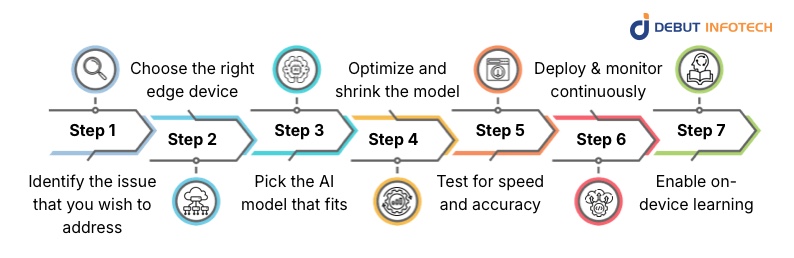
Bringing Generative AI to the edge does not need to be a complex endeavor. Consider it as a management plan of action that transforms a brilliant idea into a reality:
- Identify the issue that you wish to address
Begin with the following question: what problem do you attempt to solve? You need to know what you want whether that is to make factories run more efficiently, build smarter cars, or track equipment in real time to keep your AI on track.
- Choose the right edge device
Whether it is NVIDIA Jetson or Coral TPUs or Snapdragon X Elite, your choice of hardware will determine the speed and efficiency at which your AI will execute in real time.
- Pick the AI model that fits
Your AI can be used on the edges without consuming huge resources with lightweight models such as Gemma or LLaMA SLMs, or with a custom vision model.
- Optimize and shrink the model
Methods such as quantization and pruning can be used to make your AI execute applications more quickly, use less energy, and be more reliable when used in smaller devices.
- Test for speed and accuracy.
Test in-the-field to determine the performance of your AI. This will make sure that it acts fast and makes the correct decisions.
- Deploy and monitor continuously.
Begin your solution on the edge but do not forget to monitor its performance. Constant monitoring assists in the detection of the issues before they develop into problems.
- Enable on-device learning.
Federated learning allows your AI to continue learning directly on the device, that is, without transmitting sensitive information to the cloud, it becomes smarter and safer over time.
Using this roadmap, it is possible to make Generative AI in Edge Computing a feasible and viable concept, so that industries can walk into the future of Industry 4.0 with confidence.
Future Trends Shaping Generative AI in Edge Computing
Looking ahead, it can be seen that generative AI trends are indicating that the edge is about to become a lot smarter. Just think about having AI-enabled PCs, or even the smallest type of microcontroller, performing real-time intelligent tasks within appliances on the desk. Factories are gaining autonomy, and machines have the ability to make decisions and optimize production without the need of a human. Meanwhile, privacy-preserving GenAI will keep sensitive information safe, even as computers will be able to learn and improve locally. And with Large Vision Models (LVMs) moving to the edge, applications from industrial robotics to smart cities are about to see unprecedented speed, accuracy, and responsiveness.
The message is clear, generative AI in edge computing isn’t just a tech upgrade, it’s powering the next wave of Industry 4.0, where intelligent, real-time decisions happen closer to where the action is.
Ready to deploy generative AI beyond the cloud?
Our experts design custom edge computing solutions for unmatched speed and data privacy. Let’s build your intelligent, offline-capable application.
Final Thoughts
Generative AI in edge computing is transforming the game as automation is becoming smarter, decisions quicker and real-time intelligence more available than ever. In healthcare and automotive, manufacturing and smart cities, it is assisting companies to reduce costs, safeguard data and operate with the velocity of contemporary procedures. Firms such as Debut Infotech, one of the top generative AI development companies, are leading this revolution and assisting organizations in implementing these innovative solutions into reality and unleashing the power of AI on the edge.
Ready to explore how generative AI at the edge can transform your business? Connect with Debut Infotech today.
Frequently Asked Questions (FAQs)
Q. What is edge computing?
A. Edge computing refers to a model of distributed computing that brings the data processing and storage to the locations of data generation. Devices also perform more operations on-site, rather than sending all of them to a remote cloud or a data center.
This lowers latency, increases real-time performance and lowers bandwidth expenditure. It is particularly effective with devices at the network edge such as IoT sensors, cameras, and smart machines since they are able to process information at the point of occurrence.
Q. Does edge computing need the internet?
A. No. Edge computing does not require the continuous connection to the internet, and that is one of its main benefits. Edge devices have the capability of processing information at the local level; hence, they continue to work even when offline. As long as there is access to an internet connection, they can be able to synchronize data with central systems or even access cloud services where necessary.
Q. What is edge computing vs IoT?
A. IoT refers to a network of connected devices that collect and share data.
Edge computing, on the other hand, is a computing model that processes that data closer to where it’s created, right at the device or nearby.
Edge computing does not send all the data to a central cloud but is done locally to complete the heavy work. This renders the IoT systems quicker, more secure and efficient. Only the vital data is sent to the cloud or other systems.
Our Latest Insights



Leave a Comment