



Table of Contents
Home / Blog / Blockchain
History and Technical Innovations Behind Solana Blockchain

by

November 1, 2025

by
November 1, 2025
The history of Solana blockchain is an incredible tale of innovation and persistence. It documents the transformative experience of a single ambitious conception into one of the most efficient, fast, and developer-friendly blockchain networks in the world. Since its inception, Solana has transformed the history of decentralized technology by solving the long-standing blockchain trilemma, balancing scalability, security, and decentralization.
Solana came to the rescue when Bitcoin and Ethereum became congested and expensive to use due to high gas fees. Its novel architecture and consensus design enabled thousands of transactions per second without compromising its decentralization. This paper discusses the history of Solana blockchain, its Proof of History mechanism, its main milestones, the place of the Solana Foundation, and how it continues to improve the development of enterprise blockchains and decentralized apps (dApps).
Build Next-Gen Blockchain Solutions with Solana
Partner with Debut Infotech to develop high-performance dApps and enterprise-grade blockchain systems powered by Solana’s cutting-edge technology.
The Origins of Solana: A Vision for Scalability
The Solana origin can be traced back to 2017, when Anatoly Yakovenko, a former Qualcomm engineer, identified a significant limitation in existing blockchain systems. He observed that traditional consensus mechanisms, such as Proof of Work and Proof of Stake, require extensive communication between nodes to verify transactions. This communication slowed down networks, making scalability a challenge.
To overcome this, Yakovenko introduced an innovative idea — Solana Proof of History (PoH) — a cryptographic clock that timestamps each transaction, allowing validators to agree on the sequence of events without constant coordination. This breakthrough significantly reduced latency and increased throughput, enabling Solana to achieve speeds far surpassing those of existing blockchain networks.
Recognizing the potential of this technology, Yakovenko teamed up with Raj Gokal, Greg Fitzgerald, and Stephen Akridge. Together, they formed Solana Labs, laying the groundwork for a high-performance blockchain that could handle thousands of transactions per second while maintaining decentralization.
The Solana Whitepaper and Early Vision
In 2018, Yakovenko published the Solana whitepaper, which explained the technical foundation behind Proof of History and how it could revolutionize blockchain systems. The paper described a network that would use PoH alongside an optimized version of Proof of Stake to achieve speed, efficiency, and trust without relying on centralized intermediaries.
The Solana whitepaper attracted attention from blockchain researchers and developers who were seeking alternatives to Ethereum’s congested network. Within months, Solana Labs began building the first version of the protocol, testing its scalability through simulated environments that achieved over 50,000 transactions per second — a staggering figure compared to other chains at the time.
This early success became the foundation upon which the Solana network evolution was built, leading to one of the most advanced decentralized systems the industry had ever seen.
The Solana Timeline: From Concept to Mainnet
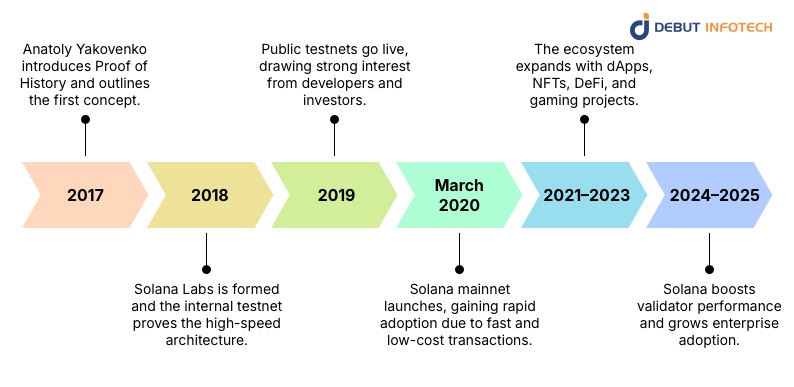
The Solana timeline showcases a series of pivotal moments that transformed a research project into a global blockchain ecosystem.
- 2017: Anatoly Yakovenko conceptualizes Proof of History and drafts the initial framework.
- 2018: Solana Labs is officially founded. The first internal testnet demonstrates the feasibility of high-speed blockchain architecture.
- 2019: Public testnets launch, showing strong throughput and attracting attention from developers and investors.
- March 2020: The Solana mainnet launch marks the beginning of Solana’s public era. It quickly gains traction due to its scalability and low transaction fees.
- 2021–2023: Massive ecosystem growth follows. The network becomes a hub for decentralized apps (dApps), NFTs, DeFi platforms, and gaming projects.
- 2024–2025: Solana continues to refine its technology stack, improving validator performance and expanding enterprise adoption.
Each step in the Solana timeline represents a crucial stage in its evolution, highlighting its ability to adapt and innovate in a rapidly changing blockchain landscape.
Solana Proof of History: The Core Innovation
At the heart of Solana’s speed and efficiency lies its unique consensus mechanism — Solana Proof of History (PoH). Unlike traditional systems, where all validators must constantly communicate to agree on transaction order, PoH provides a cryptographically secure timestamp for every event.
Here’s how it works:
- Each transaction receives a timestamp from a verifiable delay function.
- Validators use this timestamp to determine the exact order of transactions.
- Because the order is pre-established, nodes can process transactions independently, eliminating the need for constant coordination.
This innovation allows Solana to achieve lightning-fast transaction speeds and low fees, making it ideal for enterprise blockchain development and blockchain use cases that require high performance — such as gaming, DeFi, and real-time financial services.
Solana Proof of History is more than just a consensus mechanism; it’s a technical breakthrough that redefines how blockchains can achieve scalability.
Solana Technology Stack: Engineering for Performance
The Solana technology stack integrates several complementary systems designed to maximize performance and efficiency. These innovations work together to make Solana one of the fastest blockchains in the world.
1. Gulf Stream
Gulf Stream is Solana’s high-speed transaction forwarding protocol. Instead of waiting for transactions to be confirmed before being processed, this mechanism pushes transactions directly to validators ahead of time. By preemptively caching and forwarding transactions, Gulf Stream reduces confirmation delays, minimizes memory pressure on validators, and helps maintain network efficiency.
2. Sealevel
Sealevel is Solana’s parallel smart contract execution engine — a core differentiator that sets Solana apart from blockchains like Ethereum, which process transactions sequentially.
With Sealevel, multiple smart contracts can run simultaneously as long as they don’t interact with the same state. This allows developers to build complex, resource-intensive decentralized apps (dApps) that can scale without network congestion. It essentially transforms Solana into a multi-threaded blockchain, enabling better hardware utilization and higher transaction throughput.
3. Tower BFT (Byzantine Fault Tolerance)
Tower BFT is Solana’s consensus mechanism that works hand-in-hand with the Proof of History (PoH) algorithm. It leverages synchronized timestamps from PoH to establish consensus faster while minimizing unnecessary communication between nodes.
By employing a practical Byzantine Fault Tolerance (BFT) approach, Tower BFT ensures that validators can agree on the network’s state, even in the presence of malicious actors or system faults. This not only enhances security but also drastically improves speed and energy efficiency. In short, Tower BFT ensures trust and finality without slowing down the network.
4. Turbine
Turbine is Solana’s innovative block propagation protocol, designed to quickly move large volumes of data across the network. Instead of sending entire blocks in one go, Turbine breaks them down into smaller, manageable packets and distributes them in parallel.
This method reduces bandwidth usage, enhances data delivery speed, and allows the network to remain efficient even as it scales. It’s similar to how modern content delivery networks (CDNs) optimize video streaming by sending smaller data chunks to users. The result is a blockchain that can handle high traffic loads without bottlenecks.
5. Pipelining and Cloudbreak
The Pipelining process is a transaction processing unit that organizes the validation stages of a transaction — from fetching data to verifying signatures — into a streamlined assembly line. This ensures that the network continuously processes transactions at full capacity, similar to how modern CPUs use instruction pipelines to maximize performance.
Cloudbreak, on the other hand, is Solana’s scalable account database. It enables concurrent read and write operations across the network, ensuring consistent access to account data even during peak usage. Together, these two systems ensure that Solana maintains stable throughput, low latency, and predictable performance even when network activity surges.
Solana Foundation: Nurturing Ecosystem Growth
The Solana Foundation, a non-profit organization based in Switzerland, oversees the long-term sustainability and decentralization of the Solana blockchain. Its mission is to support developers, validators, and community projects that contribute to the ecosystem’s health and expansion.
The Foundation provides funding for innovation, supports hackathons, and encourages educational programs that promote blockchain literacy. It also helps ensure that Solana remains a community-driven platform, minimizing centralization risks and maintaining transparency across the network.
Under the guidance of the Solana Foundation, the network has experienced extraordinary growth within the Solana ecosystem, with thousands of projects spanning DeFi, NFTs, gaming, and Web3 infrastructure. This growth has been instrumental in cementing Solana’s position as one of the world’s leading blockchain networks.
Solana Ecosystem Growth and Market Expansion
Since the launch of the Solana mainnet, the blockchain has experienced exponential growth. Its low transaction fees, high speed, and developer-friendly tools have made it a preferred choice for top Solana blockchain development companies and individual innovators alike.
The Solana ecosystem includes:
- Decentralized apps (dApps): Powering platforms for finance, gaming, and social media.
- DeFi protocols: Enabling fast trading, staking, and yield farming without network congestion.
- NFT marketplaces: Allowing creators to mint and sell digital art affordably.
- Web3 tools and infrastructure: Supporting interoperability and cross-chain solutions.
As a result, Solana’s market cap soared within just a few years, placing it among the top blockchain networks globally. The rapid growth of the Solana ecosystem is a testament to the network’s scalability, efficiency, and adaptability to evolving blockchain use cases.
Blockchain Use Cases Powered by Solana
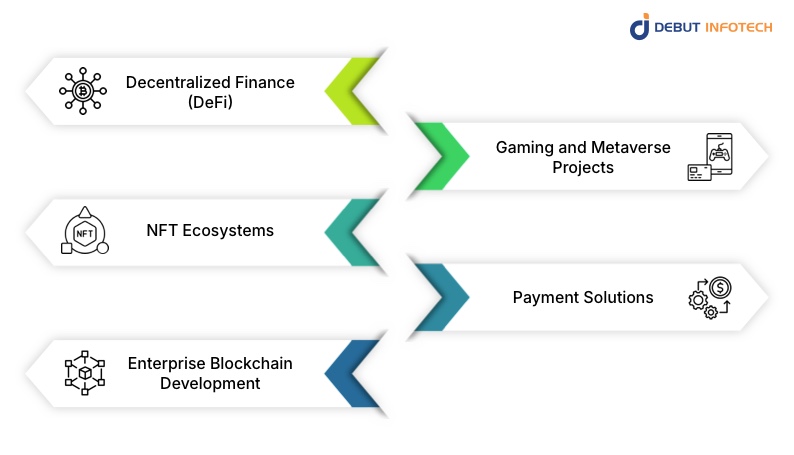
The versatility of Solana allows it to serve as the foundation for a wide range of blockchain use cases across industries:
1. Decentralized Finance (DeFi): Platforms like Serum and Raydium leverage Solana’s speed for instant, low-cost transactions, enabling real-time trading and lending.
2. Gaming and Metaverse Projects: Developers build immersive, interactive gaming worlds using Solana’s fast block times and low fees.
3. NFT Ecosystems: Marketplaces such as Magic Eden and Solsea have flourished on Solana, supporting millions of NFT transactions daily.
4. Payment Solutions: Solana Pay enables real-time payments with minimal fees, positioning Solana as a strong contender in blockchain-based fintech innovation.
5. Enterprise Blockchain Development: Enterprises use Solana for secure, high-speed data management, cross-border payments, and tokenization of assets.
These blockchain use cases demonstrate how Solana’s scalability and flexibility make it suitable for nearly any digital application — from entertainment to finance.
Solana Wallets and User Adoption
The success of the Solana ecosystem is also tied to the rise of Solana wallets that make user participation seamless. Wallets like Phantom, Solflare, and Sollet have become essential gateways for users to store, stake, and transact tokens on the network.
These wallets are designed with simplicity and security in mind, offering browser extensions and mobile apps that integrate directly with decentralized applications (dApps). Their user-friendly interfaces have contributed significantly to Solana’s adoption, allowing users to interact easily with DeFi platforms, NFT marketplaces, and other decentralized services.
Solana Development Milestones and Evolution
Over the years, Solana has achieved several Solana development milestones that solidified its reputation as one of the most advanced blockchain platforms:
- The successful implementation of Proof of History as a working consensus mechanism
- Achieving transaction speeds exceeding 65,000 per second.
- A thriving network of validators across the globe.
- Continuous updates to improve network resilience and uptime.
- A growing number of cross-chain integrations and developer partnerships.
These milestones reflect not only the Solana network evolution but also its ongoing commitment to performance, security, and decentralization.
Enterprise Adoption and Development Opportunities
With its scalability and cost-effectiveness, Solana has become an attractive option for businesses exploring blockchain solutions. The combination of Solana technology and open-source development tools provides enterprises with a reliable foundation for building scalable applications.
Partnering with a Solana project development company or blockchain consultants enables enterprises to design custom systems tailored to their operational needs — from supply chain management to financial settlement systems. The low blockchain development cost compared to legacy systems makes Solana an even more compelling choice.
As demand for enterprise-grade blockchain platforms continues to rise, Solana’s technical superiority positions it as a top contender in global blockchain adoption.
How Debut Infotech Supports Solana Blockchain Development
At Debut Infotech, we specialize in delivering robust Solana blockchain development services tailored to businesses seeking innovation and efficiency. Our team helps clients design, develop, and deploy decentralized solutions that harness the full power of Solana technology.
As a blockchain development company, we work across industries — from finance and healthcare to logistics and gaming — ensuring that every project leverages Solana’s unique advantages in scalability and speed.
Whether you need a DeFi platform, NFT marketplace, or enterprise-level dApp, Debut Infotech provides full-cycle blockchain services, from consultation to deployment and maintenance. As one of the top Solana blockchain development companies, we take pride in delivering solutions that drive real-world results.
Benefits of Building on Solana with Debut Infotech
Partnering with Debut Infotech for Solana development gives you:
- Access to experts experienced in Solana project development.
- Lower blockchain development cost through efficient, scalable architecture.
- Guidance from leading blockchain consultants for strategy and execution.
- Enterprise-ready solutions tailored to your specific needs.
- Ongoing support for future upgrades and integration.
Our commitment to excellence ensures your blockchain project is built for performance, reliability, and long-term success.
Leverage Solana’s Speed and Innovation for Your Project
Our blockchain consultants specialize in Solana blockchain development services that help you launch scalable, secure, and future-ready solutions.
Conclusion
The history of Solana blockchain is more than just a timeline of technological breakthroughs — it’s a story of ambition, collaboration, and constant innovation. From the publication of the Solana whitepaper to the Solana mainnet launch, the project has consistently pushed the boundaries of what’s possible in decentralized systems. Its Proof of History mechanism, scalable architecture, and ever-growing ecosystem have set new standards in blockchain performance.
As the Solana Foundation, developers, and community continue to expand the network’s capabilities, Solana’s role in shaping the future of blockchain technology becomes even clearer. For businesses and innovators looking to build the next generation of digital applications, Solana offers unmatched speed, scalability, and opportunity — and Debut Infotech stands ready to help you make the most of it.
Frequently Asked Questions
Q. What is the Solana blockchain and how did it begin?
A. The Solana blockchain is a high-performance decentralized network designed to support scalable and fast decentralized applications (dApps). The history of Solana blockchain began in 2017 when Anatoly Yakovenko proposed the concept of “Proof of History (PoH)”—a revolutionary approach to timekeeping in distributed systems. Together with Raj Gokal and a team of engineers, Yakovenko launched the Solana project to address blockchain scalability issues, culminating in the launch of the Solana mainnet in 2020.
Q. What makes Solana’s Proof of History unique?
A. Solana Proof of History (PoH) is a cryptographic innovation that timestamps each transaction before it’s added to the blockchain. This enables nodes to process transactions simultaneously, rather than sequentially, which significantly enhances speed and efficiency. Unlike traditional blockchains that rely solely on consensus mechanisms like Proof of Work or Proof of Stake, PoH adds a verifiable timeline, forming the foundation of Solana’s scalability.
Q. How has the Solana network evolved since its launch?
A. The Solana network evolution has been marked by rapid adoption and continuous innovation. Since its mainnet launch, Solana has achieved several development milestones, including the expansion of its ecosystem, integration with leading Solana wallets, and support for thousands of decentralized apps (dApps).
Q. Who are the founders of Solana, and what was their vision?
A. Anatoly Yakovenko and Raj Gokal, the Solana founders, envisioned a blockchain network that could handle enterprise-grade applications with minimal fees and lightning-fast transaction times. Their vision was to build a decentralized ecosystem that could rival traditional financial systems in performance, paving the way for mainstream blockchain adoption.
Q. What are some notable innovations in Solana’s technology?
A. Some key innovations that define Solana technology include Proof of History (PoH), Turbine (for data propagation), Gulf Stream (for mempool management), and Sealevel (for parallel transaction processing). Together, these technologies make Solana one of the fastest blockchains in existence, achieving sub-second finality and supporting thousands of transactions per second.
Q. How does Solana compare to other blockchain platforms?
A. While other platforms, such as Ethereum and Cardano, emphasize security and decentralization, Solana focuses heavily on speed and scalability. Its PoH mechanism, combined with Proof of Stake, offers a hybrid approach that significantly reduces latency and costs.
Q. How can businesses leverage Solana for blockchain development?
A. Businesses can collaborate with a Solana project development company or experienced blockchain consultants to build scalable, high-performance dApps on Solana. Leading blockchain development companies, such as Debut Infotech, offer comprehensive Solana blockchain development services, including wallet integration, smart contract deployment, and enterprise-grade solutions.
Our Latest Insights


Leave a Comment