



Table of Contents
Home / Blog / Coin Development
Modern ICO Development in 2026: How Today’s Models Fix the Mistakes of the Past

by

January 12, 2026

by
January 12, 2026
In 2017, this was the case with the ICO boom; projects were going live overnight, investors were rushing in without understanding what was going on, and tokens were dropping in price just as quickly as they were going up. It was very exciting, yet sloppy. And when the bubble burst, most people thought that ICOs would never come back again.
modern-ico-development-how-todays-models-fix-the-mistakes-of-the-past
But here’s the twist: they didn’t disappear, they matured.

In 2025, modern ICO development looks nothing like the hype-driven era that came before it. Founders are more intentional, investors are more cautious, and compliance isn’t an afterthought, it’s the foundation. And the market data backs up this shift. According to Verified Market Reports, the global ICO services market was valued at $5.3 billion in 2024 and is projected to reach $12.5 billion by 2033, showing just how quickly today’s ICO frameworks are maturing and becoming more professional.
In this article, we’ll look at the major mistakes that once held ICOs back and walk through how modern development models fix them. Whether you’re a founder, developer, or Web3 strategist, you’ll come away with a clear picture of what it takes to build a compliant, trustworthy, and investor-ready ICO in 2026.
Before & After: How ICO Development Evolved From Chaos to Clarity
To understand how the industry has grown, it is useful to take a step backward to the year 2017. The period was very thrilling, yet a period of shortcuts. Projects launched tokens without real utility, tokenomics collapsed the moment they hit the market, and compliance was barely part of the conversation. Many teams stayed anonymous, many products didn’t have an MVP, and fundraising goals were driven more by hype than actual development needs. It was a place whereby growth was quick, and trust was even more quick.
Jump to the present, and the strategy is nearly unidentifiable. Modern ICO development is built on purpose and structure. Teams are building tokens based on real world product uses, and tokenomics are using considerate models that are long-term-value and not short-term pumps. Compliance does not come as something that projects rush to solve later but a part and parcel of proper KYC, AML, and legal control. Teams are transparent and provide regular reports, and they will usually launch an MVP before they can invite anyone to invest. Even fundraising targets are more realistic, tied directly to what the project actually needs to build and scale.
This evolution makes one thing clear, the modern ICO landscape isn’t just a comeback, it’s a correction. The industry has grown up, and the shift from chaos to clarity is exactly why today’s token launches inspire far more trust than they did a decade ago.
Launch a modern ICO that captures investor attention.
Our end-to-end ICO development merges cutting-edge tech with secure, compliant tokenomics for maximum engagement.
Common ICO Mistakes and How Modern ICO Development Avoids Them
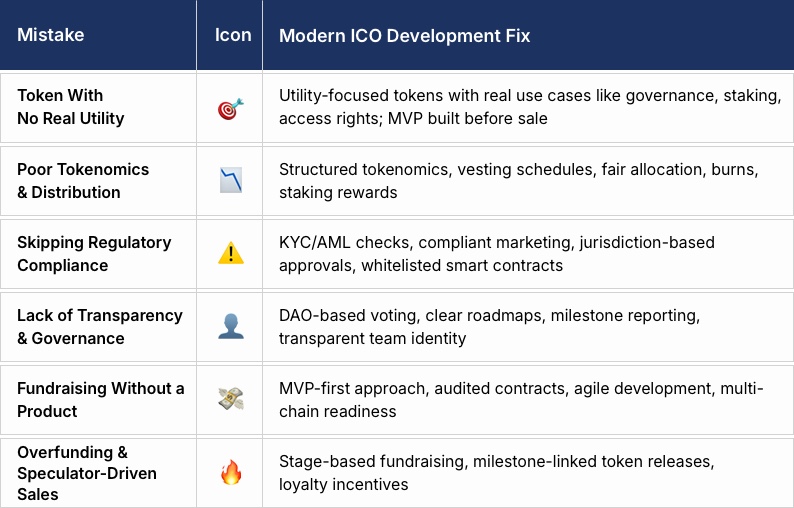
1. Launching a Token With No Real Purpose
Back in 2017, many projects rushed to create tokens simply because “everyone else was doing it.” Tokens had no real function, no ecosystem, and no roadmap. Investors quickly realized this and dumped their holdings the moment the token listed.
How modern models fix this:
Launch an ICO today is not hype-driven. Tokens are designed around real utility; governance rights, access to features, staking benefits, or in-app rewards. Most founders today create an MVP prior to the token sale to allow users to literally visualize how the token fits into the product.
2. Poor Tokenomics and Distribution
Most initial ICOs were characterized by overvalued supply of tokens, lack of a vesting schedule, and unequal distributions. Team-held tokens released too soon often caused market crashes.
How modern ICO development fixes this:
Modern ICOs focus on structured tokenomics: fair allocation, clear vesting, and limited circulating supply at launch. Features like token burns, staking rewards, and utility sinks help maintain stability. Arbitrum’s launch illustrates this approach with long-term vesting and a fair airdrop distribution; the token entered the market smoothly despite high demand.
3. Skipping Regulatory Compliance
Ignoring KYC/AML and claiming “utility” to dodge securities laws was common in early ICOs, leading to shutdowns, penalties, and investor losses.
How modern ICO development fixes this:
The design process is now inclusive of regulatory compliance. The modern systems incorporate KYC/AML validation, jurisdiction-focused approvals and whitelisted smart contracts. Marketing is also in compliance, with no false promises. Telegram’s TON project is a cautionary tale, after failing SEC compliance, it refunded $1.2 billion. Today, founders consider compliance at the very beginning and minimize legal risks to investors and projects.
4. Lack of Transparency and Governance
Lack of identity of teams, vague road maps, and lack of updates rendered mistrust and ruined most of the initial tokens.
How modern ICO development fixes this:
Transparency and governance are central today. Authenticated groups, milestones, and voting supported by Dao enable the community and establish trust. An example of this is Aave. Through its on-chain voting and communication, it made the token holders become more active, which will benefit its ecosystem in the long run.
5. Fundraising Without a Working Product
Numerous ICOs raised millions of dollars without even having a working product, and investors are left with only a promise.
How modern ICO development fixes this:
MVP-first strategies, audited smart contract development, and agile development cycles are standard today. Multi-chain scalability is often built in from the start. Chainlink followed this approach by launching with functioning oracle integrations, it earned early institutional trust and set itself apart from “whitepaper-only” projects.
6. Overfunding and Speculator-Driven Sales
Chasing sky-high caps and offering large early bonuses attracted speculators who dumped tokens immediately, causing volatility.
How modern ICO development fixes this:
The use of stage-based fundraising, milestone-based releases and the use of loyalty-based incentives are the order of the day. This is demonstrated by StarkWare, which implemented achievable caps and token release milestones to attract serious users and to prevent the boom-and-bust cycles of the previous ICOs.
How Modern ICO Models Really Work in Practice
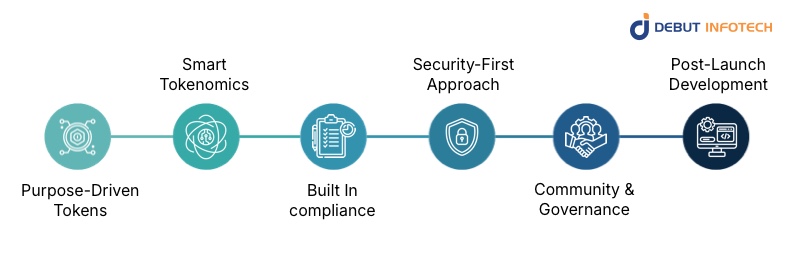
Days when ICOs were simply hype and a fast way of raising funds are long gone by. Modern ICO models have become the basis of successful projects today, which incorporate purpose, structure, and trust. The following is the practical way they operate:
1. Purpose-Driven Tokens: Tokens are no longer a means of raising money. They are actually useful, be it in stake, governance, access to your platform. The most effective ICO models ensure that your MVP or working product is there the day of launch so that investors can see that value immediately.
2. Smart Tokenomics: Modern projects do not put the distribution and supply of tokens at random. Considered vesting lists, liquidity budgets and measures, such as burns of tokens, can work to keep things stable and promote long-term retention.
3. Built In compliance: Regulatory hurdles are no longer after-thought. Modern ICO models incorporate both legal and the KYC/AML procedures early on, ensuring that your project remains within the limits of the law and ensures that investors do not run away.
4. Security-First Approach: Smart contracts are audited (and ultimately tested) to ensure the safety of the process. Formal verification helps in making sure that your code is trustworthy and makes it less likely that it will be hacked or will fail once released.
5. Community & Governance: There is nothing like transparency. ICO models of today are based on utilizing the concept of DAOs, open roadmaps, and frequent updates to transform token holders into active participants, not passive investors.
6. Post-Launch Development: Development does not end with the launch. Modern models envisage constant development of the ecosystem with staking programs, integrations, crypto token development, and utility approaches that ensure your project thrives in the long run.
Tezos ICO Case Study: The Real Story That Shows Why Compliance Matters
In 2017, Tezos announced one of the largest ICOs of all time in the history of the industry, raising $232 million to develop a self-amending blockchain with on-chain governance. The project possessed a powerful team, some new technology and an expanding community. All was going well until the time the truth struck.
The challenge? Preparation and compliance.
Soon after the ICO, there were significant delays due to internal disputes between the founders and the Tezos Foundation. Months passed without the test of smart contracts, investors got nervous, and U.S. regulators identified the ICO as an unregistered securities offering. This was followed by lawsuits which shook the trust of the community and brought years of legal headaches. Despite the huge investments, the absence of a clear governance structure and a well-established ICO compliance almost sabotaged the project.
Tezos’ story demonstrates that it is not enough to raise funds. The current development of ICO revolves around appropriate tokenomics, vesting, audited smart contracts, and on-day compliance. Paying attention to these aspects, projects can transform a token sale into a risky and short-term event to a more sustainable and growth-driven ecosystem.
Tezos has however stabilized since the. but its journey is an important lesson because effective ICOs do not begin with code, but they begin with planning, governance, and legal compliance.
Ready to build a secure and standout ICO?
Let’s transform your vision into a compelling, compliant token launch designed for success.
Endnote
Before you take your ICO live, it’s important to slow down and make sure the foundation is solid. The success of ICO development nowadays does not depend on haste to market but rather a defined token purpose, powerful tokenomics, impeccable compliance, and a team and product that investors can trust. When your smart contracts are audited, your roadmap is realistic and your post-launch plan is already in action, then you are on track. Otherwise, you should make things tight before you proceed.
Today’s investors are careful, informed, and quick to spot projects that aren’t fully prepared. Giving yourself the time to get things right makes all the difference.
If you want expert support from day one, reach out to Debut Infotech, an experienced ICO development company helping founders build compliant, secure, and high-performing token launches from the ground up.
FAQs
Q. What does ICO stand for?
ICO is an abbreviation that means Initial Coin Offering. It is a technique employed to finance a new cryptocurrency project. Imagine it as an IPO (which means Initial Public Offering) in which companies sell their shares when they first enter the stock market. The principle works in a similar way, although in the case of ICO, investors are given crypto tokens, rather than shares.
Q. What is the most successful ICO?
Ethernet (ETH) is generally regarded as the most successful ICO so far. In 2014, it raised over $18 million and produced one of the best ROIs that early investors had ever realized. More importantly, Ethereum has presented smart contracts and decentralized applications (DApps), which shifted the trend in the blockchain industry entirely.
Q. How much does it cost to develop an ICO?
The development cost of an ICO could vary. Simple projects usually begin at an average of $15,000 to $30,000, and the total expenses may vary between $8,000 up to over $200,000.
Your final budget will vary depending on various aspects of your idea, features you require, some legal and compliance considerations, as well as how much you will spend on marketing.
If it is a cost-effective alternative you need, a white-label or pre-built ICO solution tends to be the cheapest. A dedicated, fully-featured ICO platform will be more expensive and provide greater flexibility and scalability.
Q. Is an ICO profitable?
Yes, the Initial Coin Offering (ICOs) can be lucrative. They however are very risky and have a high failure rate. A number of ICOs have produced enormous returns, yet most others have caused massive losses or have become frauds.
The success of the project supporting the ICO has a significant influence on profitability. It also involves extensive research about the project, its personnel, and the market. Prior to investing it is imperative to do your homework.
Our Latest Insights


Leave a Comment