



Table of Contents
The Future of CRM: A Complete Guide to Generative AI Integration for Enterprises

by

December 8, 2025

by
December 8, 2025
Introduction
The way enterprises manage customer relationships is changing fast. Gone are the days when CRMs were just digital filing cabinets for contact details. Today, they’re becoming intelligent ecosystems powered by generative AI. As a matter of fact, McKinsey states that 63% of businesses have already experienced improved customer interactions since implementing AI into their customer relationship management systems.
However, the reality of the matter here is that this change is not about human beings being replaced by machines. It is all about enabling teams to work more productively, providing sales reps with real-time intelligence, automating tedious marketing processes, and assisting service teams in knowing what customers require before the customer requests it.
That’s the power of generative AI integration. When integrated with enterprise CRMs, it does not only make the processes faster, but it also makes them smarter. AI is changing how businesses interact and work, both through data-driven suggestions and automated processes.
In this article, we will discuss how it is possible to successfully imAI CRM optimizationplement generative AI into current enterprise CRM systems, what to anticipate, how to prepare, and the actual benefits that lie on the other side.
Understanding Generative AI in CRM
To get the most out of AI CRM optimization, it helps to first understand what generative AI really means for enterprise systems. It’s not just another automation tool, it’s a technology that can actually create, predict, and personalize at scale.
Think of it as moving from “data storage” to “data intelligence.” Traditional CRMs record what customers do; generative AI helps you understand why they do it and what they’re likely to do next.
For instance, AI can now listen to and summarize sales calls automatically in platforms like Salesforce, saving hours of manual note-taking. It can also power GPT-style chatbots that don’t just answer questions, but guide leads through personalized buying journeys, recommending the right products, at the right time.
This type of intelligence makes CRM more than a sales tool. It turns itself into a business collaborator, identifying opportunities, anticipating churn and producing content that is authentic human.
The knowledge of this base is the initial step of making your customer experience smarter, faster, and more connected than ever before, where AI does the hard work, and your team can concentrate on what does matter, creating relationships.
Turn your data into a competitive advantage with Generative AI.
Explore our seamless integration solutions that automate workflows and unlock new insights for your business.
Assessing Your Existing CRM Infrastructure
AI has the potential to transform how you do business, but first, you should know what is already going on in your CRM. The integration process of generative AI is not only about linking new tools together, but also ensuring that the groundwork is solid enough to sustain them.
Start by taking stock of your data models, APIs, and workflows. How is the flow of information in your CRM? What systems are linked and how many systems remain in silo? Visualizing this will give you a better understanding of where AI can be inserted to provide actual value, be it through automating customer responses, coming up with smarter insights, or through better lead scoring.
The second step is to find your integration points such as what areas will AI actually have to interact with your existing systems. These might be APIs which retrieve customer information, data lakes containing big data, or even touchpoints where staff interact with the clients. Being informed about these connection points in advance can assist you in the design of a more efficient and seamless rollout of AI.
Then comes your readiness check. Here are the core factors that will influence your AI success:
- Deployment model – Is your CRM cloud-based or hosted on-premises? Cloud platforms are more flexible to AI integrations.
- Data quality – AI works optimally in cases where the available data is clean, structured, and readily available.
- Compliance and security – Ensuring that your system is within industry standards such as GDPR or HIPAA in order to ensure privacy of users.
A thoughtful infrastructure evaluation will save you integration headaches in the future. It makes sure that your CRM is not merely technologically prepared, but strategically prepared to be intelligently automated through the efficient use of generative AI frameworks.
Key Integration Models for Generative AI
Regarding the implementation of generative AI for enterprise systems such as CRMs, there is no one-size-fits-all solution. The right model depends on your business goals, existing infrastructure, and how deeply you want AI to interact with your data. Let us consider three practical reasons why companies are making it happen, each with its own advantages:
1. API-Based Integration
This is among the most flexible and quickest methods when getting started. Companies may use APIs provided by vendors such as OpenAI, Anthropic or Azure Cognitive Services to add AI-generated features to their applications including automatic email templates, lead scoring, or real-time customer data.
For example, imagine your CRM automatically summarizing customer calls or generating personalized follow-up messages in seconds. With an API-based setup, all of that becomes possible without rebuilding your entire system. It’s ideal for teams that want quick AI functionality without heavy development costs.
2. Native Plugin or Extension
If your organization uses platforms like Salesforce or Microsoft Dynamics 365, you’re in luck, both now offer built-in AI assistants such as Einstein GPT and Dynamics 365 Copilot. These in-app integrations enable the teams to interact with the generative AI within the CRM interface.
That means sales reps can get predictive insights, marketers can auto-generate campaign ideas, and service agents can resolve tickets faster, all within familiar tools. It’s the most seamless route for companies already invested in enterprise-grade CRMs that are AI-ready out of the box.
3. Custom Middleware Approach
For enterprises that want more control and data security, a custom middleware approach is the way to go. This model involves building an internal microservice layer that securely connects your CRM data to your chosen AI models.
It’s more advanced but incredibly powerful. Under this setup, you can create your own generative models using proprietary data, establish strict access rules and ensure the adherence to the internal governance rules. Numerous businesses are taking this path to fit AI capabilities to their specific processes – and to gain complete authority over their sensitive customer data.
All these integration models introduce fresh opportunities of smarter, faster and more connected CRM experiences. It is important to have a small scale with APIs or big scale with a self-built AI layer, but it is necessary to choose the way to go, depending on the goals of the organization and the presence of enough resources.
The thought of implementing generative AI into your business CRM may seem like a significant burden to bear, but with a clear roadmap, it will be much easier. Think of it as the establishment of the groundwork towards a more intelligent and interconnected customer experience.The following are the steps to begin with a sound AI integration strategy:
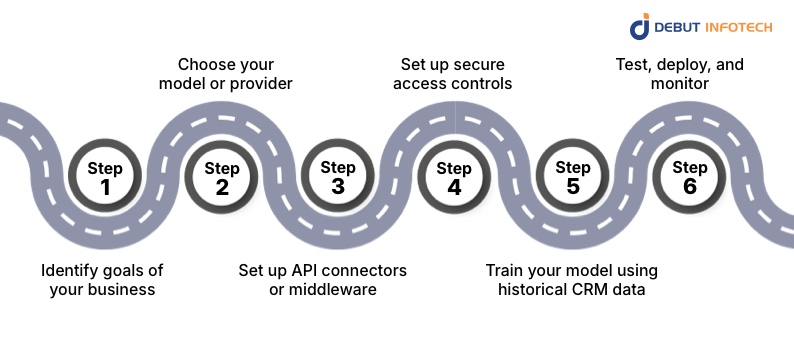
Step 1: Identify goals of your business
Before diving into code or APIs, start with why. What do you want AI to do to your CRM? That may be enhancing the lead scoring, automating the content creation of follow-ups, or performing sentiment analysis on customer interactions. Having specific objectives will keep your integration focused on the quantifiable business results, not on tech buzz.
Step 2: Choose your model or provider
Next, pick the brain behind your system. This may be a popular service such as OpenAI, Claude by Anthropic or Gemini by Google or you may create your own custom large language model (LLM) fine-tuned on your data. The decision will be based on your data privacy requirements, your scalability requirements and your budget.
Step 3: Set up API connectors or middleware
After choosing your model, you are now ready to make the connection. Introducing API connectors or middleware technology as translators can enable an ordinary communication of information between your CRM and AI platform. This makes sure that information such as the customer history, sales performance, or support tickets move safely between the two platforms to form a single intelligent source of truth.
Step 4: Set up secure access controls
Security is not something that can be added afterwards. The use of role-based access control (RBAC) allows the access and manipulation of sensitive data by authorized team members. It is a small step that safeguards your business against misuse within your company and ensures that you do not go against data privacy laws.
Step 5: Train your model using historical CRM data
AI learns through experience just as humans. Give the model information about your customers and their behaviors, preferences, and language using your historical CRM data. Clean, well-structured data will produce more accurate and useful AI-driven insights. And don’t leave out any personal identifiers to keep the things in compliance.
Step 6: Test, deploy, and monitor
And here is the fun part, which is to bring your AI to life. Begin with small cases of tests and see how it works in the real world. Look after possible bias, inaccurate answers, or lack of data. After you are sure, scale it out and continue to check its performance as time goes by. Long term success lies in continuous improvement.
When managed appropriately, the incorporation of generative AI will make your CRM more than a database, it will be an active partner that assists your team in anticipating demands, personalizing contact, and fostering better customer relations with your customers.
Common Challenges & How to Overcome Them
Integrating generative AI into a CRM system is more than a tech upgrade; it’s a mindset shift. It takes planning, collaboration, and a willingness to adapt. Here’s a look at the most common challenges teams encounter, and how you can turn each one into a growth opportunity.
1. Breaking Down Data Silos
Scattered data is one of the biggest problems that enterprises have to deal with. AI models fail to provide precise information when the information about customers is distributed among different departments, including sales, marketing, and support.
The fix? Create a unified data strategy. You can use middleware or a centralized data warehouse to bring all customer interactions and records into one intelligent ecosystem. Once that happens, intelligent CRM systems can analyze patterns across every touchpoint, giving teams a 360° view of each customer, not just fragments of their history.
2. Tackling AI Hallucinations
Generative AI is powerful, but not perfect. It produces false or misleading results in some cases, which is what professionals refer to as AI hallucinations. This may be a practical concern when a CRM is based on AI to give personalized recommendations or responses to customers.
The solution lies in retrieval-augmented generation (RAG). When you blend the power of AI with proven and organized enterprise data, you have confidence that all of the outputs of AI, be it sales forecasts or email responses, are based on facts and not hearsay.
3. Managing User Resistance
Even the smartest AI tools won’t work if your team doesn’t embrace them. The most intelligent AI tools will not be effective when your team does not adopt them.
Employees can be concerned that they will lose their jobs to automation or that new processes will be so complicated. The way to change that narrative is to pay attention to AI-assisted workflows, not AI replacements. As soon as individuals see how AI makes their work easier, they will adopt it much easier.
Future Trends: The Next Frontier of AI-Driven CRMs
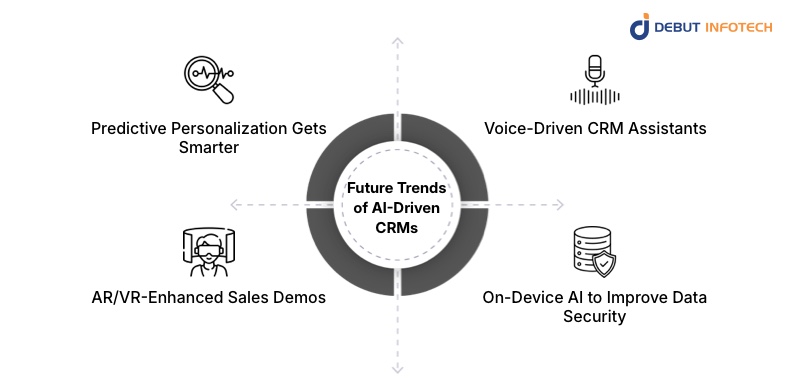
As enterprises continue to blend intelligence into their customer operations, we’re only scratching the surface of what’s possible. The next wave of AI-driven CRMs is set to feel less like software and more like a thinking partner. Here’s what’s shaping that future.
Predictive Personalization Gets Smarter
Today’s CRMs can already segment and recommend, but future systems will anticipate. With multi-modal large language models (LLMs) at the core, CRMs will combine voice, text, image, and behavioral data to predict customer needs before they’re even voiced. Imagine a sales dashboard that not only shows who to call but why they’re ready to buy and what message will convert best.
Voice-Driven CRM Assistants
Typing commands into a dashboard will soon feel outdated. AI-powered voice assistants are turning CRMs into conversational partners that can schedule follow-ups, summarize calls, and even suggest next steps, all through natural speech. This evolution will give teams back hours each week, making customer engagement more fluid and intuitive.
AR/VR-Enhanced Sales Demos
With the maturity of generative AI integration services, it is anticipated that there will be smooth AI-AR/VR fusion within CRMs. Imagine a simulated sales demonstration in which a prospective customer is able to navigate through a product in the 3D environment, controlled by an artificial intelligence agent that tailors the experience in real-time. This is not science fiction, this is how the best businesses will be able to sell their complex solutions clearly and powerfully in the near future.
On-Device AI to Improve Data Security
As privacy issues become more common, more stringent data laws are enacted, companies are moving away from cloud-intensive models in favor of on-device AI processing. This model maintains sensitive CRM data nearer to users without compromising the real-time insights. The result? Personalization at a faster and safer rate without impacting compliance and trust.
Ready to build a smarter, AI-driven business?
Our experts craft custom Generative AI strategies designed for growth and efficiency.
Final Thoughts
Fundamentally, the integration of generative AIs has little to do with replacing a human being, it has to do with assisting people to do their work. The most successful companies are adopting AI to make work easier, individualize customer relationships and access insights that have real business development.
With the right partner, that transformation doesn’t have to be complicated. Debut Infotech, a leading generative AI development company, helps organizations bring AI seamlessly into their CRM systems, blending smart automation with a human touch.
Because when your CRM truly understands your customers, every interaction becomes more meaningful and every decision more impactful.
Frequently Asked Questions (FAQs)
Q. How to Implement AI in CRM?
A. Start by defining clear goals. Then, identify the specific problems in your CRM that AI can help solve.
Focus on inefficiencies, repetitive tasks, and bottlenecks that slow your team down.
For example, traditional lead scoring methods can often mislead sales teams to chase the wrong prospects. With AI-powered lead scoring, your system can analyze data more accurately and predict which leads are most likely to convert.
Q. What are three commonly used examples of AI in CRM?
A. AI is transforming how businesses manage customer relationships. Here are three of the most common ways it’s being used in CRM systems:
Lead scoring and prioritization: AI helps identify and rank leads based on their behavior, engagement, and likelihood to convert.
Chatbots and virtual assistants: These tools handle routine customer questions, freeing up human agents for more complex tasks.
Predictive analytics: AI can forecast sales trends and detect potential customer churn before it happens, helping teams take proactive action.
Q. How Can Generative AI Be Applied in CRM Systems?
A. Generative AI is changing the way businesses use CRM platforms. It helps teams work smarter, personalize experiences, and make data-driven decisions faster.
Here are some of the most common use cases:
Smart First-Party Data Collection: Automatically gather and organize customer data to create a complete view of every client.
Personalized Customer Support: Deliver instant, human-like responses at scale through AI chatbots and virtual assistants.
Automated Lead Nurturing: Qualify, segment, and engage leads with tailored messages based on behavior and intent.
Predictive Sales Intelligence: Forecast revenue and identify high-value opportunities with AI-powered insights.
AI-Powered Marketing Execution: Generate content, suggest campaigns, and optimize marketing workflows in real time.
Our Latest Insights



Leave a Comment