



Table of Contents
The Power of ML Automation: Turning Complex Data Into Confident Business Moves

by

December 1, 2025

by
December 1, 2025
Introduction
Every business today is swimming in data including customer insights, market shifts, performance metrics and it’s growing faster than teams can keep up. Relying on human intuition alone just doesn’t cut it anymore. That’s why more organizations are turning to ML automation to make smarter, faster, and more accurate decisions.
Machine learning eliminates the guesswork of strategy. It can handle vast volumes of data, identify trends that not even a person would identify, and provide leaders with insights that can allow them to act confidently. As noted by McKinsey, firms that leverage AI and analytics have improved their decision-making by a double-digit number and, in a few other instances, by as much as 20% of their EBIT (Earnings Before Interest and Taxes) is now generated by AI-driven solutions.
In this article, we’ll break down how ML automation is reshaping business decision-making, explore real-world success stories, and show you practical ways to bring this technology into your workflow.
Because in a world driven by data, better decisions start with smarter systems.
What Is ML Automation and How It Works in Decision-Making?
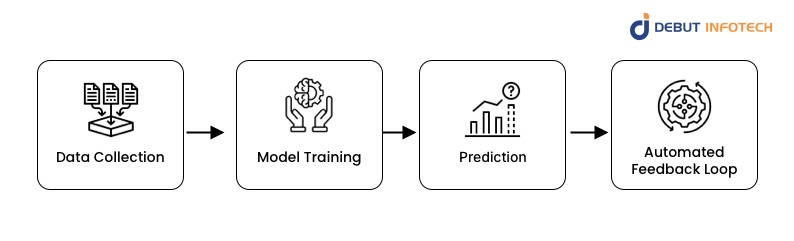
Have you ever asked yourself why some companies such as Netflix are always aware of what you will watch next- that is ML automation at work. In a simple definition, ML automation simply involves applying machine learning techniques to allow computers to make intelligent decisions without the active involvement of humans. It is a kind of a digital assistant that learns based on information, gets better with time and helps make your business smarter and quicker.
Here’s how it typically works:
- Data Collection: Everything starts with data. Businesses gather information from various sources such as customer behavior, transactions, sensors, or marketing analytics.
- Model Training: This information is subsequently used to train models with machine learning methods. Consider this step as a way of training the system to know what “good decisions” would be.
- Prediction: When trained, the model can help predict the results, propose the follow-up steps, or automatically perform some actions.
- Automated Feedback Loop: ML automation does not cease at the time of deployment. It continues to learn with each new input or result and evolves its precision and lessens human intervention with time.
A simple, real-world example is Netflix’s recommendation engine. It learns based on your viewing patterns i.e. what you watch, what you skip, and what you rate and automatically suggests what you watch next.
Turn operational data into your next competitive edge.
Our ML automation solutions streamline workflows, predict outcomes, and unlock new efficiencies. Discover how we build intelligent systems that work for you.
Why Decision Accuracy Matters in Modern Business
Every decision in business carries weight whether it’s approving a loan, adjusting pricing, or predicting customer churn. The challenge? Businesses in the present day are overwhelmed with data. Every day, over 2.5 quintillion bytes of information are being generated, and it is no longer feasible to rely solely on human judgment.
Manual decision-making at one time could have been effective in scenarios where the data were small and less complex but currently it is fraught with biases, delays and avoidable mistakes. Even the finest teams are only able to process a limited amount of information until they become tired or miss important details. That’s where auto decision making powered by machine learning steps in.
Machine learning systems do not need to go through volumes of reports to extract information; however, they analyze the patterns, identify correlations among them, and provide insights nearly in real-time. They do not substitute human beings, on the contrary they enable them to make quicker and more precise decisions using factual information rather than feelings.
Take financial institutions, for example. Many banks now use ML automation to detect unusual transactions, predict risks, and flag potential fraud in real time. The accuracy isn’t just better, it’s transformative. These systems continuously learn and adapt, becoming smarter with every data point.
Here’s a quick comparison to show the difference:
| Decision Process | Human-Only Approach | ML-Assisted (Auto Decision Making) |
| Speed | Hours or days | Seconds or less |
| Accuracy | Varies with experience | Consistently high and improving |
| Bias Risk | Moderate to high | Significantly reduced |
Key Benefits of ML Automation in Business Decision-Making
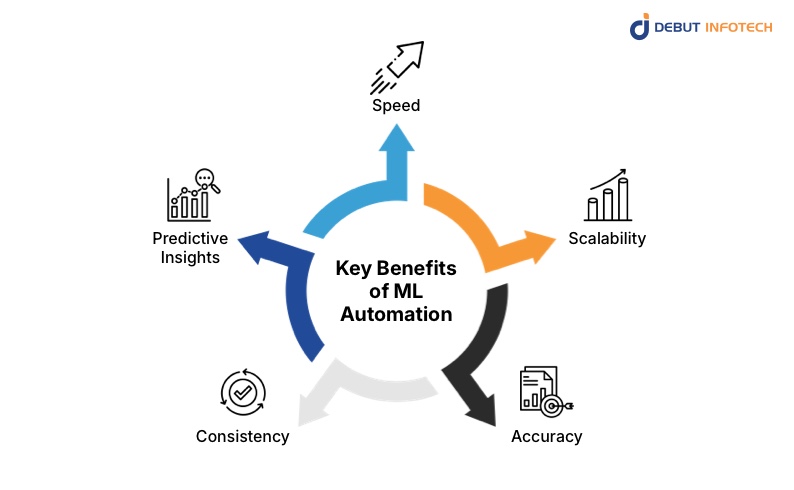
Let us be honest, the modern business environment is moving too rapidly to make decisions manually. Businesses process loads of data in a single second, and it is often hard to make sense of it all. That is where ML automation comes in, converting the unstructured data to the intelligible actionable information. Businesses are enhancing speed, accuracy, and scalability better than it has ever been, with the assistance of modern ML development services.
1. Speed
Rapid decisions are the key to success or failure of a business. ML automation enables business organizations to become faster by processing information in real time and creating immediate reactions. As an example, Amazon employs machine learning to dynamically set the price of its products in real time, reacting to changes in demand, competition, and inventory. This is how it remains agile in a highly competitive marketplace.
2. Scalability
As companies grow, so does the data they have to process. ML automation is easily scaled, and thousands (or even millions) of data points can be processed without reducing the performance. Machine learning has been applied to optimize route planning systems in logistics, in which millions of variables (such as weather, traffic, delivery windows, etc.) are analyzed to ensure that fleets operate efficiently throughout an entire region.
3. Accuracy
When prejudice or exhaustion is involved, human judgment is limited. ML automation eliminates most of that uncertainty as it deals with data only. For instance, automated credit risk scoring systems are machine learning-based tools applied in the fintech industry to assess reliability of borrowers. The result? Less expensive mistakes and more open lending policies.
4. Consistency
Opportunity can be lost in a fast-paced business environment where inconsistency occurs. ML automation is used to guarantee that all decision-making (hiring, pricing and customer service) is guided by the same rationale and quality standards. Several HR teams are already utilizing AI-based software to filter and select applicants, which has hastened, increased the recruitment process and increased its objectivity.
5. Predictive Insights
The power of ML automation is, in fact, its predictive ability. It assists businesses to predict future tendencies with confidence by analyzing historical information and identifying subtle trends. As an example, retail brands use demand forecasting systems to forecast what customers desire next, to optimize stock levels and increase sales with minimum waste.
Also Read: Machine Learning for Blockchain Data Analysis: Key Insights
Real-World Case Studies: How ML Automation Is Changing the Way Businesses Decide
Machine learning may seem like a futuristic concept, but it is already influencing the actual business results. At the retail shelves and on the factory floors, firms are leveraging ML automation in order to make smarter and quicker decisions. Here are some real cases:
1. Retail
Think of a retailer that can predict precisely when one product is going to run out and what their customers are going to desire in the next season. It is not a coincidence; it is a product of a machine learning model that was trained to analyze years of sales data, market changes, and even social trends.
Through the analysis of such huge datasets, retailers can make accurate predictions of demand. Timely restocks, less waste and custom-made marketing that feels like it is designed to meet the needs of every customer. It’s the kind of precision that’s impossible without automation.
2. Manufacturing
Manufacturing was once very reliant on manual inspection and predetermined schedules. Nowadays AI and automation have that all transformed. With sensors and machine learning on production lines, manufacturers will be able to identify defects in products immediately, streamline processes, and predict the next possible equipment failures. It implies reduced delays, reduced cost, and increased quality output- all of which are driven by data-driven insights.
3. Automotive
Machine learning is transforming the automotive industry, literally. Predictive analytics is now used by automakers as well as logistics companies to track in real time the performance of vehicles.
These smart systems are able to alert technicians even before a breakdown occurs, assist businesses in saving on the cost of maintenance and enhance road safety.Even autonomous driving systems are based on ML automation to make a decision in a split-second – learning about billions of real-world driving situations to become smarter each day.
Challenges and Ethical Considerations
AI is influential, yet its implementation in decision-making processes is not as straightforward as flicking a switch. Behind each correct foresight there lie complicated issues such as data privacy and ethics that companies have to step into with caution. Here are the major factors to consider when incorporating AI in your decision-making:
1. Ethical Implications of AI
AI is able to make very fast decisions, but that does not necessarily mean it is fair. Algorithms can potentially increase biases in training data when there are no mechanisms in place to prevent this tendency. To illustrate, in case an AI model is trained on past recruitment data, preferring one demographic over another, then it may keep such biases when filtering new applicants. To avoid this, companies need to actively monitor datasets, run fairness audits, and apply clear ethical frameworks from day one.
2. Bias in AI Systems
Bias is not always deliberate however it can be quite devastating. Even such structured models as a decision tree ML algorithm can be biased by its training data. The result? Unfair outcomes that can damage trust, brand reputation, and even lead to legal challenges. Building diverse datasets and testing models under different conditions can help mitigate this issue.
3. Data Privacy and Security
Machine learning is driven by data and with it, the need to keep it safe comes with it. The information about customers, financial details, and all sorts of other data should be stored, encrypted, and processed safely. Adherence to such laws as GDPR and industry-related standards is not a choice, but a necessity to keep customer’s trust.
4. Infrastructure and Reliability.
AI technologies require powerful computers and well-performing data pipelines. Downtime, latency, or system errors can throw off entire workflows. That’s why investing in scalable cloud infrastructure, continuous monitoring, and fallback mechanisms is non-negotiable.
Related Read: A Practical Guide to Machine Learning Benefits and Challenges
How to Implement ML Automation in Your Business
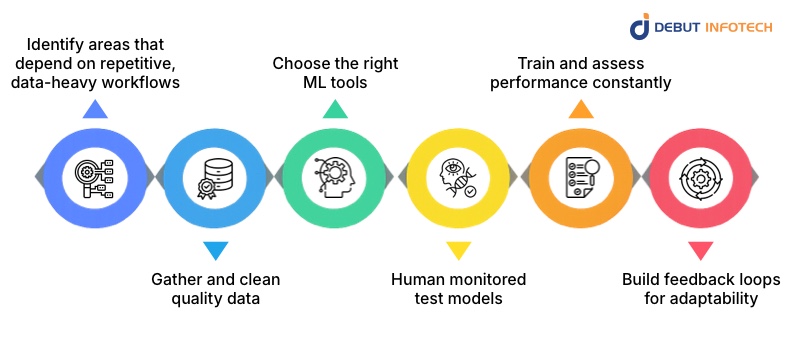
Getting started with ML automation isn’t about throwing complex algorithms at your data and hoping for magic. It is all about creating a process where technology, people, and data are bonded meaningfully. Here’s how to do it right:
1. Identify areas that depend on repetitive, data-heavy workflows
Begin by locating the sections of your business where decisions are made often and often repeat in patterns. Think of processes like lead scoring, demand forecasting, or customer service routing. They make ideal automation beginnings since machine learning is sensitive to repetition and data.
2. Gather and clean quality data
Your model is only as good as the data you feed it. Get the data, find the right sources, clean the data and eliminate duplicates, correct the errors and normalize the data. Quality decision-making is based on high-quality, unbiased information.
3. Choose the right ML tools
You don’t need to reinvent the wheel. Platforms like TensorFlow, PyTorch, or AutoML solutions make it easier to train, test, and deploy models without needing a PhD in data science. This is because the most appropriate tool will be the one that makes sense to your team in terms of technical capabilities, data volume, and application.
4. Human monitored test models
Prior to fully automating the decision making process, engage your team to check the predictions of the model. Algorithms can be missing important judgment and context, which humans bring in, particularly in infancy stages. This will assist in establishing trust in the system and avoid more expensive errors.
5. Train and assess performance constantly
Machine learning isn’t “set it and forget it.” Trends, customers behaviour and market conditions change and your models should as well. Frequent retraining ensures that your automation is also up to date with the realities of the day and that your decisions remain accurate over time.
6. Build feedback loops for adaptability
The most effective implementations do not end with deployment. Add feedback loops where users can provide feedback, monitor results and input the resultant data into your models. This assists your ML system to learn, develop and enhance constantly, just like your business.
Ready to automate and elevate your business?
Let’s design a custom ML strategy that cuts costs and accelerates growth. Get a free consultation with our automation experts.
Final Thoughts
All great business decisions begin with one thing at the end of the day, and that is good data. And in 2025, ML automation is assisting businesses with converting that data into action quicker, smarter, and more confident than ever before.
The automation of ML is no longer a buzzword, it is the core of business intelligence today, whether it comes down to anticipating customer needs beforehand or ensuring precise financial planning.
If you are willing to be able to make more, data-driven decisions that can be scaled as you grow, then it is time to hire the right professionals. Debut Infotech, a leading blockchain development company, helps businesses harness the power of ML automation to unlock real insights, reduce guesswork, and stay ahead in a rapidly changing market.
Because when innovation meets intelligence, your business doesn’t just adapt, it leads.
Frequently Asked Questions (FAQs)
Q. What is ML Automation?
A. Machine Learning Automation, or AutoML, is the process of using automation to apply machine learning to real-world problems. In simple terms, it combines the power of automation with machine learning to make data-driven tasks faster and easier.
AutoML can handle almost every step of the process, from cleaning raw datasets to building and deploying ready-to-use machine learning models. It helps teams save time, reduce errors, and focus on solving bigger business challenges instead of manual data work.
Q. What are the 4 types of Machine Learning?
A. Machine learning algorithms get smarter over time. As they process new data, they learn, adapt, and improve their performance, building “intelligence” through experience.
There are four main types of machine learning algorithms:
Supervised learning
Semi-supervised learning
Unsupervised learning
Reinforcement learning
Each type has its own way of learning from data and solving problems.
Q. Where is AutoML used?
A. AutoML, or Automated Machine Learning, is the process of automating how machine learning models are built and deployed.
It takes care of the entire workflow from data preparation to model training and tuning so users can focus on results rather than complex coding.
With AutoML, even non-experts can create and use powerful AI systems. For data scientists and developers, it simplifies and speeds up the entire AI development process.
Our Latest Insights




Leave a Comment