



Table of Contents
Home / Blog / Web Development
Node.js vs React.js: A Simple Guide to Choosing the Right Tool for Your Next Project

by

December 17, 2025

by
December 17, 2025
When discussing Node.js vs React.js, people often attempt to comprehend how two so powerful tools in JavaScript can become so similar and yet be applied to such different purposes. JavaScript is brought into the server in node.js and is used to create APIs, work with data, and manage the workflows of the backend. React does the reverse of this. It takes JavaScript to the front end and generates the buttons, layouts and interaction that users interact with on a daily basis.
They’re not rivals. They are two sides of a coin and they usually combine to create modern and high performance applications. However, understanding what each of them is used for can save you time, prevent architecture errors, and allow you to select the appropriate tool when working on your next project.
So let’s break them down in a simple, human way and explore when you should use Node.js, when React makes more sense, and when the best choice is actually both.
What Is Node.js?
JavaScript comes to the server side through Node.js. Rather than working with buttons, forms, and visuals as React does, Node.js is concerned with all the activity behind the scenes. It operates on the superfast Chrome V8 engine and operates on an event-driven, non-blocking model-in other words, a clever way of saying that it can handle many tasks at a time without feeling overburdened.
Due to this design, Node.js is a common choice when creating a Node.js backend that requires it to be fast, scalable, and reliable. Whether it is an API, a collection of microservices, or some other real-time functionality such as live chat, Node.js provides your application with the power and speed it requires to run smoothly.
Related Read: Vue.js vs React.js: A Comprehensive Guide
What Is React?
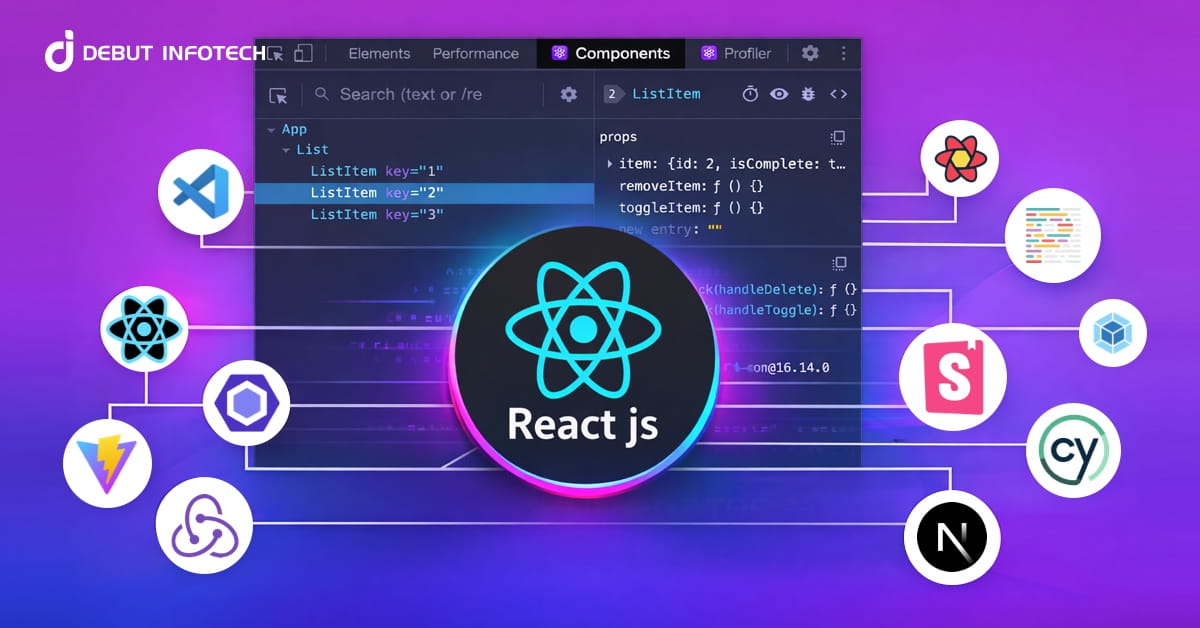
React is the component of the Node.js vs React.js discussion which is going to make your application come to life on the screen. It is an open-source, dynamic JavaScript framework by Meta that was developed to assist developers in building thoroughly interactive user interfaces without adding needless complexity.
React utilizes a virtual DOM to only update the changes and this results in users receiving responsive pages despite the data-heavy application. Its ecosystem is also among the best within the industry, and tools such as Next.js, Remix, and React Native can support web dashboards, mobile apps, etc.
While Node.js development is concerned with what is going on in the background, React ensures your frontend is made clean, intuitive, and engaging to your users.
Node.js or React? Power your project with the right tech.
Explore our tailored development services to build faster, scale smarter, and create stunning UIs. Let’s match the tech to your vision.
Node.js vs React: Key Differences at a Glance
When figuring out what to choose between Node.js and React, it might be slightly confusing at first sight, especially when you are planning what to choose in your next project or when comparing options among web development services. The good news? The distinctions are quite more apparent when you observe how each of them applies in real life.
Here’s a quick, easy-to-digest breakdown:
| Feature | Node.js | React.js |
| Type | JavaScript runtime | Frontend JavaScript library |
| Used For | Backend development, APIs, server processes | Building user interfaces and interactive screens |
| Environment | Runs on the server | Runs in the browser |
| Learning Curve | Moderate, especially for asynchronous programming | Easy to moderate—great for UI-focused work |
| Best For | Real-time apps, scalable APIs, data-driven systems | Dynamic dashboards, modern web apps, rich user experiences |
| Performance | Excellent for handling many concurrent requests | Optimized for fast, smooth UI rendering |
Concisely, Node.js is the engine to the back-end, whereas the front end is provided by a user-friendly, polished React. It is in knowing what each does so that you can select the appropriate mix to use in your project.
How and When to Use Node.js Effectively
Node.js is a strong framework that can be used to build a backend, yet understanding its usage and necessity can have a big impact on your project. Here are the top scenarios where Node.js really stands out:
1. Real-Time Applications
Node.js is best suited to applications that need real-time upkeep, such as chat applications, teamwork programs, or video conferencing applications. It has an event-driven architecture, which ensures that messages, notifications, and live data are synchronized in real time.
2. Data-Intensive Applications
You can use Node.js with apps that handle large amounts of data to allow concurrent requests effectively, ensuring your application is responsive even at heavy loads, e.g. analytics dashboard, reporting systems, or financial platforms
3. Streaming Services
Node.js is able to handle various streams of data, whether it be music or a video, or even the streaming of a live event. This is due to the fact that it has a non-blocking I/O that enables it to deliver continuously without slacking the user experience.
4. API-Driven Platforms
When you need to build a business that uses APIs, and multiple services are required to interact, Node.js is the right choice. It is also good at serving backend services connecting mobile apps, web apps, and third-party integrations and is able to handle requests and responses very fast.
Node.js is ideal in cases of businesses intending to deploy scalable and modular systems. Its lightweight execution and effective concurrent task management make it simple to develop microservices which are scalable with your business without being performance-bottlenecked.
Best Scenarios to Use React in Your Project
Depending on the project, not all require the same tools therefore understanding when the addition of React JS is appropriate and can save time and energy. Here are the top scenarios where React really shines:

1. Dynamic Dashboards
When your users require real time updates such as live analytics or performance metrics, the interactive and responsive dashboard is created using React JS app. Information can be updated in real time and the page does not have to be reloaded, thus providing the user with a smooth experience.
2. Single-Page Applications (SPAs)
React is suitable in apps where the content does not require a complete reload of the pages. It allows you to make fast, fluid experiences where people can move in quick time and everything is instantly felt.
3. Social Media Feeds
Social feeds need constant updates and engagement. React faces all live content, likes, comments and notifications easily, making the interface fast and interactive.
4. E-commerce Product Pages
With online stores, the users want to see immediate response when they are filtering on products, sorting and customizing them. These interactions are quick and user-friendly with a React JS application, which enhances conversions and user satisfaction.
Read more – Top 10 Node.js Development Companies to Watch Out in 2025
Can You Use Node.js and React Together?
Absolutely! One of the most popular matches in web development is the pairing of Node.js and React software. The backend is made with Node.js which handles server-side logic and APIs, whereas the frontend is made with React that creates fast and interactive user interfaces. The two are the foundation of the popular MERN stack that is used by a number of SaaS companies to rapidly develop, iterate, and scale applications.
Provided your project is a full-stack JavaScript application, or you are building a SaaS or mobile-first product, you might find yourself wanting to use Node.js software with React to achieve the speed, flexibility and performance required to create a smooth user experience.
Node.js vs React: Performance Insights for Your Web Apps
Both Node.js and React have their own sets of strengths when it comes to performance, and the knowledge of what each of them can offer you will be useful in making a smarter decision regarding your business, particularly when you are considering progressive web development.

Why Node.js Shines
1. Handles thousands of requests at the same time without slowing down
Node.js is based on event-driven, non-blocking architecture, that is, it does not wait for the current request to be completed before the next one is processed. This enables it to support thousands of parallel requests with ease, which is enormous when it comes to applications such as chat applications, live dashboards, or ticket booking applications with multiple users simultaneously.
2. Excels at fast input/output operations
Due to their asynchronous I/O, node.js is incredibly fast in reading and writing data to databases, files or APIs. This is because your backend is not bottlenecked which is important when your app is always processing or streaming data like in real-time analytics tools or streaming services.
3. Perfect for real-time applications
Due to its design, Node.js can be used in real-time applications such as messaging applications, online games or collaborative applications. The updates are also instant and do not require the user to reload the page which enhances a smooth and interactive user experience.
Why React Excels
1. Uses a virtual DOM to minimize unnecessary re-rendering
React has a virtual DOM which is a lightweight replica of the real one. React reuses components when the data is modified and only renders the components which have modified data. This improves speed and makes your app feel more responsive which is critical for progressive web apps and interactive dashboards.
2. Memoized and hooked to perform faster.
React hooks, like useMemo and useCallback, let developers optimize expensive calculations and component re-renders. This makes your application quick, even when it increases in complexity, so your users can have an easy time using it.
3. Works seamlessly with frameworks like Next.js for server-side rendering (SSR) and edge capabilities
React can be used with frameworks such as Next.js, so that some of your web app is rendered in the server before it is sent to the user. This enhances loading time, search optimization and performance, particularly in mobile devices, which is a major consideration in progressive web development where speed and responsiveness is a major contributor to engagement.
Read also – Why More Companies Are Hiring ReactJS Developers for Modern Web Projects
Learning Curve & Developer Experience
In the case of Node.js vs React.js, the developer experience may be very different. The learning curve of Node.js is higher due to its asynchronous programming model that requires a period to get familiar with. React is, however, more easily learned and has a rich ecosystem of tools and libraries to accelerate its development.
Understanding these differences is important to businesses that intend to develop powerful web applications, particularly when you intend to hire React.js developers or put together a team that can effectively develop both frontend and backend. As the market is currently experiencing demand for full-stack JavaScript talent, the appropriate knowledge can ensure that your project is faster, easier and more scalable.
Even seasoned developers have fallen prey to many traps that may slow down the development process, damage performance, or pose security risks. Here are four key mistakes to watch out for, explained in detail:
1. Expecting React to handle backend tasks
React is a front-end library, which is created to create interactive user interfaces, but not to run code on the server, or to work with databases.
When you attempt to use React to perform back end tasks, your application will not be able to scale and retain performance. Instead, a better strategy would be to use Node.js (or any other backend technology) to support server logic, APIs and database interactions. Consider React to be the “face” of your application and Node.js to be the “engine” of your application.
2. Pushing Node.js into CPU-heavy work
Node.js is an excellent server in terms of supporting parallel requests due to its non-blocking event-driven model. It is, however, not optimized to CPU-intensive applications, such as big computations, image processing or data crunching. Attempting to synchronize these activities in Node.js may tie up the event loop causing the whole application to slow down. However, a more appropriate way to do this is to offload resource-intensive operations to special purpose microservices, worker threads, or outside processing services, and leave the Node.js to handle I/O and concurrent requests.
3. Relying too much on client-side rendering
Loading all the content on the client-side (React by itself) may lead to slower loading of web pages, low SEO, and aggravating user experience, particularly in large-scale applications. The users may be presented with a blank page as the browser loads and runs all the JavaScript.
A better approach would be to use server-side rendering (SSR) or static site generation (SSG) frameworks like Next.js to pre-render content. This guarantees quicker start-up time and ease of interaction.
4. Installing too many npm packages
Libraries and packages are necessary to accelerate your development, though making your project reliant on too many dependencies is known to open vulnerabilities to security threats, make that bundle larger, and make the project harder to maintain. There can also be packages that are not maintained, or which have concealed exploits.
Instead, do a more thorough vetting on each dependency. Install only the packages which you really require and update them periodically and then audit your project on security problems frequently with npm audit.
Not sure if Node.js or React.js is best for your project?
Our experts will guide you to the perfect stack for performance, scalability, and a killer user experience. Get your free consultation.
Endnote
In the case of Node.js vs React.js, there is no real winner in the selection because the two tools are complementary to one another. Think of Node.js as the engine powering your backend, handling all the heavy lifting behind the scenes, while React takes care of the frontend, crafting smooth, interactive user experiences.
At Debut Infotech, we focus on both Node.js and React.js development, assisting companies in creating scalable and high-performance applications which appear attractive and perform without errors. Whether you are developing a new project or updating an existing platform, the knowledge of how and at what time to utilize them could be the difference in making apps that really shine.
Are you ready to launch your app idea? Contact our team today and let’s build something amazing together.
Frequently Asked Questions (FAQs)
Q. Which is better, Node.js or React?
A. Node.js and React aren’t meant to compete. The work they do in web development is very different. The backend is being built using Node.js. React is used for building the frontend. So, the question isn’t “Which one is better?” It is, Which one do you require in this part of the application you are doing?
Q. Is NodeJS used for frontend or backend?
A. Node.js is primarily applied in the backend. It executes JavaScript on the server, drives APIs, executes backend logic and connects to databases.
However, frontend development is also indirectly supported by Node.js. Developers often use it for tasks like:
– Managing dependencies with npm
– Running build tools such as Webpack or Gulp
– Supporting server-side rendering (SSR) for frameworks like React, Vue, and Angular
Node.js is also popular in full-stack development, since the platform allows developers to develop both the frontend and backend using a single language, JavaScript.
To be clear, Node.js does not render UI or handle visual animations. However, its contribution to the build processes, automation and SSR makes it one of the important components of the contemporary frontend workflow.
Q. Is Node.js still worth learning in 2026?
A. Absolutely.
Node.js remains among the most demanded backend technologies. Organizations use it to develop scalable applications quickly, such as real-time chat applications and business applications. The reason it is a good skill to invest in is that it has a large ecosystem, an active community, and a good job market.
To work in full-stack development or develop modern high performance applications, Node.js remains a great choice in 2026.
Our Latest Insights

Leave a Comment