



Table of Contents
Home / Blog / Blockchain
The Future of Retail Payments: Why POS Wrappers Matter for Blockchain

by

January 7, 2026

by
January 7, 2026
Introduction
If you’ve ever tried using blockchain for everyday purchases, you already know the struggle. Retail moves fast but most blockchains don’t. Between slow confirmations, unpredictable fees, clunky interfaces, and POS systems that were never designed for crypto, the whole experience can feel more experimental than practical.
Merchants want something simple. Customers want something instant. And blockchain, well, it hasn’t always delivered that at the checkout counter.
That’s why POS wrappers are becoming such a game-changer. They slip into the existing POS setup, translate blockchain payments in real time, and make crypto feel as easy as a tap-and-go transaction without asking merchants to change a single thing.
But here’s the part most people don’t know, the real power of POS wrappers goes far beyond just accepting crypto.
What Exactly Is a POS Wrapper?
A POS wrapper can be described as a translator that enables traditional point-of-sale systems to understand and process blockchain payments. Rather than compelling merchants to purchase new hardware or understand blockchain protocols and how they operate, it silently connects into their existing environment and does everything in the background.
It links blockchain payments to the POS terminal, translates on-chain activity into data accessible to the system, and eliminates all the technical friction generally associated with crypto payments. In order to maintain the speed and reliability of retail blockchain transactions, a POS wrapper manages API connections, real-time payment validation, on- and off-chain information synchronization, and even provides crypto-to-fiat alternatives in situations where merchants want to make payments in more familiar currency.
In very simple terms, it transforms blockchain payments into something that is as effortless as any regular checkout experience.
Transform your payment system into a profit powerhouse.
Our custom POS wrappers solutions unlock faster transactions, richer data, and seamless ecosystem integration.
How POS Wrappers Work: A Simple, Real-World Walkthrough
Suppose you are at the checkout counter and choose to make payments via crypto. You tap the option on the POS screen and then the POS Wrapper comes into play. It takes your payment request and routes it through a faster processing engine, often a Layer-2 network or an off-chain channel, so the transaction doesn’t get stuck waiting on a busy blockchain.
Within moments, the merchant sees an instant confirmation and completes the sale, without having to worry about delays or technical details. In the meantime, the on-chain settlement takes place transparently in the background, unknown to the shopper and the cashier.
In case the merchant wants to stick with the conventional money, the POS Wrapper can automatically deal with the crypto-to-fiat conversion, and send the end result to their bank account without any additional action. The whole process is seamless, quick, and familiar, making blockchain payments at last become a viable tool in the physical retail world.
Why POS Wrappers Matter for Scaling Real-World Blockchain Payments
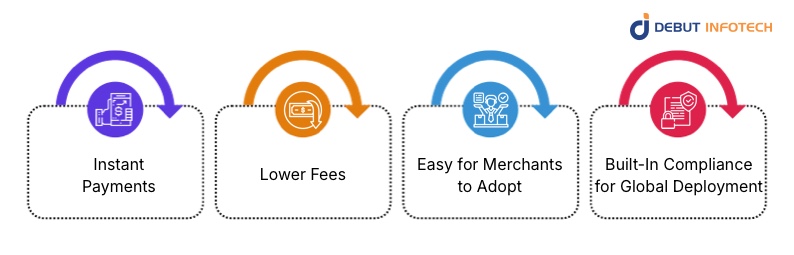
If you’ve ever tried making a crypto payment in a busy store, you already know the problem: the cashier is waiting, the line is moving, and the network is… not. That’s where POS wrappers step in. They basically smooth out all the rough edges of blockchain transaction processing so payments feel as quick and effortless as tapping a card. Here are some of the major reasons POS wrappers matter in scaling real-world blockchain payments:
Instant Payments
POS Wrappers are built to keep checkout lines moving. They tap into faster networks and technologies like Layer-2s, rollups, state channels, and even off-chain escrow models. The result? Payments confirm almost instantly, even if the actual blockchain settlement happens in the background later.
Lower Fees
In-store payments should be low and predictable. POS wrappers are useful because they batch or package transactions and this reduces fees and protects merchants against those unpredictable gas-price spikes, which render crypto unusable at scale.
Easy for Merchants to Adopt
A big win for retailers is that POS wrappers don’t require new hardware or specialized crypto knowledge.
They plug right into devices merchants already trust like Clover, Square, and Verifone, so the checkout experience stays exactly the same. The only thing that changes is the ability to accept crypto.
Built-In Compliance for Global Deployment
Regulations can get messy, especially with payments. Most POS wrapper providers operate like payment facilitators, handling KYC, AML, and other compliance requirements behind the scenes. Merchants simply turn on crypto payments knowing they’re operating within the rules.
POS Wrappers: Real-World Use Cases
Blockchain technology promises quicker, more transparent transactions, but in reality, merchants find it difficult to accept it as a method of making daily purchases. That is where POS wrappers come in. They provide an interface between complex blockchain networks and the point-of-sale systems that are already used by businesses, and therefore, crypto payments become as simple as swiping a card.
Here’s how this works in the real world:
1. Solana Pay x Shopify
Shopify allows merchants to receive Solana-based payments in real time. A simple QR code allows the customers to pay in crypto and the POS wrapper guarantees that the transaction is confirmed almost instantly. The result? Reduced processing costs compared to the old credit cards, and a checkout experience that is both familiar to merchants and shoppers.
2. Binance Pay x Retail Chains in the UAE
Cryptocurrency volatility is a major concern among retail chains, which is addressed with POS wrappers. When a customer transacts in crypto, the wrapper is immediately converted into fiat for the merchant. This implies that businesses do not need to assume extra financial risk to accept crypto and it makes the adoption much easier and preserves the speed and safety of the transactions.
3. Lightning Network POS Devices
POS wrappers make a huge difference even within the Bitcoin ecosystem. With devices powered by Lightning Network, payment processing can take less than a second allowing merchants accept crypto without any perceptible delay. The wrapper processes the blockchain settlement in the background making it reliable without affecting the customer experience.
This is not simply a technical convenience: POS wrappers serve as the practical connection, which introduces blockchain technology to physical retail. They decrease checkout friction, decrease transaction costs, safeguard merchants against crypto volatility, and instant payments. That is, they demonstrate that blockchain payments are not a purely experimental endeavor, but can be used on a large scale by ordinary businesses.
6 Essential Elements That Power a POS Wrapper
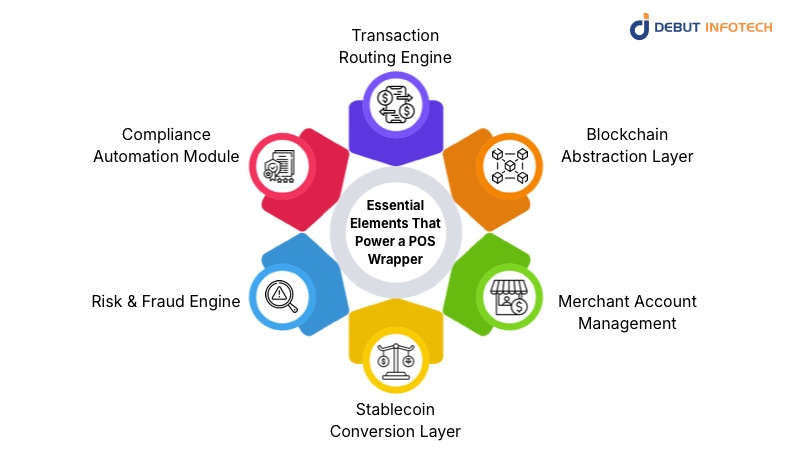
Even though POS wrappers may seem complex, they are simply what makes blockchain payments so easy and quick at the checkout. Here’s what each part does:
- Transaction Routing Engine – Transfers money to the appropriate blockchain channel immediately thereby allowing quick confirmations to merchants.
- Blockchain Abstraction Layer – Makes the on-chain and off-chain transactions simple so that merchants do not see the technical complexity.
- Merchant Account Management – Processes accounts, balances and settlements in a way that crypto payments are fluid
- Stablecoin Conversion Layer – Converts volatile crypto into stablecoins or fiat in real time to protect merchants.
- Risk & Fraud Engine – Ensures the safety of payments by identifying suspicious transactions before they get into the POS.
- Compliance Automation Module – Automates compliance needs such as the KYC and AML, and makes merchants compliant with ease.
The combination of these six building blocks demonstrates how POS wrappers are transforming complex blockchain use cases into a seamless and daily retail payment experience, and thus, making crypto viable at scale.
Why Merchants and Consumers Are Embracing POS Wrappers
POS wrappers make accepting crypto simple for merchants, turning what used to be a complicated process into something almost effortless. Businesses are able to receive lower rates than with traditional credit cards, receive payments faster, and reach a global market of cryptocurrency users, and not have to fear chargebacks.
For consumers, it is easy and convenient to pay using crypto. The transactions are nearly immediate, the fees are kept minimal and certain systems even provide their users with loyalty tokens or on-chain receipts. Payments can also be more private than traditional methods depending on the blockchain.
In a seamless manner by linking merchants to the blockchain, POS wrappers make crypto payments viable, efficient, and enjoyable by all.
Real-World Limitations of POS Wrappers You Need to Understand
Although real-world crypto payments have become easier with POS wrappers, there are a couple of issues to consider, such as businesses that are thinking of blockchain integration more extensively. The following is a basic illustration of what those restrictions would appear like in a typical retail setting:
1. Dependence on Stable Internet Connectivity
POS wrappers require a stable internet connection to connect with the blockchain and payment processing layer. When a store experiences slow network or network failure, a transaction can slow down, may not verify immediately or fall back to manual provision. In the case of busy shopping centers, a couple of seconds of delay can influence the checkout process.
2. Regulatory Uncertainty in Certain Regions
Not every country has definite crypto payments guidelines. Others are still determining how digital assets need to be taxed, tracked or reported. It implies that the businesses that implement POS wrappers might have to remain adaptable and open to new regulations, particularly regarding KYC, AML, and consumer protection.
3. Merchant Education & Training Gaps
Most merchants and store staff are new to blockchain-based payments. Even if the technology feels simple from a customer’s perspective, businesses still need guidance on:
- How to accept payments
- How settlement works
- How refunds or disputes are handled
- How to use the POS wrapper dashboard
Without proper training, even the best tools can feel confusing or underused.
4. Token Price Volatility & Risk Management
While stablecoins solve most volatility concerns, not all customers pay with stable assets. Some may prefer BTC or other tokens that swing in value. POS wrappers must include strong risk-management tools, like instant conversion, to protect merchants from unexpected price drops during settlement.
The Future of POS Wrappers in Web3 Commerce
The way things are going, POS Wrappers won’t just make crypto payments easier, they’re set to reshape how in-store transactions work across modern blockchain platforms.
We are already getting glimpses of the future. AI-enabled fraud detection will assist merchants in identifying suspicious activities before it becomes an issue. Automated reconciliation tools will take the headache out of end-of-day accounting, syncing payments across chains without manual checks.
With the development of POS Wrappers, there will be smooth multi-chain processing, making it possible to accept payments in any wallet or any network without having to juggle multiple systems. The use of universal crypto-to-fiat rails will also be a thing, where businesses can settle in the currency of their choice and with no volatility, no additional steps.
And with central banks exploring CBDCs, POS Wrappers may become the bridge that finally connects traditional finance with Web3, making everyday blockchain transactions feel as simple as tapping a card.
Want a POS wrapper that fuels growth?
Let’s design a tailored solution that boosts revenue and enhances customer loyalty.
Final Thoughts
Blockchain is the future way, yet its practical implementation is achieved when it is simplified to ordinary transactions. That is precisely what POS wrappers introduce to the table; they make the sophisticated blockchain operations feel as a recognizable, rapid, and hassle-free checkout experience.
As more retailers experiment with blockchain-powered payments, one thing is becoming clear: the future belongs to solutions that make advanced tech feel invisible to the end user. And that’s where POS wrappers shine.
If you’re exploring how to bring this future into your business, Debut Infotech is one of the top blockchain development companies leading this transition. Our team develops actual scalable solutions that allow brands to migrate to modern blockchain-ready POS systems, with assurance and clarity, out of their current traditional setups.
The adoption of blockchain is not a trend anymore. With the right partners and tools, it’s becoming a practical upgrade and POS wrappers are paving the way.
Frequently Asked Questions (FAQs)
Q. What is a POS wrapper in blockchain?
A. A POS wrapper works like a translator for payments. It helps traditional point-of-sale systems understand and process blockchain transactions. Merchants don’t need new hardware or any blockchain knowledge. The POS wrapper plugs into their existing setup and handles everything quietly in the background.
Q. How do POS wrappers make blockchain payments faster?
A. POS Wrappers, point-of-sale systems integrated with crypto payment processors, speed up blockchain payments by cutting out unnecessary intermediaries. Rather than going through dozens of confirmations or intermediaries, transactions may flow between the customer and the wallet of the merchant. This enables payments to occur almost instantly and this enables checkout to be fast and smooth to all.
Q. What is layer 2 in blockchain?
A. A Layer 2 blockchain is a network built on top of a main blockchain, like Ethereum (Layer 1).
Rather than executing each of the transactions in Layer 1, Layer 2 executes the vast majority of them off-chain. It packages these transactions and subsequently bankrupts them at the head blockchain.
The method is far faster, lessens expenses, and is more scalable, yet with the added advantage of having the security of the base chain.
Consider it in the following way: Layer 1 is the secure highway that is decentralized. The layer 2 is a speedy expressway that speeds up the transactions and then rejoins them to the main road.
Our Latest Insights


Leave a Comment