



Table of Contents
The ROI of Hiring a Generative AI Consultant for Your Digital Transformation

by

November 17, 2025

by
November 17, 2025
Hiring a generative AI consultant can transform digital transformation efforts into measurable business growth.
According to Deloitte, 85 % of organisations increased their AI spending last year, yet many struggle to turn that investment into profit. A Boston Consulting Group report found that companies that apply AI strategically see up to 2.1 times greater ROI than their competitors.
The difference often lies in execution—how effectively AI is integrated into operations, governance, and workflows. A Generative AI Consultant helps bridge that gap by aligning technology and strategy to deliver sustainable results that enhance efficiency, improve decision-making, and strengthen competitive advantage.
In this piece, we will look into who a generative AI consultant is, what they do, and how they help businesses. Furthermore, we will shed some light on how generative AI consultants drive ROI, how to measure ROI, and how to find the right one for your business.
Drive Innovation Without Overspending
With our tailored AI consulting approach, you’ll see measurable results without wasting time or budget on unnecessary tools.
Who is a Generative AI Consultant?
A generative AI consultant is a professional who helps organizations identify, design, and implement AI-driven systems that can generate content, insights, or solutions. Their work bridges technical expertise and business strategy, ensuring that AI models align with operational goals. They assess data readiness, select the right AI tools, and guide responsible adoption across departments to create measurable business outcomes.
What Do Generative AI Consultants Do?
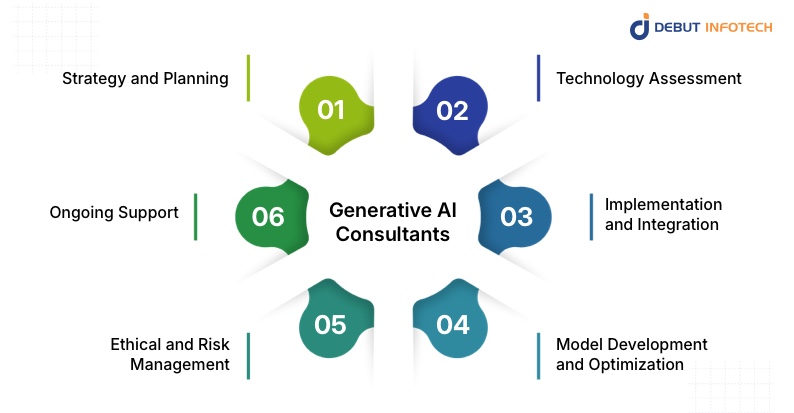
a) Strategy and Planning
Consultants start by defining an actionable roadmap that aligns AI use cases with business priorities. They evaluate where generative models, such as GPT and diffusion models, can add value, helping companies move from experimentation to implementation. Their guidance helps leadership teams make confident, data-backed investment decisions that reduce uncertainty.
b) Technology Assessment
A consultant evaluates the client’s existing digital ecosystem to determine the technical feasibility of integrating generative AI. This includes assessing computing power, data pipelines, APIs, and security frameworks. The goal of generative AI consulting is to identify opportunities for improvement while ensuring scalability and regulatory compliance.
c) Implementation and Integration
Once the plan is set, consultants coordinate deployment by integrating generative AI tools into existing workflows. They ensure smooth compatibility with enterprise systems and streamline human-AI collaboration. The result is a faster transition from traditional operations to automated, intelligent processes that boost output and consistency.
d) Model Development and Optimization
Generative AI consultants design, train, and fine-tune custom models to meet the client’s objectives. They handle data preprocessing, prompt engineering, and model validation, ensuring that outputs are relevant and accurate. Continuous optimization helps maintain performance as data evolves and business needs change.
e) Ethical and Risk Management
Ethical oversight is central to a consultant’s role. They create frameworks that prevent misuse, bias, or data privacy breaches in AI-generated outcomes. This not only safeguards brand reputation but also promotes responsible AI practices that strengthen public trust and regulatory alignment.
f) Ongoing Support
Consultants provide continuous monitoring and improvement after deployment. They track model accuracy, update data sets, and address performance issues. Their ongoing involvement helps organizations adapt as technology and market conditions evolve.
Also Read: 12 Expert Tips for Choosing the Best Generative AI Company
How Generative AI Consultants Help Your Business
1. Improve Customer Experience
Generative AI consultants enhance customer interactions through intelligent chatbots, personalized recommendations, and adaptive content generation. They design systems that analyze customer behavior and intent in real time, allowing businesses to deliver faster, more relevant responses that increase engagement, loyalty, and overall satisfaction across every digital touchpoint.
2. Streamline Operations
Consultants identify areas where manual tasks can be automated through AI-driven tools. By applying natural language models and process automation, they reduce repetitive workloads, eliminate inefficiencies, and simplify document handling, reporting, and communication. This structured automation accelerates output and strengthens operational consistency across teams and departments.
3. Data-Driven Decision Making
Generative AI consultants turn raw, unstructured data into actionable insights using advanced analytics and predictive modeling. They help organizations visualize complex patterns, forecast demand, and optimize strategy. This data-first approach enables business leaders to make informed, timely decisions that minimize uncertainty and improve performance outcomes across multiple operations.
4. Drive Innovation
Consultants introduce generative AI models that spark creative problem-solving and product experimentation. They assist R&D teams in ideation, rapid prototyping, and design simulation. This results in shorter innovation cycles and the discovery of new market opportunities that redefine competitiveness and expand the organization’s capacity for long-term growth.
5. Improve Efficiency
Through system optimization and workflow automation, consultants enable teams to work faster and with fewer errors. They deploy predictive maintenance tools, intelligent scheduling, and adaptive systems that respond to real-time changes. These enhancements lead to streamlined performance, reduced downtime, and greater consistency in service delivery and output quality.
6. Gain Competitive Advantage
Generative AI consultants empower organizations to outpace competitors by deploying custom AI tools tailored to their market needs. Their strategic insights enable early adoption of emerging technologies, faster innovation cycles, and smarter data use. This positions companies as leaders in efficiency, adaptability, and intelligent business operations.
7. Cost Reduction
By automating repetitive processes, consultants minimize labor costs, reduce operational waste, and cut the time spent on low-value tasks. They also optimize infrastructure use and streamline data workflows, helping companies sustain profitability. These combined savings improve financial performance and free resources for strategic investment and expansion.
8. Ensure Responsible Adoption
Consultants guide businesses through ethical generative AI implementation by developing governance models that prioritize transparency, accountability, and compliance. They assess potential risks, monitor data security, and ensure fairness in model outputs. This responsible adoption framework builds stakeholder confidence and supports sustainable, trustworthy AI-driven transformation.
How Generative AI Consultants Drive ROI
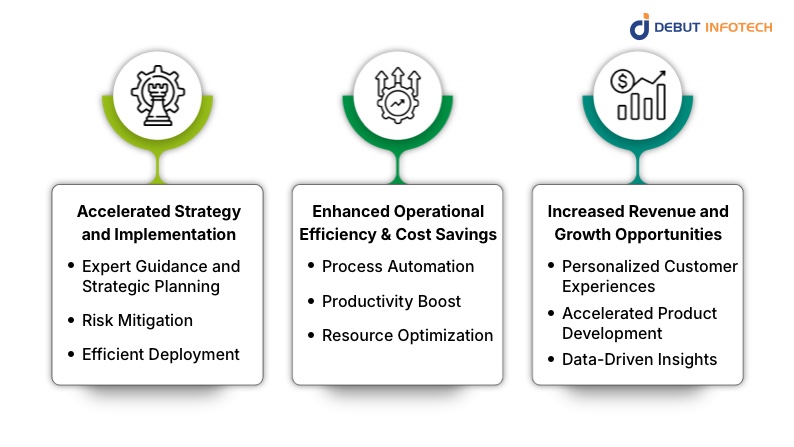
1. Accelerated Strategy and Implementation
a) Expert Guidance and Strategic Planning
Consultants accelerate digital transformation ROI by setting clear, measurable milestones. Their expertise ensures that AI projects stay focused, within budget, and aligned with business outcomes.
b) Risk Mitigation
They assess potential risks—technical, ethical, or operational—and design preventive measures. This reduces the likelihood of costly setbacks during deployment.
c) Efficient Deployment
Consultants streamline workflows, shorten project timelines, and maximize the impact of every resource invested, driving faster time-to-value for AI initiatives.
2. Enhanced Operational Efficiency and Cost Savings
a) Process Automation
By automating repetitive, time-intensive tasks, consultants or generative AI development companies help teams focus on higher-value work. This leads to a measurable increase in productivity.
b) Productivity Boost
Generative AI improves workflow efficiency by providing real-time assistance, reducing workload stress and boosting team morale.
c) Resource Optimization
Consultants identify underused resources and redirect them toward critical functions. This strategic realignment improves both cost-efficiency and output.
3. Increased Revenue and Growth Opportunities
a) Personalized Customer Experiences
AI-generated personalization drives repeat sales and customer retention. Consultants fine-tune models that understand preferences and predict behavior accurately.
b) Accelerated Product Development
Generative AI speeds up design and testing cycles. Consultants help teams prototype faster and move products to market ahead of competitors.
c) Data-Driven Insights
They transform raw data into actionable intelligence, uncovering patterns that reveal new revenue streams and market trends.
Measuring the ROI of a Generative AI Consultant
1. Establish a Baseline
a) Operational Benchmarks
Consultants start by measuring key operational metrics—efficiency, output quality, and process time—to set a baseline for evaluating AI performance.
b) Financial Metrics
They analyze cost structures, revenue growth, and return-on-investment indicators to quantify the financial impact of generative AI projects.
c) Relational Metrics
Beyond numbers, consultants assess client satisfaction, employee adoption rates, and stakeholder engagement to capture non-financial benefits.
2. Define and Calculate Costs
a) Consultant Fees
Costs vary based on project scope and expertise level. Consultants clarify fee structures early to maintain transparency and alignment.
b) Infrastructure Costs
Consultants account for expenses tied to computing power, storage, and licensing. These are integrated into ROI projections for accurate forecasting.
c) Data Preparation
Data cleaning and labeling often demand significant resources. Consultants evaluate these costs upfront to ensure realistic expectations.
d) Training and Maintenance
They factor in continuous model tuning, staff training, and system maintenance to sustain performance over time.
3. Track and Evaluate Benefits
a) Quantitative ROI
Consultants measure generative AI ROI using tangible metrics such as revenue growth, reduced downtime, or faster delivery times.
b) Qualitative ROI
They also evaluate softer outcomes, such as employee satisfaction, innovation capability, and customer trust.
4. Continuously Monitor and Iterate
a) Use Leading Indicators
Monitoring early signals such as engagement rates or model accuracy helps consultants identify opportunities for improvement before issues escalate.
b) Assess Risk
Consultants regularly re-evaluate operational, financial, and ethical risks to maintain compliance and stability.
c) Evaluate Payback Period
They calculate how quickly investments yield measurable returns, ensuring ongoing accountability and strategic refinement.
Before You Begin Your Search For A Generative AI Consultant
Here are some questions you should ask yourself before beginning a search for a generative AI consultant:
1. What business problem are you trying to solve?
Start by identifying the specific challenge you want to address with generative AI. Whether it’s automating workflows, improving customer engagement, or enhancing data analysis, defining a clear problem statement ensures consultants can design targeted solutions that align directly with your strategic and operational priorities.
2. What are your success metrics?
Outline how success will be measured once the AI solution is implemented. Metrics may include time savings, increased accuracy, cost reduction, or improved customer satisfaction. Establishing these benchmarks helps you and your consultant stay focused on quantifiable outcomes and track progress throughout every project stage.
3. What is your budget and timeline?
Determine the financial and time constraints before starting your search. A defined budget ensures the consultant tailors strategies that deliver maximum business value of AI within your means. At the same time, a realistic timeline supports efficient planning, structured implementation, and accountability for delivering measurable results within the agreed schedule.
4. What is your team’s current capability?
Evaluate your team’s readiness to work with generative AI tools and technologies. Understanding internal skills and gaps helps identify whether training, reskilling, or external technical support is needed. This preparation allows consultants to collaborate effectively and ensures smooth integration of AI solutions within your operations.
Key Criteria for Evaluating Generative AI Consultants
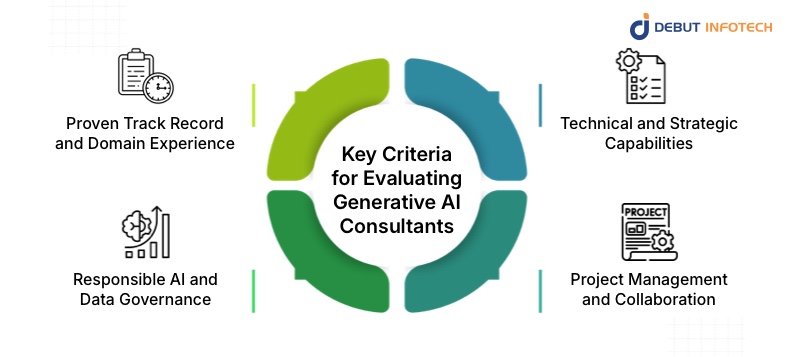
1. Proven Track Record and Domain Experience
A reliable gen AI consultant should have measurable achievements across industries, backed by successful deployments and documented case studies. Their prior experience in implementing generative AI projects—whether in finance, healthcare, or retail—demonstrates practical expertise and adaptability.
Reviewing their track record helps you gauge whether they can replicate similar success within your organization’s specific context and challenges.
2. Technical and Strategic Capabilities
Look for consultants who combine technical mastery with strong business acumen. They should understand data engineering, model tuning, and prompt optimization, and be able to align these technologies with your broader goals. This dual capability ensures that solutions are not only innovative but also strategically positioned to generate measurable business impact and long-term scalability.
3. Responsible AI and Data Governance
A competent consultant or generative AI development company prioritizes ethical AI practices and strict data governance. They implement transparency, fairness, and privacy protocols to minimize bias and prevent misuse of generated content. Their framework should align with global standards such as GDPR, ensuring compliance, stakeholder trust, and sustainable AI operations that uphold regulatory integrity and brand reputation.
4. Project Management and Collaboration
Effective project management defines how smoothly implementation unfolds. Choose consultants who communicate clearly, document thoroughly, and coordinate cross-functional teams seamlessly. They should foster collaboration among technical, operational, and leadership teams to ensure alignment from concept to execution. Strong coordination reduces friction, maintains accountability, and guarantees consistent progress throughout every phase of the project.
Get AI Strategies That Pay Off
Our consultants design practical, revenue-focused AI roadmaps—built to deliver visible impact, not vague promises.
Questions to Ask Potential Generative AI Consultants
1. Business and ROI Focus
Ask how the consultant measures success beyond implementation. A credible expert should link AI outcomes directly to business objectives, such as increased efficiency, reduced costs, or enhanced revenue. Their ability to quantify impact shows whether they understand both the technical and financial dimensions of generative enterprise AI adoption.
2. Strategy and Technology
Evaluate how the consultant balances strategic planning with technical execution. They should articulate how generative AI aligns with your company’s digital AI transformation strategy, goals, infrastructure readiness, and long-term scalability. Clear insight into both areas indicates a structured, adaptable approach to implementing AI solutions that deliver real operational value.
3. Risk and Ethics
Discuss their ethical approach to deploying generative AI. Consultants must outline generative AI frameworks for data privacy, model bias reduction, and compliance with legal standards. Their ability to anticipate and mitigate ethical risks ensures your business maintains integrity while adopting AI responsibly and transparently.
4. Scalability
Ask how their AI solutions can expand as your business grows. Scalable design ensures that tools remain efficient as data volumes, customer base, or use cases increase. Consultants should provide a roadmap showing how systems will evolve without requiring costly overhauls or disrupting existing workflows.
5. Data Integration
Inquire about their approach to integrating AI with your current systems. Consultants should be skilled at connecting APIs, databases, and third-party tools seamlessly. Their technical plan should guarantee smooth interoperability, minimal downtime, and secure data flow, making the transition from legacy systems to AI-driven processes efficient and low-risk.
6. Team and Support
Understand what level of post-deployment assistance they offer. A dependable consultant provides continuous monitoring, model updates, and staff training to maintain peak system performance. Their commitment to long-term support ensures your organization stays competitive and agile as generative AI technologies continue to evolve.
Partnering with a Trusted Generative AI Consultancy
Debut Infotech is a reliable Generative AI consultancy company that helps businesses unlock the measurable ROI of generative AI through practical, results-driven solutions.
We combine deep technical expertise with strategic insight to design AI systems that streamline operations, boost revenue, and drive innovation responsibly. From model development to full-scale implementation, we ensure every AI investment delivers sustained business growth, operational efficiency, and long-term competitive advantage across industries.
Conclusion
Partnering with a Generative AI Consultant ensures your AI strategy delivers consistent, measurable ROI. Beyond technical deployment, they fine-tune processes, strengthen data pipelines, and optimise model performance to meet business goals. Their expertise supports scalability, compliance, and innovation across departments.
With the right consultant, your organisation doesn’t just adapt to AI—it thrives on it. The result is a more agile, efficient, and future-ready business capable of achieving real impact through intelligent digital transformation.
FAQs
Q. What is the 30% rule in AI?
The 30% rule in AI suggests that automating around 30% of a task or workflow delivers strong productivity gains without losing the human touch. It’s a sweet spot—enough automation to save time and money but not so much that it disrupts creativity or decision-making.
Q. What does an AI consultant do?
An AI consultant helps businesses identify where AI can make real improvements. They design strategies, choose tools, train models, and integrate AI systems into workflows. Their goal is to make sure AI solutions align with business goals and deliver measurable value, not just fancy tech demos.
Q. Which language is best for generative AI?
Python is the top choice for generative AI. It’s flexible, well-supported, and includes libraries such as TensorFlow, PyTorch, and Hugging Face that simplify model training and deployment. Other languages like R or JavaScript can work too, but Python dominates because of its community and versatility.
Q. How much do AI consultants charge?
AI consultant rates vary depending on experience and project scope. On average, they charge between $100 and $300 per hour. Some prefer project-based pricing, ranging from $10,000 to $100,000 or more. It all depends on how complex the AI system is and the value it’s expected to deliver.
Q. How generative AI impacts your digital transformation priorities?
Generative AI changes how businesses approach digital transformation. It accelerates automation, enhances creativity, and improves decision-making. Companies shift focus from routine digitization to innovation—building smarter products, personalizing user experiences, and reducing time-to-market. It’s less about adapting to technology and more about using AI to lead change.
Our Latest Insights




Leave a Comment