



Table of Contents
Home / Blog / Web Development
How Much Does SaaS Development Cost?

by

December 10, 2025
by
December 10, 2025
Your SaaS development cost for any product development project can never be fixed.
It depends on many factors, ranging from the geographical location of your preferred development team and the chosen engagement model to the type of SaaS product you want to build and the level of sophistication of the UI/UX design, among many others.
Now, if you prefer not to get into the nitty-gritty of budgeting, you could just request a free consultation with our expert Enterprise Software Development team at Debut Infotech Pvt Ltd, and they would give you a full cost breakdown for your unique SaaS product idea.
But if you’re interested in looking at the backend and capitalizing SaaS development costs yourself, then this article was written with you in mind. We’ve broken down each cost factor and provided potential dollar values to help you make an educated guess.
Grab a calculator.
Need a rough estimate for SaaS development costs?
Contact our SaaS development experts at Debut Infotech Pvt Ltd to share your concept and get professional insights on realistic budgets, timelines, and the best technology stack for your project.
Factors That Determine SaaS Development Cost
To help you get a rough idea of how much it’ll cost to produce that SaaS product idea you have, we’ll walk you through a list of factors that contribute to the final value.
Below, we have highlighted a number of factors ranging from where your team is located to how complex your product becomes.
Let’s start with one of the biggest variables: geography.
1. Geographical Location of the Development Team
Where your development team is based has a major influence on your overall SaaS development cost. The major reason for this is that labor rates differ widely around the world. This difference stems from a range of factors, including differences in living costs, taxes, and demand for technical talent.
To give you some more perspective, the table below gives you a quick look at average hourly rates in key regions:
| Region | Average Hourly Rate (USD) | Example Countries |
| North America | $100 – $200/hour | USA, Canada |
| Western Europe | $70 – $150/hour | UK, Germany, France |
| Eastern Europe | $40 – $70/hour | Poland, Ukraine, Romania |
| Asia | $25 – $60/hour | India, Vietnam, Philippines |
| Latin America | $35 – $65/hour | Brazil, Argentina, Mexico |
I’m sure you’re already seeing how these average hourly rates contribute incrementally to the final cost. Let’s say your SaaS product idea requires a 1000-hour SaaS MVP build. That means, depending on technical talent from the US, you’ll need to allocate about $150,000–$200,000 to employee costs and about $50,000–$80,000 in Eastern Europe.
Notice the significant differences?
It’s almost enough to determine whether a startup can launch this quarter or needs to delay until next year.
But cost isn’t everything.
Factors such as communication, time zones, and cultural alignment can also come into play. This is because working with a team halfway across the world can slow decision-making, leading to additional costs to keep things running.
2. Team Type or Engagement Model
The next major factor influencing your SaaS development costs is the type of team or engagement model you choose. This decision isn’t just about choosing who gets to write the code. It’s more about shaping your entire budget and determining how efficiently your product gets to market.
To give you a better idea of how team types and engagement models influence your SaaS development cost, here’s a quick snapshot of the average costs associated with common team types:
| Team Type / Model | Average Cost Range (USD) | Typical Scenario |
| In-house team | $200,000 – $400,000 per year | Salaried developers, benefits, and office overheads |
| Freelancers | $25 – $120/hour | Flexible hiring but less predictable coordination |
| Outsourced SaaS development company | $50,000 – $200,000 per project | Turnkey teams handling full product builds |
| Dedicated offshore team | $40 – $80/hour | Long-term collaboration with lower regional rates |
Now, how does this impact your bottom line?
An in-house team gives you total control, but it’s also the most expensive route because you have to incur additional costs such as benefits, office overheads, and steady salaries, regardless of each personnel’s productivity most of the time. On the other hand, freelancers have lower upfront costs but can raise management and quality risks.
However, if you choose to outsource to a custom software development company Debut Infotech Pvt Ltd, you can capitalize custom SaaS solutions costs more effectively. This is because this model offers structure, accountability, and lower hourly rates, all without the long-term overhead.
What we are saying, effectively, is that an engagement model could be the reason you spend either $70,000 or $300,000 on the same SaaS platform.
3. Type of SaaS Product
All SaaS products do not have the same level of sophistication. As such, the type of SaaS product you’re building and the amount of functionality it includes play a major role in the overall development cost. When you develop different types of SaaS software—whether it’s a simple tool or a complex enterprise system—the pricing can vary significantly. In fact, the difference between a basic SaaS tool with limited features and a full-scale enterprise platform built through SaaS platform development or SaaS product development can often run into hundreds of thousands of dollars.
Here’s a quick breakdown to give you some perspective:
| SaaS Type | Average Development Cost (USD) | Examples |
| Simple SaaS Tools | $30,000 – $80,000 | Note-taking apps, scheduling tools |
| Mid-level SaaS Platforms | $80,000 – $150,000 | CRMs, e-learning systems, and collaboration apps |
| Complex / Enterprise SaaS | $200,000 – $500,000+ | ERPs, AI-driven analytics, finance or healthcare platforms |
Therefore, it is safe to say that adding more layers of functionality to your product increases the impact on the overall bottom line. And that is because more features require more development hours, more testing procedures, and even more integrations with third-party systems.
So what should you do?
Our dedicated software development team advises startups to start lean with only a functional MVP when validating an idea. Next, they recommend testing this MVP with a few users to confirm the idea’s validity. And once you’re sure the market wants your idea, you can then start building a larger-scale product. That’s when you should expect a bigger budget and longer timelines.
At the end of the day, the cost of developing a SaaS platform increases as your project idea becomes more complex. The key to maintaining balance lies in understanding where your product fits in that spectrum so you can plan strategically.
4. UI/UX Design
If there’s one area many founders underestimate in their budgeting, it’s design. Yet, it’s one of the clearest cost drivers in any SaaS project.
So why does UI/UX design contribute significantly to your overall SaaS development cost?
This is because user adoption and revenue depend heavily on your product’s UI/UX design. Even if your product has a strong codebase and perfect logic, if users find it difficult to comprehend and navigate, fewer people will want to use it, which is a waste of money.
As a result, UI/UX demands a precise fusion of technical proficiency, psychology, and creativity. This can be costly.
To put things in terms of numbers, the table below highlights what typical design investments look like:
| Design Scope | Average Cost Range (USD) | Description |
| Basic / Template-based | $3,000 – $10,000 | Simple interface, limited customization |
| Custom UI/UX | $15,000 – $40,000 | Tailored layouts, original graphics, and user flow testing |
| Advanced / Enterprise | $50,000+ | Complex dashboards, animations, and accessibility features |
So, how does this play into your overall budget?
If you need a SaaS product that is more polished and interactive, then you should be willing and ready to incur higher costs. This is because UI/UX designers have to do more and better wireframing, user testing, and prototype refinements to get the best version.
But here’s the trade-off: if you invest in all these components of a great design early, you eventually end up saving more money in the long run because your product is likely to experience fewer support tickets and less rework, and most importantly, you get to retain users for longer.
5. Technology Stack and Integrations
The technology choices behind your SaaS product are another silent factor that can either tighten or stretch your budget. You see, every programming language, framework, and integration you choose has its own price tag — not just in tools and licenses, but in the kind of expertise required to make it all work.
So, how does your tech stack influence your SaaS development cost?
Certain tech stacks are more interoperable and sophisticated than others. For instance, NodeJS and React have sizable development ecosystems and are more widely used. Building a SaaS product using these technologies would therefore be comparatively less expensive than using more specialized tech stacks, such as machine learning with Python or even enterprise cloud solutions like Kubernetes or AWS Lambda.
Here’s a rough idea of how tech stack and integration choices can affect your budget:
| Technology Scope | Average Cost Range (USD) | Description |
| Basic Stack | $30,000 – $70,000 | Common tools like React, Node.js, MySQL |
| Intermediate Stack | $80,000 – $150,000 | Mix of modern frameworks, APIs, and cloud hosting |
| Advanced Stack | $200,000+ | AI, data analytics, or multi-cloud infrastructure |
Integrations such as CRM connections, analytics tools, and external APIs also factor into the equation.
Therefore, as a founder or decision-maker, you should choose your technology strategically, with strong consideration for your budget, not just on technical grounds. This is the only way for you to build something solid without unnecessarily inflating your cost of developing a SaaS platform.
Related Read: Common Challenges in SaaS Development: How to Protect Your Business and Ensure Growth
6. Security and Compliance
While security and compliance are among the most vital necessities of any SaaS product, some founders, out of enthusiasm and naivety, often underestimate them as major cost drivers.
Don’t be like them.
So why do they matter so much?
Because a single breach can cripple your reputation and drain your finances faster than any marketing mistake ever could.
So, how much impact do security and compliance have on overall costs?
The truth is, it varies depending on the kind of SaaS platform you’re building. For instance, a simple internal app won’t need the same level of protection as a healthcare SaaS product handling patient data. But the more sensitive your users’ data is, the more you’ll spend on compliance and testing.
The good news? Investing in security early often saves you far more in the long run. Retrofitting protection after launch is almost always more expensive. It’s like buying insurance — you hope you’ll never need it, but when you do, it could be the one thing keeping your business afloat.
7. Additional Cost Influencers
Sorry to break it to you, but you don’t get to stop investing in your SaaS product after launch. In fact, you need to keep it alive, secure, and relevant, and that costs money.
Here’s why:
Launching your SaaS means preparing servers, optimizing performance, and making sure everything works seamlessly for real users. And when you’re done with that, you need to implement regular updates and bug fixes, introduce new features based on the demands of your users, scale your current infrastructure as the user base grows, and support your customers with any issues they face.
Sounds like a lot, doesn’t it? It is, and you need to set a portion of your budget aside for that.
Wondering how much?
The general rule of thumb is that ongoing maintenance costs should range from 15% to 25% of the initial SaaS development cost each year.
Here’s what typically falls under those recurring costs:
- Server and hosting fees
- Bug fixes and performance optimization
- Feature updates and UI improvements
- Technical support and user management
- Security patches and version upgrades
All these things keep the SaaS product running smoothly and, in turn, keep you from incurring even larger costs fixing anything that breaks due to a lack of maintenance.
How to Minimize SaaS Development Costs
Now you know the major factors that determine your overall SaaS development cost. And I must agree, it might feel a bit overwhelming. But here at Debut Infotech Pvt Ltd, we focus on helping prospective SaaS builders like you get the best of both worlds: high-quality products and affordable pricing.
Over the years, we have been helping businesses build awesome products for the right price, and the following are some of our most effective tips and tricks for beating down the SaaS development cost.
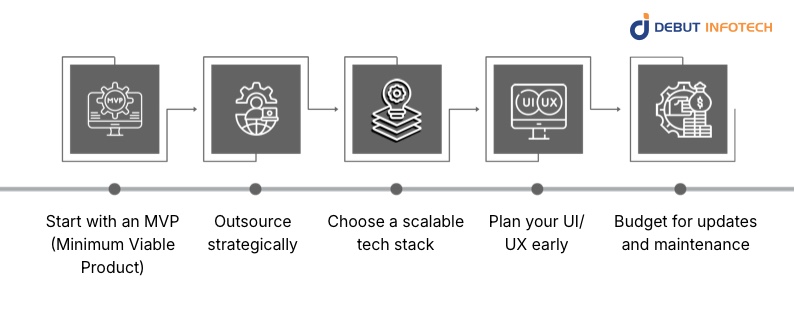
1. Start with an MVP (Minimum Viable Product).
Build only what’s necessary to test your idea and attract early users. This helps you validate your concept before investing heavily.
2. Outsource strategically.
Partnering with reliable offshore SaaS development companies like Debut Infotech Pvt Ltd can reduce expenses by up to 50% while maintaining quality and speed. This is also where choosing to hire SaaS developers with the right expertise can significantly impact your efficiency and cost structure.
3. Choose a scalable tech stack.
Pick technologies that are stable, well-documented, and easy to maintain. This prevents costly rebuilds later.
4. Plan your UI/UX early.
A clear design direction saves hours of rework and reduces development cycles — two things that quietly inflate your SaaS development cost.
5. Budget for updates and maintenance.
Treat post-launch expenses as part of your development plan, not an afterthought.
Managing your resources this way allows you to capitalize SaaS development costs wisely — ensuring every dollar you spend contributes directly to growth.
Ready to build your SaaS product?
Reach out to our SaaS development experts at Debut Infotech Pvt Ltd to start developing your custom SaaS platform with the right technology, timeline, and cost strategy.
Conclusion
As you’ve seen, your total SaaS development services cost depends on several moving parts, from where your team is located and the engagement model you choose to the type of product, its complexity, and the quality of design and security you build in. Each decision has a price tag, but with smart planning, those costs become investments that pay off in the long term.
If you’re ready to bring your SaaS application development idea to life, Debut Infotech Pvt Ltd can help. Our team of experienced developers and project strategists can analyze your idea and provide a unique, personalized price quote so you can start development right away, with clarity, precision, and confidence.
Get in touch today!
Frequently Asked Questions (FAQs)
Q. How much does SaaS software development cost?
A. For mid-level platforms, the typical cost to establish a SaaS application is between $50,000 and $250,000. Complex business solutions with cutting-edge security and integrations might cost more than $500,000. The final cost of SaaS development is influenced by several factors, including team location, design quality, and the technology stack.
Q. How much does it cost to implement SaaS?
A. The cost of implementation typically ranges from $20,000 to $100,000, depending on the breadth and complexity. This includes training, data migration, customisation, and integration with current systems. The cost of implementation increases with the customization of your system.
Q. What are 5 common startup costs?
A. Product development, UI/UX design, marketing, legal and compliance fees, and operations (hosting, support, admin) are typical startup expenditures. Development and marketing typically account for the majority of launch costs for SaaS businesses.
Q. Can SaaS development costs be capitalized?
A. Yes, in accordance with specific accounting rules. While research and planning expenses must be expensed immediately, costs directly related to software development, such as coding, testing, and implementation, can often be capitalized. For correct treatment, it is best to speak with a financial advisor.
Q. How long does it take to develop a SaaS platform?
A. Depending on complexity, different timelines apply. A full-scale SaaS application with sophisticated features may take 9 to 12 months or longer, whereas a basic MVP might take 3 to 6 months. How quickly you can launch depends on several factors, including team size, scope, and technology stack.
Our Latest Insights

Leave a Comment