



Table of Contents
The Must-Have Skills Every Remote Developer Needs by 2026

by

December 6, 2025

by
December 6, 2025
With the rapid growth of the digital economy, demand for skilled developers is expected to skyrocket, particularly for those who work remotely. Business organizations globally are increasingly interested to hire remote developers capable of working together, innovating, and providing quality digital solutions without necessarily being restricted by geographical location. Remote development is no longer a short-term trend, even for startups, but has become the new bedrock of software innovation around the world.
The remote developer world will exist in a future characterized by sophisticated technology piles, automation instruments, and cloud-native development patterns by 2026. The victory in this sphere will require mastery of technical and soft skills, as well as a thorough grasp of the latest technologies, including AI, blockchain, and AR/VR. This guide will discuss the necessary developer skills and abilities to become a computer programmer in the new age of digital revolution, and how global firms, such as Debut Infotech, can leverage teams with knowledge in custom software development services.
Transform Your Digital Vision with Global Expertise
Partner with Debut Infotech’s skilled remote developers to build scalable, secure, and high-performing software solutions.
The Changing Landscape of Remote Development
The shift toward distributed teams has redefined how developers work and collaborate. Organizations now focus on agility, scalability, and access to global talent pools. With cloud-based tools, real-time communication platforms, and digital project management systems, developers can contribute from anywhere in the world.
The rise of countries to hire remote developers, such as India, Poland, Ukraine, and the Philippines, has further diversified the industry. These countries offer world-class technical education, cost-efficient collaboration, and time zone flexibility — making them preferred destinations for businesses seeking dedicated software development teams.
By 2026, the global software market will expect developers to combine coding mastery with adaptability. They must not only write clean code but also understand business needs, automate workflows, and contribute to product strategy.
Core Technical Skills Every Remote Developer Must Master
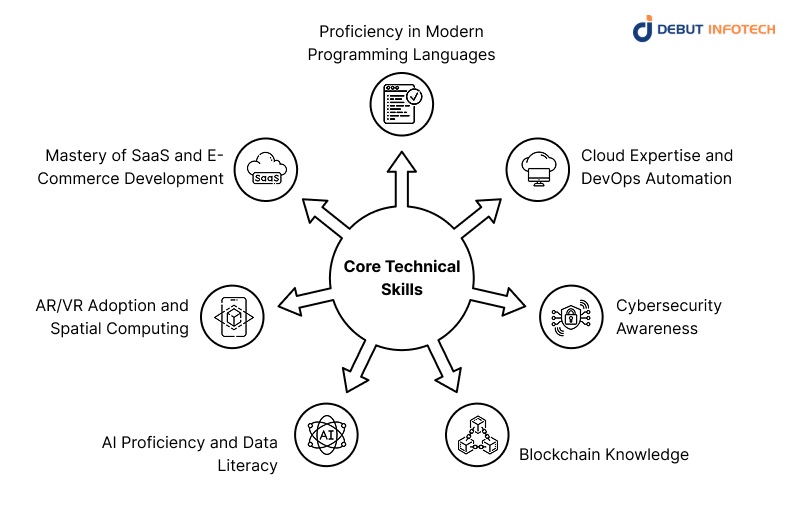
To stay competitive, remote developers must continually refine their development skills and remain aligned with evolving developer trends. Below are the most critical technical abilities shaping the future of software development.
1. Proficiency in Modern Programming Languages
Every developer should have a strong command of core languages like JavaScript, Python, Java, and C#. However, new frameworks and runtime environments are constantly emerging, requiring continuous learning and adaptation. Developers focusing on progressive web development and mobile web app development should master frameworks such as React, Vue.js, Angular, and Flutter.
In addition, server-side technologies like Node.js, Django, and Laravel will remain vital for scalable and secure application architecture. The abilities needed to be a computer programmer extend beyond syntax — they involve understanding performance optimization, error handling, and integration with APIs.
2. Cloud Expertise and DevOps Automation
Cloud computing is the backbone of modern remote development. Developers must have deep familiarity with cloud platforms such as AWS, Azure, or Google Cloud. Knowledge of containerization (Docker, Kubernetes) and CI/CD pipelines is essential for seamless deployment and version control.
DevOps automation reduces manual workloads, ensuring continuous integration and smooth software delivery — crucial for globally distributed teams. By mastering cloud-native development, developers enhance scalability, security, and resilience across applications.
3. Cybersecurity Awareness
With remote work expanding the digital attack surface, cybersecurity is no longer optional — it’s a necessity. Developers need to build applications with security-first architecture, incorporating practices like encryption, secure authentication, and vulnerability testing.
Understanding OWASP guidelines, implementing zero-trust models, and staying up to date with data privacy regulations are key competencies. Businesses that offer custom software development services prioritize hiring developers who integrate security into every stage of the web application development lifecycle.
4. Blockchain Knowledge
By 2026, blockchain technology will be a standard part of decentralized applications (DApps), supply chain systems, and digital finance. Developers should understand concepts like smart contracts, distributed ledgers, and consensus algorithms.
Whether working with DeFi ecosystems or developing tokenized assets, blockchain-savvy developers will be essential for enterprises adopting transparency and automation in their digital systems. Many web development companies are already investing in blockchain platforms to expand their innovation footprint.
5. AI Proficiency and Data Literacy
Artificial Intelligence (AI) is transforming software across industries — from chatbots and recommendation engines to predictive analytics and automation. Developers who can build, train, and deploy machine learning models will be highly sought after.
For instance, businesses looking to hire remote AI developers will value candidates proficient in TensorFlow, PyTorch, and OpenAI frameworks. Additionally, understanding data processing, model evaluation, and algorithm ethics will help developers design smarter and fairer applications.
6. AR/VR Adoption and Spatial Computing
The convergence of physical and digital worlds is accelerating through augmented reality (AR) and virtual reality (VR). By 2026, AR/VR integration in e-learning, retail, and gaming will become mainstream.
Remote developers specializing in AR/VR adoption should understand Unity, Unreal Engine, and WebXR standards. Combined with strong UI/UX principles, these skills enable immersive user experiences that drive engagement and brand differentiation.
7. Mastery of SaaS and E-Commerce Development
The global shift to subscription-based software means developers must be comfortable building and maintaining SaaS development platforms. This includes integrating APIs, managing user authentication, and optimizing multi-tenant architectures.
Similarly, e-commerce website development remains a vital domain where developers implement secure payment gateways, inventory systems, and personalized shopping experiences. Mastery in these areas ensures alignment with business models that rely on recurring revenue and customer retention.
Key Soft Skills for Remote Developers
Technical brilliance may get a developer hired, but soft skills are what make them thrive in remote environments. In distributed teams, collaboration, communication, and adaptability often determine long-term success. These skills bridge the gap between individual performance and collective innovation.
1. Effective Communication
In a remote setup, clarity is king. Developers must articulate their thoughts concisely through documentation, emails, code comments, and virtual meetings. The ability to explain complex technical details in simple terms ensures that everyone — from project managers to non-technical stakeholders — stays aligned. Strong written and verbal communication not only reduces misunderstandings but also fosters trust across geographically diverse teams.
2. Time Management and Accountability
Remote developers enjoy flexibility, but that freedom comes with responsibility. Managing time efficiently and maintaining consistent output without direct supervision reflects professional discipline. Setting clear daily goals, using productivity tools, and tracking milestones are essential habits. Accountability—owning one’s results and meeting deadlines—becomes a defining factor of reliability in distributed teams.
3. Collaboration Across Tools
Modern development teams rely on digital ecosystems to stay connected. Mastery of platforms like GitHub, Jira, Trello, Slack, and Notion enables seamless coordination, real-time feedback, and transparent progress tracking. Effective collaboration also means knowing when to ask for help, proactively share updates, and contribute meaningfully to group problem-solving. Remote developers who embrace these collaboration tools become integral to the team’s workflow, not just contributors.
4. Continuous Learning and Adaptability
The tech landscape shifts faster than ever. Frameworks evolve, programming paradigms change, and new tools emerge constantly. Successful remote developers stay curious — engaging in self-learning through online courses, open-source contributions, and community discussions. Adaptability ensures they remain relevant even when project requirements or technologies pivot unexpectedly. Those who invest in learning not only future-proof their careers but also bring innovation to their teams.
5. Emotional Intelligence and Empathy
In remote teams, tone and context can easily be lost in text-based communication. Emotional intelligence (EQ) helps developers navigate interpersonal dynamics with empathy and patience. Recognizing teammates’ challenges, respecting cultural differences, and maintaining a positive, solution-oriented attitude strengthen team cohesion. Developers who lead with empathy help create a supportive virtual environment where creativity and collaboration can thrive.
6. Problem-Solving and Initiative
Remote environments often require independent decision-making. Developers who can identify issues early, troubleshoot efficiently, and propose actionable solutions are invaluable. Initiative — the willingness to take ownership without being told — demonstrates leadership potential. Whether it’s optimizing code or suggesting workflow improvements, proactive problem-solvers stand out as dependable team members.
7. Adaptation to Asynchronous Workflows
Since remote teams frequently operate across time zones, asynchronous communication becomes the norm. Developers must learn to document updates thoroughly, leave actionable comments, and ensure progress continues even when others are offline. Embracing asynchronous workflows promotes smoother handoffs, reduces meeting fatigue, and maximizes productivity around the clock.
The Emerging Role of Dedicated Remote Teams
As enterprises scale their digital presence, many are opting to hire remote developers through established outsourcing partners or dedicated software development teams. These teams function as extensions of internal departments, handling specialized projects like SaaS development, progressive web development, or mobile web app development.
Benefits of Hiring Dedicated Remote Teams
- Cost Efficiency: Hiring developers from cost-effective regions reduces web application development cost while maintaining quality. It also reduces overhead costs such as office space and infrastructure, allowing businesses to allocate savings toward innovation and product growth.
- Access to Expertise: Remote hiring opens access to a global pool of specialists in emerging technologies such as AI, blockchain, and AR/VR. This ensures businesses can find the exact skills they need for complex projects, regardless of location.
- Scalability: Remote teams can easily expand or contract based on project demands, keeping operations flexible and efficient. This scalability supports both short-term and long-term goals without unnecessary hiring delays.
- Continuous Delivery: With developers spread across different time zones, work continues around the clock. This 24/7 cycle enables faster project turnaround, constant updates, and quicker time-to-market.
Leading Countries to Hire Remote Developers
| Region | Strengths | Specializations |
| India | Large talent pool, cost-effective | Blockchain, AI, SaaS |
| Ukraine | Strong tech education | Web development, cybersecurity |
| Poland | EU compliance, high English proficiency | Enterprise software, mobile apps |
| Philippines | Excellent communication skills | Front-end, QA testing |
| Brazil | Time zone alignment with the Americas | Cloud solutions, DevOps |
Tech Stack for Web Development in 2026
The tech stack for web development continues to evolve, emphasizing modularity, scalability, and performance. Remote developers must be comfortable working across multiple layers — from front-end frameworks to back-end infrastructures.
| Layer | Tools & Frameworks | Purpose |
| Front-End | React, Vue.js, Angular, Svelte | User interface development |
| Back-End | Node.js, Django, Laravel, Ruby on Rails | Application logic and APIs |
| Database | PostgreSQL, MongoDB, Firebase | Data management |
| DevOps | Docker, Jenkins, Kubernetes | CI/CD and deployment |
| Cloud | AWS, Azure, Google Cloud | Scalability and infrastructure |
| Security | HashiCorp Vault, OWASP tools | Application protection |
Mastery of this ecosystem helps developers transition smoothly between projects while maintaining code quality and reliability.
Developer Trends Shaping 2026 and Beyond
The next few years will bring unprecedented innovation in software engineering. Developers must be proactive in embracing developer trends that define modern digital ecosystems:
- AI-Augmented Coding: AI-powered tools, such as code assistants, will enhance productivity.
- Decentralized Applications (DApps): Blockchain integration will make DApps a mainstream alternative to centralized platforms.
- Low-Code/No-Code Collaboration: Developers will increasingly collaborate with non-technical users via drag-and-drop environments.
- Quantum Computing Awareness: Early understanding of quantum-safe algorithms will prepare developers for future challenges.
- Sustainability in Tech: Green software engineering practices will gain traction as organizations aim for energy-efficient coding and hosting.
How Debut Infotech Supports the Future of Remote Development
At Debut Infotech, we understand that building future-ready applications requires more than just coding skills — it demands innovation, adaptability, and vision. As a leading blockchain development company and provider of custom software development services, we empower enterprises to embrace cutting-edge solutions across diverse industries.
Our expertise spans DApp development services, SaaS platforms, e-commerce website development, and mobile web app development — all backed by a dedicated software development team skilled in cloud architecture, security, and automation. Whether you’re looking to hire remote AI developers or assemble a team for progressive web development, Debut Infotech delivers scalable and secure digital transformation.
Benefits of Upskilling for Future-Ready Developers
Developers who continually evolve their skill sets gain multiple long-term advantages:
- Higher Employability: Professionals with advanced technical and remote skills attract more opportunities from global organizations. Their adaptability and cross-platform expertise set them apart in competitive markets.
- Innovation Leadership: Developers proficient in next-gen technologies can actively contribute to cutting-edge projects, positioning themselves as innovators and thought leaders within their fields.
- Better Compensation: Companies are increasingly willing to offer premium pay and flexible benefits to secure top-tier talent with in-demand development skills and proven remote experience.
- Career Longevity: Continuous learning and tech upskilling keep developers relevant in an ever-evolving industry. Staying ahead of trends ensures long-term career stability and growth.
- Global Recognition: By collaborating on international projects, remote developers gain exposure, build diverse portfolios, and strengthen their professional credibility worldwide.
By 2026, the difference between a good developer and a great one will depend on how deeply they understand the interplay between technology, business needs, and user experience.
Stay Ahead in the Remote Tech Revolution
Hire top-tier developers with proven expertise in AI, blockchain, SaaS, and cloud systems from Debut Infotech.
Conclusion
The world of remote development is evolving at lightning speed, blending technology with global collaboration like never before. To remain competitive, developers must master both technical depth and strategic agility. The future belongs to those who can balance cloud expertise, AI proficiency, blockchain knowledge, and cybersecurity awareness — while maintaining clear communication and adaptability in distributed work environments.
For businesses aiming to hire remote developers or build advanced digital products, the key lies in partnering with the right experts. Debut Infotech continues to lead this transformation, helping organizations develop resilient, future-ready systems through world-class custom software development services and innovative remote team models. As we approach 2026, these must-have skills will not just define successful developers — they will shape the future of the global tech ecosystem.
Frequently Asked Questions
Q. What are the top skills for remote developers in 2026?
By 2026, remote developers will need strong expertise in cloud computing, AI and machine learning, cybersecurity, blockchain technology, and SaaS development. In addition to these technical skills, communication, collaboration, and time management are equally essential to succeed in distributed work environments.
Q. Why are soft skills important for remote developers?
Soft skills ensure smooth coordination within global teams. Since remote developers work across time zones and cultures, clear communication, adaptability, and accountability help maintain productivity and trust across virtual teams.
Q. Which programming languages should remote developers focus on?
Developers should prioritize JavaScript, Python, TypeScript, and Rust for versatility and scalability. For web and mobile projects, mastering frameworks like React, Vue.js, Node.js, and Flutter is vital to meet future custom software development services demand.
Q. How can developers stay updated with new technologies?
Remote developers can stay ahead by continuously engaging in tech upskilling, joining online developer communities, and contributing to open-source projects. Keeping pace with developer trends like AI automation, blockchain adoption, and progressive web development ensures long-term relevance.
Q. What makes cloud and DevOps skills so critical for remote work?
Cloud and DevOps automation streamline collaboration, deployment, and scalability for distributed teams. Developers with experience in AWS, Azure, or Google Cloud can build reliable, high-performing applications that reduce downtime and accelerate delivery cycles.
Q. How can companies benefit when they hire remote developers?
Businesses that hire remote developers gain access to global talent, cost-effective development, and 24/7 productivity. This model supports faster delivery, flexibility in scaling teams, and the ability to build specialized solutions like e-commerce website development or SaaS platforms.
Q. Why choose Debut Infotech for remote development projects?
Debut Infotech stands out as a trusted blockchain development company and leader in custom software development services. Their dedicated teams specialize in AI, blockchain, cloud, and web development — empowering enterprises to innovate efficiently and future-proof their digital operations.
Our Latest Insights



Leave a Comment