



Table of Contents
Why Businesses Are Turning to Hybrid AI for Smarter & Transparent Automation

by

December 9, 2025

by
December 9, 2025
A few years ago, businesses rushed to automate everything with AI from customer service to decision-making. The promise was simple; faster, smarter systems that could run on their own. But over time, many teams hit the same roadblock, their AI could analyze data, yet it couldn’t reason through it. It could predict outcomes, but not explain them.
That gap led to the rise of Hybrid AI, a more balanced approach that blends the pattern-recognition power of machine learning with the structured logic of rule-based systems. The result? Automation that not only works smarter, but also makes sense.
Hybrid AI introduces a sense of context, transparency, and flexible thinking to businesses that they were lacking. It enables systems to make intelligent and reliable decisions whether it is in the diagnosis of a medical condition, fraud prevention, or in the area of logistics.
In this post, we will unravel what is unique about Hybrid AI, why it is addressing the largest pain points of automation, and explain why progressive organizations are betting on it to determine the future of intelligent operations. Let’s dive in!
What Is Hybrid AI?
Suppose you are solving a complicated problem. There are instances when you have a set of rules or guidelines to guide you to the right direction such as having a map to direct you on how to move from point A to point B. That is Symbolic AI, which is everything about adhering to clear and logical rules. Just suppose, too, that you can learn to watch what goes on around you, to see what patterns there are, and change your mode of approach. That is Machine Learning (ML), where the system gets to learn and gets better as it gains experience.
Now, Hybrid AI combines these two. It is a combination of the two best worlds, the consistency of rules and reasoning and the adaptability of learning through data. Combining the two methods develops an AI that is capable of reasoning, adapting, and smarter decision-making.
Related Read: AI for Startups: Exploring Use Cases, Technologies and Benefits
Here’s how it works:
- Symbolic AI assists AI to adhere to pre-set rules and interpret information. It works well when making decisions that need to be open and based on clear reasoning.
- Machine Learning (ML) assists AI to learn by experience, identify patterns, forecast results and improve with practice. However, individually, ML is not always clear as to why a decision was taken.
Making them work together in Hybrid AI results in a system that is not only intelligent but also understandable. It is able to make logical decisions based on reasoning, and it is able to learn by experience in the real world to get better with time.
To illustrate this, we will use the example of a customer service bot being asked a question that it does not know how to respond to. It will make use of Symbolic AI to abide by the rules and give the most appropriate reply it can. When it continues to fail, Machine Learning comes in, and it learns, and increases the behavior of the AI chatbot in future times. In the long run, this translates to reduced mistakes and more useful and correct answers.
Ready to fuse human expertise with AI automation?
Our Hybrid AI solutions blend strategic insight with intelligent tech for unmatched accuracy and adaptability.
Why Are Businesses Turning to Hybrid AI?
The idea of Hybrid Intelligence is being found valuable by more and more businesses, and it’s not hard to understand why. The following is what is fueling the change:
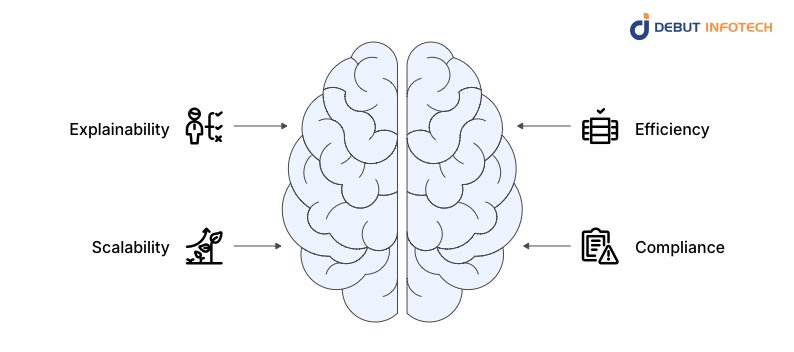
Explainability: This is one of the largest puzzles surrounding the use of AI, as it is not well understood how decisions are made. In Hybrid AI, businesses can easily find out the reasons why a decision was made due to the fact that it uses both machine learning and rule-based logic. This does not only make AI systems smarter, but more transparent as well and that is what companies require, particularly in complex decisions.
Efficiency: Hybrid AI is the ideal collaboration of logic and learning. Machine learning is able to evolve as time passes, yet it can be resource intensive. Combining it with symbolic AI businesses have the best of the two worlds; they can have powerful data-driven insights without paying the cost of high compute that is associated with systems purely based on machine learning. It’s a win-win for efficiency!
Scalability: No matter what industry you are in, Hybrid AI has the ability to scale across all departments without problems. Consider a scenario where the AI system has the ability to take care of payroll records and customer queries, among other things and learns and evolves in real time. That is what Hybrid AI is all about, it can be easily scaled as your business expands.
Compliance: As new rules such as the AI Act come into effect, companies should be capable of justifying the decisions of their AI. Hybrid AI assists in this, so as to give definitive reasoning to all decisions. This simplifies the auditing AI systems and keeps companies on the right side of the law particularly in regards to transparency and accountability.
Real-World Hybrid AI Applications Across Industries
Hybrid AI isn’t just a buzzword, it is quietly transforming the way industries operate as a whole, as well as making automation more human, reliable, and flexible. Let us consider the various industries that are utilizing this powerful artificial intelligence technology.
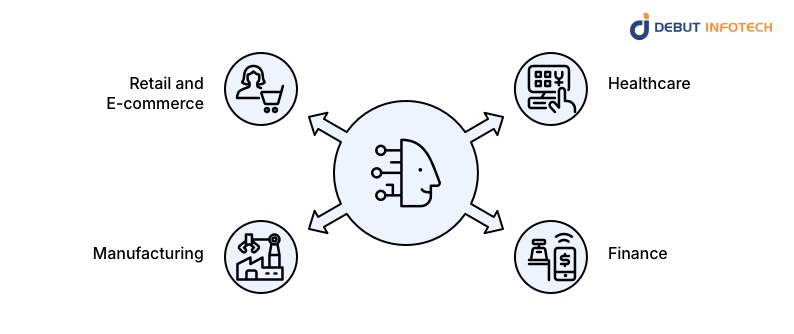
Healthcare
Think of a doctor applying medical intuition and accurate data insights to make a diagnosis, that is how Hybrid AI can be applied to healthcare. Doctors can arrive at conclusions faster and more accurately by using machine learning (reading medical pictures) to complement rule-based reasoning (symptom checking and patient history). Naturally, such systems are also required to comply with high privacy standards such as HIPAA and GDPR to ensure the safety of patient data.
Finance
Hybrid AI is helping banks and fintech platforms to keep one step ahead of fraud. Machine learning models compare the abnormal patterns in transactions whereas rule-based systems determine whether the activity violates compliance rules. This two-layered security can assist financial institutions to be trustful and transparent according to regulations, like PCI DSS and SOC 2.
Manufacturing
Imagine a factory where machines are capable of knowing when they require a tune up. Under Hybrid AI, predictive maintenance becomes even more than simple warnings, systems can make decisions regarding the operations data and determine when the intervention is required in reality. The result? Less breakdowns, reduced downtime and smooth operations.
Retail & E-commerce
In e-commerce, Hybrid AI can assist brands to learn more about customers without stepping over ethical boundaries. It uses both machine learning information on behavior and rule-based filters to provide personalized, relevant, and fair suggestions. It is more human-like in the sense that you are assisted by someone who really understands what you like.
Read this blog also: What is Hybrid App Development? Everything You Need to Know
Implementation Challenges of Hybrid AI
Implementing Hybrid AI sounds exciting (and it is) but it’s not without its bumps along the way. What most companies soon realize is that it is not as easy as flicking a switch to combine symbolic thinking with machine learning systems. These systems possess varying strengths and structures, and this makes it hard to integrate them. It is at that point that modular APIs and AI orchestration platforms are useful, enabling the team to connect various components without introducing any discontinuity into what was already operational.
Another big challenge is data. Most organizations have tons of it but it’s often scattered across departments, cloud systems, and legacy databases. These silos complicate the learning process or decision-making by the AI. The fix? Creating a single data fabric or hybrid MLOps platforms that ensure that data remains connected, consistent, and most importantly secure.
And that brings us to a key concern, AI data security. As more systems and models interact, keeping sensitive data safe becomes even more critical. Businesses need to ensure encryption, access control, and compliance are built into every layer of their AI infrastructure, not added as an afterthought.
Lastly, there is the skills gap. Hybrid systems require professionals that know not only data science but also the traditional rule-based logic. To address that gap, it may be possible to partner with seasoned providers of AI and continue with the projects without any setbacks.
The Future of Smarter Automation with Hybrid AI
Automation isn’t just getting faster, it’s getting wiser. Businesses are moving past simple rule-based systems and into an era where machines can understand intent, context, and logic. That is where the true hybrid AI market opportunity is, in the construction of systems that can propose thought with us, rather than on our behalf.
Recent estimates show that the global market of hybrid intelligence is estimated at $18.39 billion in 2025, with an anticipated growth of $74.01 billion by 2032 with an astonishing growth rate of 22% CAGR. Such growth is not merely a hype, but a sign that businesses are placing their bets on AI that entails a combination of reasoning and learning.
So, what’s driving this shift?
- AI agents are getting proactive: Future automation tools will not merely be able to perform commands, they will learn evolving objectives, evolve with them, and perform real-time self-corrections.
- Human-AI collaboration becomes standard: With smarter systems, human supervision is critically important as the system requires some ethical controls and creative problem-solving. Expect to see “human-in-the-loop” models powering everything from customer service bots to predictive maintenance tools.
- Scalable hybrid ecosystems: Businesses are deploying scalable AI architectures that are connecting cloud, edge, and on-premises systems. The result? More intelligent automation that can easily expand across departments.
- Explainability takes center stage: Regulations and user trust are compelling AI systems to be more transparent. Hybrid AI, which combines symbolic reasoning (for logic) with machine learning (for adaptability) is uniquely positioned to deliver explainable automation.
Read more – Artificial Intelligence Use Cases in Action: Transforming Businesses
Over the coming decade, automation will no longer resemble a collection of fixed workflows but rather the form of an ecosystem, which will evolve under learning. Companies that embrace this hybrid future early will be the ones redefining efficiency, not just following it.
Build a smarter, more intuitive business with Hybrid AI.
Let Debut Infotech craft a custom AI strategy that learns and grows with you.
Final Thoughts
As businesses chase smarter, faster, and more reliable automation, Hybrid AI is proving to be the key. It is the balance of human reasoning and machine intelligence; where logic and learning collide. It does not substitute people but enhances what they already do best, which is to be creative in solving problems, make ethical choices, and gain trust in technology.
In industries such as healthcare or retail, Hybrid AI is assisting organizations in automating in a contextual, accurate, and accountable manner. That is what makes it not only a tech trend, but a long-term plan of creating intelligent, people-centered systems.
At Debut Infotech, we believe innovation should feel intuitive. Our team, as one of the top AI development companies, assists businesses to leverage Hybrid AI to improve business operations, decision-making, and build automation that actually knows what you want.
The future of automation does not only have to do with smarter machines, but smarter collaborations between people and AI. And with Debut Infotech by your side, that future is already within reach.
Frequently Asked Questions (FAQs)
Q. What Does Hybrid AI Mean?
A. Hybrid AI is an approach that blends multiple artificial intelligence techniques into one system.
It typically combines machine learning (which learns from data) and symbolic reasoning (which follows logical rules).
By working together, these methods balance each other’s strengths and fill in each other’s gaps.
The result is smarter, more flexible AI that can both learn and reason, just like humans do.
Q. What’s the Difference Between Hybrid AI and Generative AI?
A. The key difference lies in how they work and what they’re used for.
Hybrid AI combines multiple AI approaches, including both traditional AI and generative AI to get the best of each. It’s like having one system that can analyze data logically and create something new from it. Generative AI, on the other hand, focuses on creativity. It’s designed to produce new content such as text, images, or code by learning from existing data.
In simple terms:
– Hybrid AI blends reasoning and creativity to handle a wider range of tasks.
– Generative AI specializes in generating new outputs based on what it has learned.
For example, a hybrid AI system might use traditional AI to analyze customer data and then apply generative AI to automatically create personalized reports or marketing content based on that analysis.
Q. What Is the Hybrid AI Advantage with NVIDIA?
A. The Hybrid AI Advantage with NVIDIA is a joint initiative between Lenovo and NVIDIA.
It’s designed to help businesses adopt and scale artificial intelligence faster and more efficiently.
This collaboration combines NVIDIA’s accelerated computing and networking technologies with Lenovo’s AI-ready platforms and services. Together, they create a full-stack foundation for building, managing, and expanding AI solutions across hybrid environments, including cloud, edge, and on-premises systems.
The goal?
To boost productivity, agility, and efficiency through intelligent AI agents and validated, real-world use cases.
Our Latest Insights

Leave a Comment