



Table of Contents
Home / Blog / Coin Development
Understanding the x402 Standard: Enabling Native Payments for the Modern Web

by

December 26, 2025

by
December 26, 2025
The internet is great at moving information. Pages load instantly, APIs talk to each other in milliseconds, and AI agents automate tasks faster than any human could. But there’s one thing the web has never been able to move natively, money.
Interestingly, the blueprint for it has been sitting in the HTTP spec since 1997 under the code 402 Payment Required. It just never did anything, until now.
With the arrival of the x402 Standard, Coinbase has finally activated this long-forgotten part of the web and turned it into a real payment layer. But this isn’t just a clever upgrade, it fixes a very real problem.
Today’s payment systems were built for humans, not machines. They assume someone is manually entering a card number, approving an OTP, or waiting days for a transaction to clear. That works for e-commerce, but it breaks completely when APIs, autonomous systems, and AI agents need to pay for services on their own.
The x402 Standard gives the modern web what it has always been missing: a native way for software to send value as easily as it sends data.
In this guide, we’ll break down why traditional payments can’t keep up, and how x402 finally brings true, machine-native payments to the internet.
What is x402?
x402 is an open, HTTP-based payment standard that makes online value exchange feel effortless. Instead of pushing users through login screens, checkout pages, or redirect loops, a server can simply reply with a native 402 status code. Your system pays the required amount in USDC, the payment is verified onchain, and the content is delivered, all within one clean request–response cycle. It’s a streamlined approach built for modern stablecoin payment infrastructure where both humans and machines expect instant results.
A good way to picture it is with cloud-based data tools. Imagine you’re trying to download a single high-value dataset from a provider you’ve never used before. Rather than creating an account or committing to a monthly plan, the service returns a 402 request, your browser automatically pays a tiny fee, and the dataset downloads immediately. No friction, no commitments, just simple, on-demand value exchange powered by x402.
Automate your protocol’s revenue with the x402 Standard.
We build tokens that generate yield through automated tax conversions, designed for growth and utility.
Why Web2 Payments Don’t Work for Today’s Apps
The web has evolved with APIs talking to each other, AI agents make decisions on their own, and apps can operate at machine speed. Yet most online payments are still built for humans, not machines. That’s where they break. Here’s why traditional systems fall short:
Humans Still Have to Do Everything
Old-school payment systems assume someone is sitting there: entering card details, confirming OTPs, or completing KYC checks. That’s fine for shopping, but useless when an AI agent or an automated API needs to pay instantly. Modern apps need payments that happen automatically and programmatically.
Too Many Middlemen
Credit card networks, gateways, banks, each adds fees, delays, and friction. Trying to charge a fraction of a cent per API call? The transaction costs make it impossible. Micro-payments simply don’t work on legacy rails.
Payments Are Stuck in Borders
Different countries, different banks, different rules. For global apps, integrating all these systems is a headache. Payments that should happen in milliseconds end up taking days.
AI Agents Can’t Send Money
Today’s AI can fetch data, run computations, and trigger actions but it can’t pay for them. That’s exactly what the x402 stablecoin protocol fixes. It gives AI and APIs a native way to move money inside HTTP, making micro-payments instant and automatic.
In testing AI-powered data services, we’ve seen how traditional payments break down, even a $0.01 per-query fee gets eaten up by processing costs and delays. With the x402 stablecoin protocol, these tiny payments can settle instantly, enabling real-time pay-per-use APIs and allowing AI agents to transact autonomously.
How x402 Makes HTTP Payments Simple
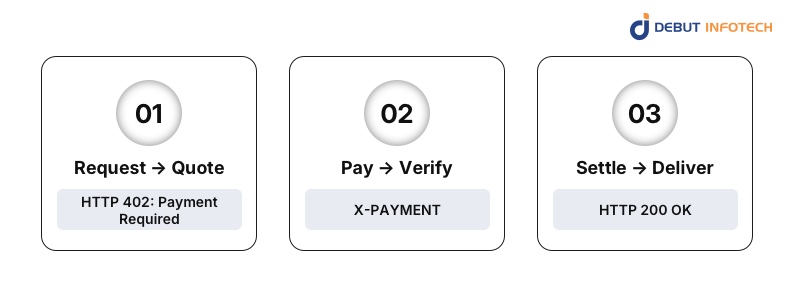
x402 turns every web request into a built-in payment experience, so your apps, APIs, and AI agents can handle transactions without extra steps. Here’s the flow in three simple stages:
1. Request → Quote
Your client or app asks for a resource. The server does not give a generic error but rather responds by sending a HTTP 402: Payment Required response containing the precise price and instructions to make the payment. We all know what is required, at the very beginning.
2. Pay → Verify
The client sends a signed payment payload back in an X-PAYMENT header. The server quickly checks it with the facilitator to confirm the payment is valid. No logins, checkouts, or extra clicks, just a smooth, automated verification.
3. Settle → Deliver
Once verified, the facilitator settles the transaction onchain, and the server delivers the content or service along with an HTTP 200 OK and a transaction hash. The entire payment lifecycle is wrapped neatly into one HTTP conversation.
With x402, HTTP Payments become as natural as loading a webpage, fast, transparent, and fully programmable. It’s a seamless bridge between requests and real-world value.
What x402 Makes Possible: Real-World Value Exchange
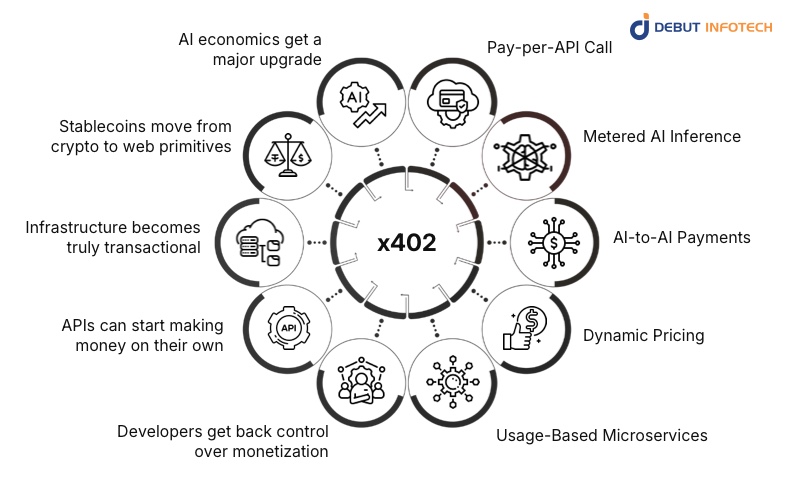
The x402 Standard isn’t just a technical upgrade, it lets the web finally handle real value exchange as smoothly as it handles data. Here’s what that looks like in practice:
Pay-per-API Call
APIs no longer need rigid subscriptions. With x402, each request can carry its own payment, creating a direct, verifiable value exchange. For example, Dune Analytics already lets users run queries with a credit-based system: each SQL query consumes credits based on compute resources used. x402 brings this model natively to the web, so each API call can trigger a stablecoin payment automatically.
Metered AI Inference
AI workloads can be expensive, but why pay for more than you use? With x402, you can pay per GPU second or per-token inference. It’s similar to how OpenAI charges per token processed in GPT models, except now, payments could happen instantly between systems without a human in the loop.
AI-to-AI Payments
Autonomous agents can transact directly with each other. Imagine a trading bot paying a data-fetching bot for a price feed, all automatically. Chainlink Functions already demonstrates a primitive version of this: developers pay LINK per request to access off-chain computation. x402 makes this same concept native to HTTP with stablecoin settlement.
Dynamic Pricing
Pricing can also be real-time depending on demand, system load, or network congestion. Instead of static subscription tiers, each request can reflect true value, ensuring fair payment. This is similar to AWS Lambda, which charges per execution time and resource usage, x402 just brings this logic to machine-to-machine payments.
Usage-Based Microservices
APIs can now fund themselves through usage-based payments. Each call becomes a tiny transaction that sustains the service automatically. Think of it like microeconomies for every service endpoint: developers no longer rely on subscription models to cover costs.
Developers get back control over monetization
x402 doesn’t rely on platforms or payment providers to set pricing anymore, but instead, it occurs at the protocol level. It implies that developers will have the option of determining the amount of charge to impose on each API call or each compute cycle or each data request, without using third-party billing infrastructure.
APIs can start making money on their own
Micro-payments become effortless, turning APIs from cost centers into self-sustaining revenue engines. No more SaaS overhead or subscription headaches, your endpoints can earn as they serve.
Infrastructure becomes truly transactional
Everything from CDNs to RPC endpoints and GPU clouds can now be billed per resource unit, in real time. Compute, storage, and bandwidth turn into monetizable assets, giving your infrastructure a new layer of economic intelligence.
Stablecoins move from crypto to web primitives
USDC and other stablecoins become the native way value travels across the internet. Think of them as the “TCP/IP of payments” fast, programmable, and verifiable, letting machines pay each other seamlessly. By embedding stablecoin payments directly into HTTP requests, x402 doesn’t just streamline transactions, it unlocks entirely new business models for AI-driven applications and microservice architectures.
AI economics get a major upgrade
Autonomous agents are now able to work commercially without human input. They are able to afford services, retrieve data, and coordinate with other AI systems in real time.
Hidden Challenges and Risks You Should Know
While the x402 Standard is a game-changer for AI-powered payments and stablecoin-enabled applications, it’s not without challenges. Understanding these risks is key, especially for businesses building stablecoin development services.
1. Token Limitations
Right now, USDC is the only token that fully supports the EIP-3009 standard, which x402 relies on for onchain authorization and settlement. That means using other tokens requires custom implementations, adding extra complexity for development teams. For instance, a developer creating a micro-payment API might find USDC transactions smooth, while every other token demands additional coding, testing, and infrastructure. This can slow down deployment and limit flexibility in multi-token payment systems.
2. Facilitator Centralization
Most x402 implementations depend on Coinbase’s facilitator to verify and settle payments. This is convenient, but it forms one point of control. The implication of centralization is that it may cause issues of trust, slowness in decentralized ecosystems, and cause your system to depend on uptime and policies of a third party. Should Coinbase go down or modify its policies, artificial intelligence-based payment flows will break down, affecting more services that depend on flawless micro-payments.
3. Privacy Concerns
Each x402 transaction associates web activity (IP addresses, timestamps, etc.) with onchain payments. In the case of AI agents that use common micro-payments, this results in patterns that can be reversed to users or behaviors. As an illustration, an AI agent that has access to high quality datasets a thousand times may accidentally reveal operational plans or customer information, and this aspect of privacy must be carefully addressed.
4. Compliance and Regulatory Hurdles
The x402 Standard does not include KYC, AML, or sanctions screening, and businesses have to manage a complex regulatory environment. Different countries have very different rules and cross-border payments can also lead to a licensing or reporting obligation. A startup offering AI-powered analytics via x402 could find itself suddenly under the scope of multiple financial regulations, requiring costly compliance measures that slow down operations.
5. Chain Finality and Gas Spikes
Onchain settlement isn’t always instant or predictable. Networks may go dead, payments may get trapped mid-way, and charges may soar when there is congestion. To make automated payments work, developers have to add retry logic to their code, fallback mechanisms, or escrow-like solutions to make sure their systems work. In the absence of these protections, AI agents that pay for micro-services might have failed transactions or unforeseen expenses, which affects the reliability of workflow.
6. Micro-Payment Volatility
Even stablecoins might have slight changes to their value and gas costs may outweigh the payment itself. Very low charges like 0.01 per API call can easily be counterfeited. To remain profitable, developers and businesses should handle the cost of pricing and transaction costs carefully with applications of pay-per-use or agent-driven systems.
Launch a token that works for you.
Let’s design your custom x402 Standard token to automate yield and drive engagement. From concept to deployment, we’ll guide you.
Final Thoughts
At its core, the x402 Standard is about giving the internet something it never truly had, a native way for requests to carry value. No hype, just a cleaner, faster way for APIs, AI agents, and services to pay and get paid in real time.
We may be early, but the direction is obvious. As machine-to-machine commerce grows, protocols like x402 won’t be optional, they’ll be the backbone of how the programmable web works.
If you’re exploring how to build for this next wave, Debut Infotech can help. As a leading crypto token development company, they guide teams in adopting emerging standards like x402 and turning them into real-world products.
Ready to build with the x402 Standard? Connect with Debut Infotech to get started.
Frequently Asked Questions (FAQs)
Q. What is the x402 payment?
A. The x402 payment is an open, internet-native payment protocol. It’s built on the little-used HTTP 402 “Payment Required” status code.
With x402, websites and APIs can accept instant, automatic payments for things like content or API usage. There’s no need for accounts, logins, or complicated authentication.
Clients, including AI agents, simply pay for what they use. The payment itself becomes the authentication step, making the entire process fast and frictionless.
Q. How does X402 work?
A. X402 actualizes the previous HTTP 402: Payment Required status code. It provides servers with an easy method to demand money before access to a resource is provided.
Upon request by a client the server is able to reply with a 402 status and add machine-readable payment conditions. The client is then able to use a digital wallet to make the payment. Subsequently, the client resends the request plus evidence of payment to the X-PAYMENT header.
The server validates the payment and after this, opens the resource. It provides instant, pay-per-use access without accounts, logins, or subscriptions and it works with both humans and automated AI agents.
Q. What does code 402 mean?
A. The 402 Payment Required status code indicates that you need to make a payment before accessing a resource.
This code was originally reserved for future digital payment systems, but many websites now use it in a practical way.
You’ll typically see a 402 error when a service is blocked due to a payment issue, for example, an unpaid subscription or a failed credit card transaction.
Our Latest Insights


Leave a Comment