



Table of Contents
Home / Blog / Mobile Development
Why Businesses Are Adopting Android App Bundles

by

December 30, 2025
by
December 30, 2025
For years, APKs were the undisputed standard for shipping Android apps. One file for every device. One bulky download for every user. One size fits all—even when it didn’t. That was the norm. And for a long time, businesses simply worked around the limitations, wrestling with performance issues, heavy installs, and the usual Android App Development Challenges that came with them.
But then came Android App Bundles—lighter, smarter, more flexible, and undeniably more efficient. Suddenly, developers didn’t need to package everything into one oversized file. Users no longer had to download what their devices didn’t need. And businesses began noticing the gains almost immediately.
So, it’s no surprise that companies everywhere are transitioning to AABs. The benefits speak for themselves.
In this article, we’ll break things down clearly: first, a simple explanation of what Android App Bundles actually are, and then a detailed look at the key reasons businesses are making the switch.
What are Android App Bundles?
Android App Bundles are the latest Google-mandated publishing format for developing and publishing Android apps. They are a set of standards that Google has recently recommended for building and releasing new applications on the Google Play Store.
This new publishing format was introduced by Google because it is smarter, lighter, and more flexible than the former Android Package Kit (APK) format.
Compared to the former APK publishing format, the Android App Bundle typically contains all compiled code and assets in a single upload file (.aab), while allowing the app store to generate device-specific APKs. The difference between this new publishing format and the latter is that app developers used to be responsible for generating APKs for individual devices. And the main advantage of this is that the end-users only have to download the files needed by their devices, instead of downloading everything as they used to with the APK publishing format.
Since Google made it clear that the Android App Bundle is now the recognised standard for developing and publishing apps on the Google Play Store, we have seen an increase in the number of apps using the format, ranging from giants like Netflix and X (Twitter) to most other less-common apps on the Google Play Store. In fact, research shows that over 40% of all releases on Google Play can be accounted for by Android App Bundles.
So, why have businesses taken to this new app publishing format?
What is it about developing and publishing new apps on the Google Play Store in the form of Android App Bundles that makes businesses prefer them so much, and more specifically, why should you consider using the approach?
Below, we’ve documented 15 tangible reasons provided by companies that have been patronising our mobile app development services at Debut Infotech Pvt Ltd.
Let’s examine them!
Ready to upgrade your Android experience?
Build an app that’s lighter, faster, and perfectly optimized for every device. Our team at Debut Infotech delivers modern, high-performance Android solutions powered by the latest app bundle standards.
10 Tangible Reasons Why Businesses are Adopting Android App Bundles
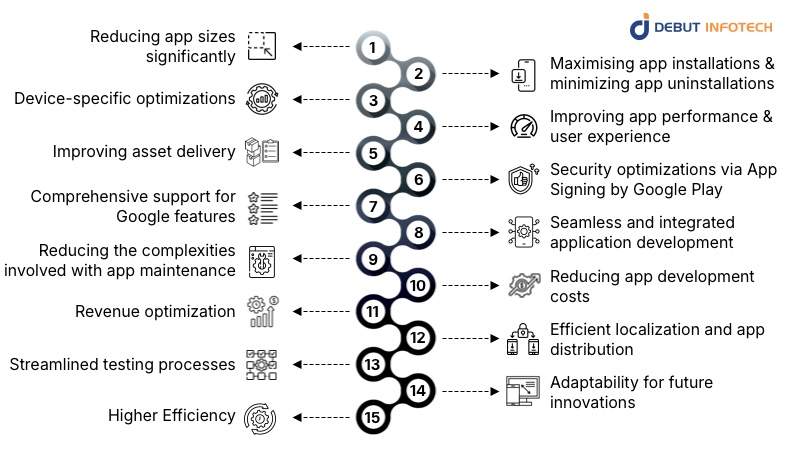
In no particular order, the following are some of the most valid reasons why your business should adopt Android App Bundles:
1. Reducing app sizes significantly
In plain terms, you could save your end users up to 15-20% in storage space when you publish your apps on the Google Play Store using the Android App Bundle format. This is because they only download the key components required for the app to perform optimally on their device, not on all types of devices. This could include the required languages, screen densities, CPU architectures, and so on. As you might expect, the smaller app sizes may mean faster download speeds, and who wouldn’t love that?
2. Maximising app installations and minimizing app uninstallations
When users know they’ll be downloading your apps in a few seconds with little or no impact on their device storage performance, then it makes sense to think that they might readily download such apps. And that’s why most businesses have switched to APB.
That’s not all: the reduction in app sizes has also been confirmed to increase update rates while limiting the number of app uninstalls. This is because the app’s small size eliminates the need to delete specific apps frequently to make space for new ones. Also, there’s no point in uninstalling a small app in the rare case a user needs to free up space for another one.
3. Device-specific optimizations
From the perspectives of an everyday Android app user, Android apps published with the APB are generally sharper, faster, and more efficient. You experience fewer lags, little or no abrupt shutdowns. The app just performs smoothly.
You know why?
The APB as a publishing format ensures that the Google Play Store generates a specific and optimized APK just for that device. The direct implications of this are twofold: firstly, Google Play Store wouldn’t be shipping any irrelevant files in terms of images and languages that the user’s device wouldn’t need. Secondly, that app becomes extremely optimized for that device in terms of hardware architecture, specific screen densities, and many more peculiarities.
Read more – Top 10 Android App Development Companies in USA
4. Improving app performance and user experience
And you know what all these device-specific optimizations translate to?
Excellent app performances and user experiences!
When the app is optimized for that specific device, it benefits from smoother app performance and faster load times. Consequently, end users have a good time using the app, and before you know it, app download metrics start skyrocketing. This is one of the major reasons why many app businesses have been switching from APKs to Android app bundles when building their apps.
5. Improving asset delivery
Another reason businesses are now using Android app bundles is that they enable a modular, on-demand model for feature and asset delivery.
What does this mean?
It means that Android app bundles allow you to split features into modules and deliver them conditionally, whether when a user installs the app or its update, or at any other time they deem fit for their needs. This reason is also closely tied to the idea of saving storage space on a user’s device.
For instance, your business may decide to maintain a lean base app that provides only basic functionality, while giving users the autonomy to decide whether to download additional, heavier, or less-used functionality. These could be AR features, language packs, resolution files, HD graphics, or basically any other app-specific feature.
That’s cool and functional, isn’t it?
6. Security optimizations via App Signing by Google Play
Unlike with the APK format, publishing an application using an Android App Bundle means Google Play will handle the app’s signing and key management via the Google Play App Signing protocol. Obviously, that is way more effective and secure than you handling it yourself with the APK format.
As such, the app experiences fewer manual signing errors and better-protected signing keys, ultimately keeping the end user’s vital information safer than it would have been with the APK format. Which user wouldn’t love that?
The heightened security concerns in recent times make this even more significant.
7. Comprehensive support for Google features
Another big reason businesses are embracing Android App Bundles is the stronger, more seamless support for Google’s modern app technologies.
Features such as Play Feature Delivery, Play Asset Delivery, Instant Apps, and advanced optimization tools work seamlessly with the AAB format. This gives developers access to more flexible delivery options, faster load experiences, and smoother integrations with Google’s evolving ecosystem.
With APKs, on the other hand, many of these capabilities were limited or simply unavailable. So, if your business wants to stay aligned with Google’s latest tools—and benefit from them—the app bundle format is the clear and future-ready choice.
8. Seamless and integrated application development
Developing apps in the AAB format also feels more streamlined for engineering teams. App bundles push developers toward a modular structure, meaning each part of the app can be built, tested, and improved independently. This naturally reduces friction during development because teams can work on smaller components rather than digging through a single massive codebase.
Consequently, it makes collaboration easier, especially for distributed teams or companies with multiple developers touching the same app. Overall, the development process becomes smoother, more organized, and far less chaotic compared to the old, monolithic APK workflows.
9. Reducing the complexities involved with app maintenance
It also generally gets easier to maintain your applications when you publish them with the Android App Bundles. The app’s modular design allows your developers to update specific features or assets without updating other parts of the codebase that are not concerned with those features.
The implication is that you have a higher chance of dealing with fewer bugs and spend less time shipping routine updates. That easily translates to lower costs for developer hours. Consequently, businesses no longer have to generate multiple APKs or manage version inconsistencies across different devices and architectures. Everything is centralized and handled elegantly by Google Play. This simplicity not only reduces technical overhead but also ensures that users always receive the most accurate, optimized updates for their devices.
10. Reducing app development costs
Apart from just the reduction in developer fees, the app development cost reduces as well. The simpler, modular, and more efficient nature of the development model usually translates to lower development costs.
Furthermore, with Android App Bundles, businesses save money on everything from engineering hours to testing, maintenance, and update cycles. Developers don’t need to build and manage dozens of APK versions manually anymore, and testing teams don’t have to test every single device variation manually. On top of that, fewer performance issues and fewer user complaints mean less time spent on emergency fixes. In short, AAB reduces unnecessary complexity—and every eliminated complexity translates into real, measurable cost savings for the business.
11. Revenue optimization
Businesses also report higher revenue opportunities after switching to Android App Bundles, and the reason is simple: better user experiences often lead to better user retention. Smaller app sizes, smoother performance, and faster updates reduce friction during installs, meaning more users actually complete the download process. And since users are less likely to uninstall an app that runs smoothly, businesses naturally see higher engagement and longer lifetime value. For apps with in-app purchases or ads, every extra day a user stays active can directly boost revenue. AAB indirectly—but powerfully—supports monetization by supporting stronger user loyalty.
12. Efficient localization and app distribution
One of Android App Bundles’ underrated strengths is its localization support. Instead of shipping all language packs to every device, the Play Store sends only the languages a user needs. This makes the app smaller and more relevant to each region.
For businesses targeting multiple markets, this is a significant advantage, as it keeps the app lightweight while still offering a personalized experience. Distribution also becomes easier because the Play Store automatically manages all device configurations. Whether you’re targeting five countries or fifty, localization becomes smoother, cleaner, and much more efficient.
13. Streamlined testing processes
Testing an app used to be one of the most time-consuming parts of Android development—especially with multiple APK versions floating around. Android App Bundles simplify this drastically. With a modular structure and device-specific APK generation handled by the Play Store, developers can focus on testing core features instead of juggling compatibility issues. Automated testing tools also work better with bundles, allowing teams to catch issues faster and ship updates sooner. This reduces the testing workload and ensures that the final product is more stable. In essence, AAB makes quality assurance less stressful and more predictable.
14. Adaptability for future innovations
Technology evolves quickly, and Android App Bundles prepare your application for changes that haven’t arrived yet. Because the format is modular and tightly aligned with Google’s long-term roadmap, it’s easier to adopt new features, new device types, or emerging technologies. Whether Google introduces a new delivery mechanism, a new device specification, or enhancements to the Play Store ecosystem, apps published in the AAB format are already positioned to take advantage of them. This adaptability gives businesses peace of mind—they know their app won’t fall behind or require massive rebuilding efforts anytime soon.
Read also – Top Android Development Tools and Technologies
15. Higher Efficiency
At the end of the day, efficiency is one of the biggest reasons companies switch to Android App Bundles. Everything—from development and testing to distribution and performance—is simply more optimized. Developers spend less time on repetitive tasks, users enjoy faster downloads and smoother experiences, and businesses benefit from improved retention and lower long-term costs. It’s a win-win for all parties involved. The AAB format removes much of the unnecessary weight of APKs and replaces it with a smarter, streamlined approach to building and delivering Android apps.
Ready to switch to smarter Android development?
Leverage the full power of Android App Bundles with an app that’s optimized, lightweight, and built for real user impact. Our experts at Debut Infotech turn complex ideas into smooth, high-performing Android experiences.
Conclusion
By now, you can clearly see how the shift from APKs to Android App Bundles represents an adjustment to Android app development evolution. First, they were bulky one-size-fits-all solutions; now, it’s smaller installs, easier updates, and better modularity. This is the reality and future of the Android ecosystem. And when you look at how these benefits translate into real business outcomes—higher installs, fewer uninstalls, happier users—it becomes clear why so many companies are embracing the new standard.
If your business is serious about staying competitive, delivering better user experiences, and overcoming recurring Android App Development Challenges, adopting the AAB format is the smarter move.
And if you need a team that understands this transition inside out, Debut Infotech’s Android app development experts are here to help you build, optimize, and scale apps that meet today’s expectations and tomorrow’s demands. Let’s bring your next Android app to life the right way.
Frequently Asked Questions (FAQs)
Q. What are the benefits of Android App Bundle?
A. Android App Bundles enable developers to release apps that are more compact, quicker, and effective. Users just download what their specific device needs, which improves performance and uses less storage. Because lighter apps are easier and faster for customers to download, they simplify development, reduce maintenance costs, and increase installation rates for businesses.
Q. What is the significance of a bundle in an Android app?
A. The bundle’s clever handling of app delivery is what matters. The app bundle enables Google Play to automatically generate device-optimized APKs rather than sending a single, bulky APK to every user. Smoother performance, fewer unnecessary files, and an improved user experience result from this, particularly for consumers with slower devices or limited storage.
Q. Are Android App Bundles mandatory for publishing on Google Play?
A. Yes, Google now requires developers to use Android App Bundles rather than conventional APKs for most new apps. This change guarantees optimal delivery, smaller program files, enhanced security, and more effective resource management across various Android devices globally for all apps published on the Play Store.
Q. Do Android App Bundles improve app performance?
A. Of course. Bundles enable Google Play to offer only the files a device actually needs, making the app lighter and more hardware-specific. This results in reduced performance issues, quicker load times, and more seamless navigation. Because AAB improves the overall user experience, businesses often adopt it.
Q. Are Android App Bundles harder to develop than APKs?
A. Not at all. Although AAB may feel odd at first, developers soon find that the modular structure simplifies and cleans up work. In practice, it eliminates the need to manage multiple APK versions, simplifies updates, and reduces long-term complexity. App packages eventually reduce development expenses and effort.
Our Latest Insights



Leave a Comment