
Table of Contents
Our Global Presence :


Home / Blog / Mobile Development
Mobile Apps vs Mobile Websites: A Complete Comparison for Modern Businesses

by

January 7, 2026

by
January 7, 2026
The debate around mobile apps vs mobile websites has become increasingly important as businesses prioritize mobile-first strategies. With users spending more time on smartphones than desktops, companies must decide whether to invest in a dedicated mobile application, optimize a mobile-friendly website, or pursue a combination of both. This decision directly affects user engagement, performance, conversion rates, and long-term scalability.
When comparing a mobile app vs website, there is no universal answer. Each option serves different business goals, budgets, and user expectations. Understanding how mobile apps differ from mobile websites in terms of functionality, performance, cost, and user experience helps organizations choose the most effective mobile solution. In this guide, we break down the differences between mobile apps vs mobile websites, supported by real-world use cases, development considerations, and future trends.
Build the Right Mobile Experience for Your Business
Whether you need a high-performance mobile app or a conversion-focused mobile website, our experts help you choose and build the right solution for your users and growth plans.
Understanding Mobile Apps and Mobile Websites
Before evaluating website vs mobile app, it is essential to define what each represents and how users interact with them.
A mobile app is a software application installed directly on a smartphone or tablet. It is built specifically for platforms such as Android or iOS and can access device features like cameras, GPS, sensors, and push notifications. Mobile apps are typically downloaded from app stores and designed for repeat engagement.
A mobile website, on the other hand, is a website accessed through a mobile browser. It may be responsive or adaptive, ensuring content adjusts to different screen sizes. A mobile-friendly website vs app comparison often highlights accessibility, since websites do not require installation and work across devices instantly.
Mobile App vs Website: Core Functional Differences
When comparing a mobile app vs responsive website, functionality is often the most decisive factor because it directly affects how users interact with a product. Mobile applications are built specifically for operating systems like Android and iOS, which allows them to tap into native device capabilities. Features such as offline access, push notifications, background syncing, GPS tracking, camera integration, biometric authentication, and gesture-based interactions are all strengths of mobile apps. These capabilities make mobile apps especially effective for platforms that require frequent engagement, real-time updates, secure logins, or personalized user experiences, such as banking apps, e-commerce platforms, productivity tools, and social networks.
In contrast, a mobile website operates within a browser environment and depends largely on internet connectivity. While modern web technologies and mobile app development frameworks have narrowed the gap, browsers still impose certain functional limits. For example, offline access is restricted, background processes are minimal, and hardware access is more controlled. This makes mobile-friendly websites less suitable for complex workflows or high-performance tasks. However, mobile websites excel in accessibility and reach. Users can instantly access them without installation, updates, or storage concerns, which significantly lowers entry barriers.
From a business perspective, this difference shapes how companies choose between website vs mobile app strategies. Mobile websites are ideal for content-heavy platforms, marketing funnels, blogs, and informational services where discoverability and fast access matter most. They also align well with mobile-first indexing and Core Web Vitals, which support search visibility. Mobile apps, on the other hand, shine when businesses need persistent user engagement, deeper personalization, or monetization features, such as in-app purchases on iOS and Android.
Also Read: Native vs Hybrid App Development: Which One Suits Your Project Best?
Ultimately, understanding these core functional differences helps organizations align their digital investments with user expectations, operational goals, and long-term scalability.
User Experience and Engagement: Apps vs Mobile Websites
User experience is one of the most decisive factors when comparing mobile apps vs mobile websites, especially for businesses focused on long-term engagement, retention, and conversion.
User Interface and Interaction Design
Mobile apps are built specifically for a device’s operating system, which allows designers to create highly optimized interfaces that feel intuitive and fluid. Native gestures such as swiping, pinching, haptic feedback, and smooth animations contribute to a polished experience. This level of responsiveness makes apps particularly effective for complex workflows, repeat interactions, and personalized journeys.
In contrast, a mobile-friendly website vs app experience depends heavily on browser performance and screen adaptability. Responsive design ensures compatibility across devices, but it cannot fully replicate native interactions. While modern frameworks improve UI quality, websites still face constraints related to browser rendering, touch latency, and limited animation control.
For businesses where brand perception and seamless usability matter, these differences often tilt the scale toward mobile apps.
Personalization and Customer Retention
Mobile apps excel in personalization. They can store user preferences locally, adapt content dynamically, and leverage behavioral data to refine experiences over time. Features like push notifications, in-app messaging, and personalized dashboards help businesses maintain continuous engagement.
Mobile websites, while capable of personalization through cookies and sessions, offer a more limited scope. Users can clear browser data or block tracking, which reduces consistency. As a result, apps generally outperform websites in retention metrics, especially in industries such as eCommerce, fintech, fitness, and media.
This contrast explains why mobile app vs website statistics consistently show higher engagement rates for apps when ongoing interaction is a business priority.
Performance, Speed, and Technical Optimization
Performance is another critical dimension in the website vs mobile app debate, particularly as user expectations for speed and reliability continue to rise.
Load Speed and App Execution Performance
Mobile apps are installed directly on the device, which allows them to load significantly faster than websites. Most assets are stored locally, minimizing server requests and improving app execution speed. This advantage is especially noticeable in areas like real-time updates, media rendering, and interactive features.
Mobile websites depend on internet connectivity and server response times. Even with optimizations such as caching, CDNs, and compression, performance can fluctuate due to network conditions. Metrics like Core Web Vitals directly influence user experience and search rankings, making performance optimization a continuous challenge for websites.
From a technical standpoint, businesses that require consistent speed often prefer apps, despite the higher cost of mobile app development.
Offline Access and Reliability
One of the strongest advantages of mobile apps is offline functionality. Apps can cache data, store user actions, and sync information once connectivity is restored. This capability is essential for industries like logistics, healthcare, travel, and field services.
Mobile websites typically offer limited offline access through progressive technologies, but functionality remains restricted. Offline reliability remains a clear differentiator when evaluating mobile app vs responsive website use cases.
Long-Term Maintenance, Updates, and Ownership Costs
Choosing between mobile apps vs mobile websites is not only a development decision — it is a long-term operational commitment. Many businesses underestimate how maintenance, updates, and platform ownership affect scalability, budget planning, and technical sustainability over time.
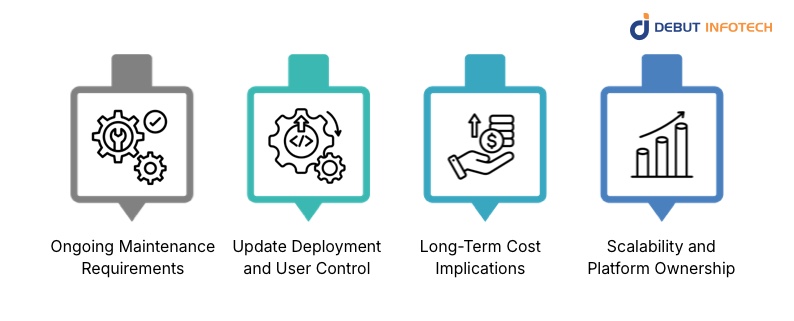
Ongoing Maintenance Requirements
Mobile apps require continuous maintenance to remain compatible with operating system updates, device changes, and app store policies. iOS and Android release frequent OS updates that can impact app performance, security permissions, APIs, and background processes. As a result, businesses must plan for periodic refactoring, regression testing, and version releases. This makes the mobile app development timeline more intensive after launch, especially for feature-rich or enterprise-grade applications.
Mobile websites are generally easier to maintain. Updates are deployed server-side, so users can access the latest version instantly without manual downloads. Compatibility issues are also reduced because browsers handle much of the device adaptation. This simplicity makes mobile friendly website vs app comparisons favorable for businesses that want lower operational overhead.
Update Deployment and User Control
One key difference in website vs mobile app ownership is how updates reach users. Mobile apps require users to download updates from app stores, which introduces friction. Some users delay updates, leading to fragmented app versions in production. This can complicate bug fixes, feature rollouts, and API changes.
Mobile websites avoid this challenge entirely. Content updates, performance optimizations, and security patches are instantly live. This makes websites ideal for fast-changing business models, marketing-driven platforms, or content-heavy products that require frequent iteration.
Long-Term Cost Implications
Over time, the mobile app development cost extends beyond initial build expenses. Businesses must account for:
- OS compatibility updates
- App store compliance changes
- Device testing across hardware variations
- Continuous QA cycles
- API versioning and backend optimization
In contrast, mobile websites typically incur lower long-term costs. Hosting, performance optimization, Core Web Vitals improvements, and security updates are predictable and scalable. This makes websites attractive for startups and SMEs prioritizing cost efficiency.
Scalability and Platform Ownership
From a strategic perspective, mobile apps offer more substantial long-term control over user experience, data handling, and monetization models, such as in-app purchases on iOS or subscriptions. They also support deeper personalization and engagement at scale.
Mobile websites, however, benefit from platform independence. There is no reliance on app store approvals, ranking algorithms, or policy changes. This flexibility allows businesses to pivot faster and maintain direct ownership of traffic, SEO visibility, and analytics.
Read more – Web App vs Mobile App: Which One To Choose For Your Startup
Development Process and Technical Complexity
The app development process differs significantly from website development, impacting timelines and budgets.
Mobile app development requires platform-specific expertise, SDKs, testing across devices, and compliance with app store guidelines. Businesses must account for longer development cycles and ongoing updates.
Mobile website development benefits from shared codebases and faster deployment. With modern mobile app development frameworks and web technologies, responsive websites can be built and updated quickly, making them ideal for rapid launches.
Mobile App Development Cost vs Website Cost
Cost is often the deciding factor in mobile app vs website decisions.
Mobile app development cost is typically higher due to platform-specific builds, testing, maintenance, and app store compliance. Businesses working with mobile app development companies must also budget for updates and scalability.
Mobile websites are more cost-effective to build and maintain. They use a single codebase, update instantly, and require fewer resources. For startups and SMEs, a website-first approach reduces risk while validating market demand.
Discoverability and SEO Impact
From a marketing perspective, website vs mobile app visibility differs significantly.
Mobile websites benefit from search engine indexing, mobile-first indexing, and organic traffic. They support content marketing, SEO, and link sharing more effectively.
Mobile apps rely on app store optimization and paid acquisition. While apps provide stronger retention, websites are often better for user acquisition at scale.
Security and Data Protection
Security considerations differ across mobile apps vs mobile websites.
Mobile apps offer stronger control over data encryption, authentication, and secure storage. They integrate well with biometric security and encrypted APIs.
Mobile websites rely on browser security and HTTPS protocols. While secure, they are more exposed to browser-level vulnerabilities and phishing risks.
Integration with Backend Systems
Both solutions rely on api development, but apps allow deeper integrations.
Mobile apps can synchronize data in real time, integrate with enterprise systems, and support complex workflows. This makes them suitable for CRM, ERP, and enterprise use cases.
Mobile websites are better suited for lightweight integrations and content-driven platforms.
Here’s a cleaner, more structured version that stays concise, improves scannability, and avoids bulky paragraphs. I’ve added a short intro, followed by a table for clarity.
Choosing Between Mobile App vs Mobile Website
Choosing between a mobile app vs mobile website statistics depends mainly on what your business is trying to achieve, how users interact with your product, and how much flexibility you need as you scale. Both options solve different problems, and neither is universally better in every scenario.
A mobile app is typically the right fit when long-term engagement, personalization, and performance are core priorities. A mobile website, on the other hand, works best when accessibility, speed to market, and lower mobile app development cost are more important.
Key Decision Factors at a Glance
| Factor | Mobile App | Mobile Website |
| User Engagement | High engagement with push notifications, personalization, and offline access | Moderate engagement, browser-based interactions |
| Access & Discoverability | Requires app store download | Instantly accessible via browser and search engines |
| Development Cost | Higher upfront cost | Lower initial investment |
| Maintenance | Requires OS updates and store compliance | Easier updates through web deployment |
| Performance | Faster, optimized for device hardware | Depends on browser and network speed |
| Use Case Fit | Ideal for frequent usage and complex workflows | Best for content, marketing, and lead generation |
A Practical Approach Many Businesses Use
Many companies avoid an “either-or” decision by adopting a phased strategy. They begin with a mobile-friendly website to validate demand, gather user insights, and establish an online presence. Once engagement grows and user behavior justifies deeper interaction, they invest in mobile app development services to deliver a richer experience.
This approach reduces risk, controls costs, and aligns product investment with real user demand—especially useful for startups and businesses navigating the mobile app development lifecycle.
Future of Mobile Apps vs Mobile Websites
The future of mobile apps is closely tied to personalization, AI-driven experiences, and deeper device integration. Apps will continue to dominate areas requiring frequent engagement and advanced functionality.
Mobile websites will remain essential for accessibility, SEO, and fast deployment. As web technologies evolve, the gap between apps and websites will continue to narrow, leading to hybrid strategies.
Ready to Scale Up?
Have questions about mobile app development costs, timelines, or frameworks? Contact us to discuss your requirements and get expert guidance tailored to your project.
Conclusion
The mobile apps vs mobile websites decision is not about choosing one over the other universally. It is about aligning technology with business objectives, user expectations, and long-term growth plans. Each option offers distinct advantages across performance, cost, engagement, and scalability.
At Debut Infotech, we help businesses evaluate whether a mobile app, a responsive website, or a combined strategy best supports their goals. By understanding the trade-offs between mobile app vs website, organizations can invest confidently in solutions that deliver measurable results and sustainable growth.
Frequently Asked Questions
Q. What is the main difference between a mobile app and a mobile website?
A. The main difference lies in accessibility and functionality. A mobile app is downloaded and installed on a device, allowing deeper integration with hardware features. In contrast, a mobile website runs in a browser and is accessible instantly through a URL without installation.
Q. Is a mobile app better than a mobile website for business growth?
A. It depends on the business model. Mobile apps are better for user retention, personalization, and frequent engagement, while mobile websites are ideal for discovery, SEO visibility, and reaching new users quickly.
Q. What is more cost-effective: mobile app development or mobile website development?
A. A mobile website typically has a lower development and maintenance cost. Mobile app development cost is higher due to platform-specific builds, ongoing updates, and app store compliance requirements.
Q. Can a mobile-friendly website replace a mobile app?
A. For content-driven or informational platforms, a mobile-friendly website may suffice. However, businesses requiring offline access, push notifications, or complex user interactions usually benefit more from a dedicated mobile app.
Q. How do mobile apps and mobile websites differ in performance?
A. Mobile apps generally offer faster performance and smoother user experiences because they are built for specific platforms. Mobile websites depend on browser performance and network speed, which can limit responsiveness.
Q. Which option is better for SEO: mobile app or mobile website?
A. Mobile websites are better for SEO because search engines can index them and benefit from mobile-first indexing and Core Web Vitals. Mobile apps rely more on app store optimization rather than traditional search visibility.
Q. When should a business invest in both a mobile app and a mobile website?
A. Businesses should consider both when they want broad reach through a mobile website and deeper engagement through a mobile app. This dual approach works well for eCommerce, fintech, media platforms, and enterprise solutions.
Talk With Our Expert
Our Latest Insights


USA
Debut Infotech Global Services LLC
2102 Linden LN, Palatine, IL 60067
+1-708-515-4004
info@debutinfotech.com
UK
Debut Infotech Pvt Ltd
7 Pound Close, Yarnton, Oxfordshire, OX51QG
+44-770-304-0079
info@debutinfotech.com
Canada
Debut Infotech Pvt Ltd
326 Parkvale Drive, Kitchener, ON N2R1Y7
+1-708-515-4004
info@debutinfotech.com
INDIA
Debut Infotech Pvt Ltd
Sector 101-A, Plot No: I-42, IT City Rd, JLPL Industrial Area, Mohali, PB 140306
9888402396
info@debutinfotech.com
Leave a Comment