
Table of Contents
Our Global Presence :


Home / Blog / Mobile Development
Swift Programming vs Objective-C: Which Should You Choose for iOS Development?

by

January 5, 2026

by
January 5, 2026
Swift Programming vs Objective-C is a common crossroads for teams building iOS, macOS, watchOS, and tvOS applications. Both languages power Apple’s platforms, but they differ in design philosophy, safety features, performance characteristics, and developer ergonomics. Choosing the correct language affects maintenance, hiring, security, and long-term product velocity. Debut Infotech helps companies evaluate these trade-offs so can pick the best path for their product and team.
Understanding the differences starts with language histories and then moves into practical areas such as compilation speed, runtime performance, memory safety, code maintainability, and build-time comparisons. This article walks through those topics, explains migration strategies for legacy apps, and lays out clear guidelines for when to pick Swift or Objective-C for new and ongoing projects.
A Brief History and Context
Objective-C first appeared in the early 1980s as an extension of the C language that added object-oriented features influenced by Smalltalk. It became Apple’s primary language for macOS and iOS development for decades. The language relies heavily on dynamic dispatch and the Objective-C runtime.
Swift was introduced by Apple in 2014 to modernize development on Apple platforms. It embraces safety, modern syntax, strong typing, and performance improvements. Swift removes many of the footguns associated with Objective-C while maintaining seamless interoperability with existing Objective-C vs Swift codebases and frameworks.
Read more – iOS App Development: Guide to Building High-Performance Apps
Planning a shift from Objective-C to Swift or upgrading an existing iOS app?
Our iOS architects assess your codebase and recommend a secure, scalable modernization strategy.
Language Design and Syntax
The most noticeable difference between Swift and Objective-C begins with how each language is written and structured. Syntax affects readability, development speed, and how quickly new engineers can onboard to an iOS project. Comparing their design philosophies helps teams understand which language better supports modern development practices.
Syntax and Readability
Swift emphasizes concise, readable code. Features such as type inference, modern control flow, and expressive standard library APIs make common tasks shorter and clearer. Objective-C uses C-style syntax with message-passing syntax, such as [object method]. New developers often find Swift easier to learn and maintain.
Type System and Safety
Swift implements a robust static type system with optionals to explicitly represent missing values. This reduces runtime null pointer errors and improves compiler-time checks. Objective-C’s dynamic typing and the historical reliance on nil handling offer flexibility but require greater discipline to avoid bugs.
Error Handling
Swift provides structured error handling with throw, try, and catch patterns. Objective-C uses NSError patterns and exceptions sparingly. Swift’s approach makes control flow for error-prone operations easier to reason about.
Memory Management and Safety
Memory handling plays a critical role in the stability and security of an iOS app. Swift was created to reduce common developer mistakes, while Objective-C relies more heavily on manual checks. Exploring how each language manages memory provides insight into app reliability and long-term maintainability.
Automatic Reference Counting (ARC)
Both languages use ARC to manage memory. The core mechanics are similar: the compiler injects retain and release calls. However, Swift’s ownership model, value types, and stricter typing reduce the surface area for retain cycles and memory leaks.
Value Types vs Reference Types
Swift offers both structs (value types) and classes (reference types). Value types promote safer concurrency and predictable behavior because they are copied rather than shared. Objective-C primarily relies on reference types, which can make reasoning about shared mutable state harder.
Swift Safety Features
Swift includes additional safety features such as bounds-checked arrays, strict typing, and optionals. These features reduce common runtime crashes and improve overall app stability.
Performance Considerations
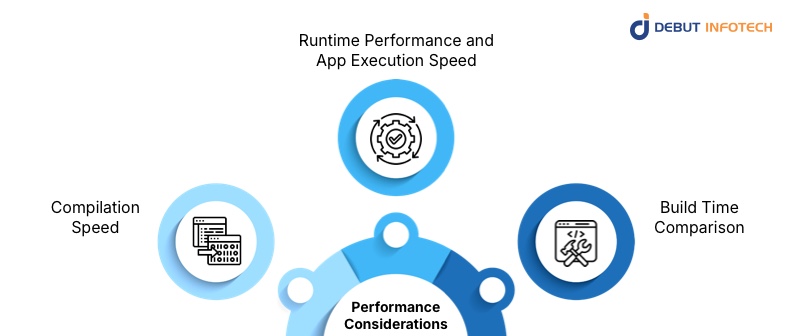
Performance often influences the choice of programming language, especially for enterprise iOS app development and high-efficiency mobile systems. Assessing compilation speed, runtime behavior, and execution efficiency reveals how Swift compares to Objective-C in real development environments.
Compilation Speed
Compilation speed depends on project size and language features. Historically, Objective-C had faster incremental builds for some legacy setups. Swift’s compiler has improved dramatically, and modern toolchains offer competitive build times. When evaluating compilation speed, consider modularization strategies and incremental build tooling.
Runtime Performance and App Execution Speed
At runtime, both languages can be performant. Swift was designed for speed with optimizations that make many operations as fast or faster than their Objective-C equivalents. In tight loops or compute-heavy tasks, Swift’s value types and optimized code generation can yield performance advantages. Objective-C’s dynamic dispatch can be slightly slower for method calls compared to Swift’s optimized dispatch, but in many real app scenarios, this difference is negligible.
Build Time Comparison
Large Swift projects can face longer clean build times due to heavy type checking and optimizations. Splitting code into frameworks and using precompiled modules can mitigate this. Objective-C projects may have shorter clean builds in some setups, but modern build systems and incremental compilation reduce that gap.
Interoperability and the Objective-C Runtime
Despite Swift’s popularity, Objective-C remains deeply embedded in Apple’s ecosystem. Understanding how Swift interfaces with the Objective-C runtime helps teams manage mixed-language codebases and leverage legacy libraries without sacrificing modernization.
Bridging Between Swift and Objective-C
Swift was engineered to interoperate with Objective-C. You can call Objective-C APIs from Swift and vice versa using bridging headers and annotations. This makes it practical to adopt Swift incrementally in legacy apps.
Objective-C Runtime Capabilities
Objective-C runtime offers dynamic features such as method swizzling, message forwarding, and dynamic class creation. For some advanced runtime metaprogramming patterns, Objective-C remains uniquely capable. Swift can interoperate, but does not expose all dynamic features as ergonomically.
Read also – Native vs Hybrid App Development: Which One Suits Your Project Best?
Tooling, Ecosystem and Frameworks
The Apple developer ecosystem offers extensive frameworks, SDKs, and development tools for both languages, but the level of support differs. Analyzing the tooling advantages of each language gives companies clarity on productivity, debugging efficiency, and access to the latest innovations.
Xcode and Debugging
Both languages use Xcode as the primary IDE. Xcode offers debugging, profiling, and testing tools that support Swift and Objective-C. Swift’s integration with the tooling continues to improve, with features such as Playgrounds for rapid prototyping.
Frameworks in Swift
Modern Apple frameworks are embracing Swift-first APIs. Many new SDK features and third-party libraries are optimized for Swift. Frameworks in Swift often provide safer, clearer APIs than their Objective-C counterparts.
Third-Party Libraries and Package Managers
Swift Package Manager, CocoaPods, and Carthage are commonly used for dependency management. Swift Package Manager is now the preferred tool for many Swift projects because of its tight integration with Xcode.
Concurrency Models
As apps grow more complex, concurrency becomes a critical factor in ensuring responsiveness and stability. Swift’s modern concurrency model offers significant improvements over Objective-C’s traditional APIs. Understanding these differences is essential for teams building scalable iOS applications.
Swift Concurrency
Swift introduced structured concurrency with async/await and actors. These constructs simplify writing asynchronous code and make concurrent programming safer. They reduce callback hell and improve readability.
Objective-C Concurrency Patterns
Objective-C uses Grand Central Dispatch (GCD) and operation queues for concurrency. While powerful, these patterns require careful handling of thread-safety and synchronization. Swift’s concurrency model builds on GCD but provides higher-level abstractions.
Security in iOS Apps
Security is central to mobile development, especially in finance, healthcare, and enterprise use cases. Comparing Swift’s built-in safety mechanisms with Objective-C’s more manual approach highlights how each language protects against vulnerabilities and unsafe code.
Memory Safety and Security
Swift’s memory-safety features reduce certain classes of vulnerabilities such as buffer overflows and null dereferences. This makes Swift attractive for applications that require high security.
Secure Coding Practices
Regardless of language, secure coding practices and proper use of Apple’s security APIs matter most. Swift’s clearer types and optionals help developers avoid common mistakes that can lead to security issues.
Code Maintainability and Developer Productivity
Code maintainability directly impacts scalability, iteration speed, and developer satisfaction. Swift’s modern syntax generally improves productivity, while Objective-C requires greater expertise but offers greater flexibility for legacy systems. Understanding these trade-offs helps teams build stable, future-ready applications.
Readability and Onboarding
Teams often find Swift’s concise syntax easier to read and maintain. Onboarding new developers can be faster with Swift due to lower boilerplate and better tooling.
Refactoring and Tool Support
Swift’s strong type system and compiler checks make automated refactoring safer. Xcode’s refactoring tools often work better with Swift projects.
Long-Term Maintainability
For greenfield projects, Swift is generally the better choice for maintainability. For large legacy codebases with extensive Objective-C, a mixed approach or gradual migration may be more practical.
Migration Strategies and Interoperability
Security is central to mobile development, especially in finance, healthcare, and enterprise use cases. Comparing Swift’s built-in safety mechanisms with Objective-C’s more manual approach highlights how each language protects against vulnerabilities and unsafe code.
Incremental Migration Approach
You can migrate Objective-C code to Swift incrementally. Start by writing new modules in Swift, exposing Objective-C headers to Swift via bridging headers, and gradually refactoring older components.
Mixed-Language Projects
Many production apps use both languages. Key advice: create clear module boundaries, write comprehensive tests, and maintain a consistent API surface to avoid coupling problems.
When to Choose Swift vs Objective-C
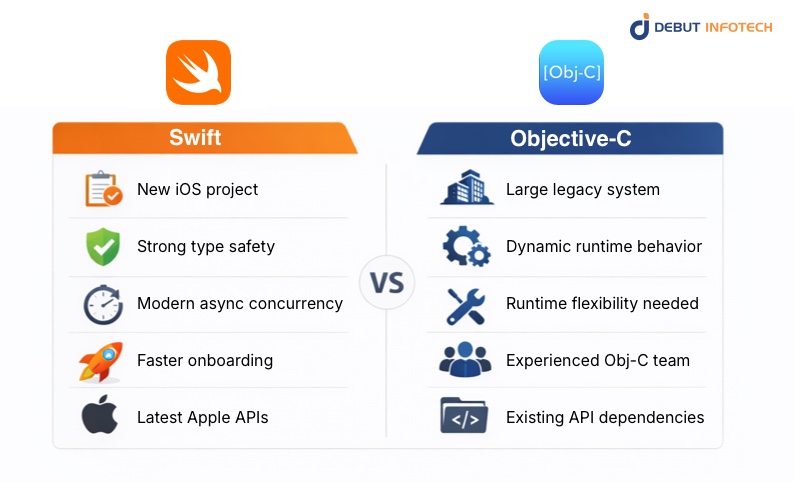
Choose Swift When:
- You are starting a new project.
- You want strong language safety and modern concurrency features.
- You aim for rapid developer onboarding and higher productivity.
- You plan to adopt recent Apple frameworks and APIs.
Choose Objective-C When:
- You maintain a large, mission-critical legacy codebase.
- Your project relies heavily on dynamic runtime features of Objective-C.
- Immediate migration costs outweigh long-term benefits.
Hiring, Team and Cost Considerations
Choosing between Swift and Objective-C isn’t only a technical decision — it impacts hiring, resource allocation, and development budgets. Understanding labor market realities and skill availability helps businesses plan team structures more effectively.
Hiring iOS Developers
Swift talent is abundant and growing. If you need to hire iOS developers, look for candidates experienced in Swift, Swift concurrency, and modern frameworks. For legacy Objective-C maintenance, specialty skills in Objective-C and the Objective-C runtime remain valuable.
Development Cost and Timeline
Swift projects often reduce development time because of higher-level abstractions and reduced boilerplate. However, migration projects can add cost. Budget for audits, testing, and incremental refactoring when moving from Objective-C to Swift.
Practical Benchmarks and Real-World Examples
Benchmark comparisons and real-world case studies provide clarity on how both languages behave in real-world use cases. This section sets the stage for evidence-based insights, helping companies make data-driven decisions for current and future iOS projects.
Is Swift Faster Than Objective-C?
In many practical scenarios, Swift is as fast as, or even faster than, Objective-C. For CPU-bound tasks, Swift’s optimizations and value types can outperform Objective-C. For dynamic runtime features, Objective-C remains competitive.
Real-World Trade-offs
Performance, maintainability, and team expertise determine the right choice. Benchmark critical paths of your application and make decisions based on measured data rather than assumptions.
Best Practices for Mixed Projects
- Use clear module boundaries and well-defined APIs.
- Keep Objective-C interoperability headers tidy.
- Write unit and integration tests when migrating code.
- Leverage Swift Package Manager for new Swift modules.
- Document runtime-dependent code and patterns that rely on Objective-C features.
Making the Decision: A Practical Checklist
- Project age and existing codebase size: a major Objective-C investment suggests a mixed approach.
- Team skills and hiring market: assess availability of Swift vs Objective-C talent.
- Security and compliance requirements: prefer Swift for stronger safety features.
- Time-to-market and feature roadmap: choose the language that accelerates delivery.
- Long-term maintainability and architecture: prefer Swift for new, long-lived products.
Looking for a clear estimate for Swift adoption or mixed-language refactoring?
We provide tailored timelines, cost breakdowns, and technical guidance for your iOS roadmap.
The Future of Swift and Objective-C in iOS Development
As Apple continues to evolve its ecosystem, the trajectory of Swift programming vs Objective-C becomes clearer. Swift has rapidly matured into the primary language for iOS mobile app development, offering modern syntax, improved memory safety, and powerful new features such as Swift Concurrency and structured async/await workflows. These capabilities drastically improve app responsiveness, reduce race conditions, and enhance overall security in iOS apps, making Swift a preferred choice for new builds.
Objective-C, however, is far from obsolete. Apple still maintains the Objective-C runtime, and thousands of enterprise systems, legacy codebases, and long-standing products continue to run efficiently on Objective-C. Many iPhone app development firms rely on Objective-C specialists to maintain or refactor older apps. This ensures ongoing demand for both languages, especially in sectors where stability, predictability, and long-term support are critical.
Looking ahead, the industry expects Swift to remain the dominant language for modern development, particularly for teams adopting advanced mobile app development services, machine learning integrations, and scalable architectures. Meanwhile, Objective-C will continue to play a foundational role in maintaining historic projects and enabling interoperability with low-level system components. For businesses planning long-term digital strategies, understanding when to use Swift, when to rely on Objective-C, and how to blend both languages will be essential for maintaining competitive performance — while controlling iOS app development cost and reducing technical debt.
Conclusion
Choosing between Swift Programming vs Objective-C is less about right or wrong and more about fit for purpose. Swift offers modern language features, improved safety, and better developer ergonomics, making it ideal for new projects and teams prioritizing speed and long-term maintainability. Objective-C still holds value for large legacy systems, deep runtime metaprogramming, and scenarios where immediate migration is impractical.
Debut Infotech partners with organizations to evaluate DETAILED trade-offs, plan incremental migrations, and implement scalable architectures that combine the strengths of both languages. Whether you need to hire full-time iOS developers, assemble a mixed-language team, or design an upgrade path, Debut Infotech can help you choose the most cost-effective and future-proof route. By aligning language choices with business goals, teams can deliver robust, secure, and high-performance iOS applications.
Two calls to action
- Ready to modernize your iOS app or plan a migration from Objective-C to Swift? Contact our iOS architects for a technical assessment.
- Want a tailored cost and timeline estimate for Swift adoption or mixed-language refactoring? Contact us to schedule a consultation.
Frequently Asked Questions
Q. Which is better for iOS development: Swift or Objective-C?
A. Swift is generally better for modern iOS development due to its clean syntax, strong safety features, faster development cycles, and long-term Apple support. Objective-C, however, remains valuable for maintaining legacy iOS apps or working with older codebases.
Q. Is Swift faster than Objective-C?
A. Yes, in many cases. Swift offers improved compilation speed, runtime performance, and memory safety, thanks to its modern compiler and optimized execution engine. Although Objective-C is still performant, Swift is built for speed and efficiency across newer iOS frameworks.
Q. Should startups choose Swift over Objective-C?
A. Yes. Swift is ideal for startups because it reduces the mobile app development timeline, helps maintain cleaner codebases, and lowers long-term development costs. Objective-C is recommended only when working on legacy systems.
Q. Why do some enterprise apps still use Objective-C?
A. Many enterprise apps were built years ago in Objective-C, and migrating large codebases to Swift can be expensive. Objective-C also offers dynamic runtime capabilities that some large businesses still rely on.
Q. Is Swift more secure than Objective-C?
A. Yes. Swift provides strong memory safety, type safety, and fewer pointer-related vulnerabilities. These improvements enhance security in iOS apps, especially in enterprise environments.
Q. Can Swift and Objective-C be used together in one project?
A. Absolutely. Apple designed Swift to interoperate seamlessly with Objective-C. Teams can gradually migrate old code or introduce Swift features into existing Objective-C projects without rewriting the entire application.
Q. Which language lowers development costs for iOS apps?
A. Swift typically lowers iOS app development cost due to faster development, better maintainability, and reduced debugging time. Objective-C may increase costs if the project requires developers skilled in a language fewer engineers specialize in today.
Talk With Our Expert
Our Latest Insights


USA
Debut Infotech Global Services LLC
2102 Linden LN, Palatine, IL 60067
+1-708-515-4004
info@debutinfotech.com
UK
Debut Infotech Pvt Ltd
7 Pound Close, Yarnton, Oxfordshire, OX51QG
+44-770-304-0079
info@debutinfotech.com
Canada
Debut Infotech Pvt Ltd
326 Parkvale Drive, Kitchener, ON N2R1Y7
+1-708-515-4004
info@debutinfotech.com
INDIA
Debut Infotech Pvt Ltd
Sector 101-A, Plot No: I-42, IT City Rd, JLPL Industrial Area, Mohali, PB 140306
9888402396
info@debutinfotech.com
Leave a Comment