



Table of Contents
Home / Blog / Mobile Development
Understanding ROI in Mobile App Development

by

November 20, 2025
by
November 20, 2025
A lot of businesses start app development thinking it’s cheaper to do everything in-house but that move often backfires. Between rising costs, skill gaps, and delays, what was meant to save money can quickly drain resources.
Here’s why that matters, mobile apps generated over $935 billion in revenue in 2024. That number shows just how massive the mobile opportunity really is and how much you stand to gain with the right approach.
Collaboration with an established mobile development company could be the difference. Using their skills, you will be able to speed up development, eliminate redundant costs, and develop an app that real businesses can use to achieve real outcomes.
In this post, we’ll break down how working with the right Android team can turn your app idea into a long-term growth engine.
What is ROI in Mobile App Development
Whenever the majority of the population hears “ROI”, they immediately assume profit margins and income expansion. However, in mobile app development, ROI is much more than monetary rewards, it is the total value of your app to your business and to the people using it.
Think of ROI on Android mobile apps as a combination of direct and indirect gains. The direct ROI can be easily quantified by the number of downloads, in-app purchases, subscriptions, or ad revenue. These are figures which are in your balance sheet.
But what truly defines a successful app goes deeper. Long-term value resides in the indirect ROI, and these are things such as time saved with automation, lower maintenance costs with clean and scalable code and higher customer retention with a smoother user experience. As an illustration, an Android application which incorporates real time analytics can reduce decision-making time by fifty percent, and a modular architecture can save thousands in subsequent updates.
Read More – How Much Does Mobile App Development Cost In 2025?
Concisely, the most intelligent mobile app development strategies are not geared towards quick profitability, but rather long-term legacy. A top Android development company knows how to blend performance, usability, and scalability to deliver ROI that grows with your business.
The Hidden Costs of DIY or In-House App Development
At first glance, building your app in-house might seem like a smart move. It is as though you are saving money keeping everything under one roof anyway. But in reality, the hidden costs can quietly eat away at your budget and your timeline.
In case your internal team lacks the Android expertise, minor mistakes can result in the repetition of work, late releases, and unreliable user experiences. Every missed deadline or bug fix stretches your project further and drives costs up.
Then there’s the expense no one likes to talk about; hiring, onboarding, and licensing tools for app design, testing, and deployment. What starts as a “cost-saving” idea often turns into a cycle of inefficiency.
That’s why businesses looking to measure mobile app ROI accurately often find that partnering with Android development companies delivers better long-term value. With the right team in place, you gain access to proven workflows, advanced tools, and expertise that help your app hit the market faster without the financial surprises that come with going it alone.
How to Calculate Mobile App ROI (Step-by-Step for Real Results)
So you’ve built an app but is it truly paying off? Understanding your return on investment (ROI) helps you see whether your efforts are turning into actual business value. And the good news? You don’t need to be a finance expert to figure it out.
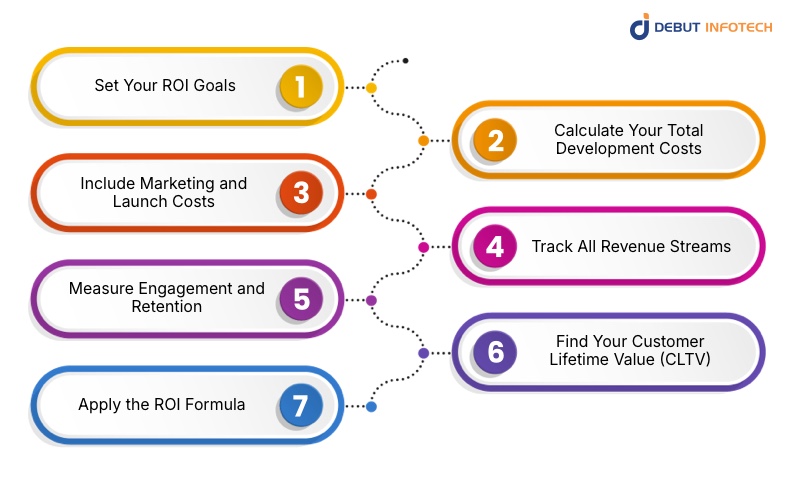
Here is a straightforward, practical method to gauge your app’s ROI and reveal the impact of every step of your process, the development to the performance of your app, on your bottom line.
1. Set Your ROI Goals
Start with the “why.” What is your desired outcome of your app? It might be increased sales, increased user engagement or even better brand visibility. Defining your goals makes measuring what success means much easier, as well as what types of returns are most important to your business.
2. Calculate Your Total Development Costs
Next, total up everything that went into creating your app. That is design, development, testing, and project management. Don’t forget the extras like third-party tools, plugins, or licenses, they add up fast. In case you have contracted a React Native or custom app development firm, add it as well. It is essential to have the full scope of what you have invested to carry out a true ROI analysis
3. Include Marketing and Launch Costs
Developing the app is one thing, but getting people to use it is the other. Include your pre- and post-launch marketing expenses: paid ads, influencer collaborations, ASO (App Store Optimization), social campaigns, and PR. Such activities will promote your visibility and downloads, which have a direct impact on your ROI.
4. Track All Revenue Streams
List the sources of your app income. Is it via subscriptions, in-app purchases, ad revenues or product sales? In the case of an enterprise application, think about the cost-saving or productivity increases it generates. Knowing all possible sources of income would provide you with an actual image of the performance of your app, in terms of earnings.
5. Measure Engagement and Retention
Figures do not define everything, the user behavior does. Monitor daily active users, monthly active users, and how long people spend on your app. High level of engagement tends to equate to improved conversions and increased growth in the long term. It can also be used to measure the general app performance.
6. Find Your Customer Lifetime Value (CLTV)
CLTV is used to view the value of a user over time. Multiply their average spend by how often they purchase and how long they stick around. Then contrast it against your acquisition costs to determine whether you are acquiring profitable users.
7. Apply the ROI Formula
Here’s the simple math behind it all:
ROI = [(Total Return – Total Investment) / Total Investment] x 100
When the number is positive you have a profitable app. Continue to re-calculate as your costs and performance data change as this is not a one time project.
Related Read: Understanding the Mobile App Development Lifecycle
Common ROI Pitfalls and How to Avoid Them
Even the best app ideas can fall short if you’re not careful about how you measure success. In numerous companies, ROI decreases due to limited clarity of their objectives, lack of visibility of their costs, ineffective targeting of the audience, or short-term thinking. Let’s break down the biggest pitfalls and how to stay ahead of them.
1. Ignoring Clear KPIs
When you are not certain what success is, how do you know when you are successful? It is essential to make clear, measurable KPIs. They assist you in monitoring progress, what is working and how to change your strategy before everything goes wrong. This can keep your mobile app development services on course with actual business ambitions, rather than mere vanity metrics, when properly executed.
2. Poor Target Audience Fit
You may develop a tremendous app but you won’t get results unless it is targeted to the right audience. Give yourself an opportunity to get to know your users well, both their habits, preferences and pain points. Use analytics and feedback to refine your messaging and design. The closer you are to your audience, the higher your ROI will be.
3. Short-Term Thinking
Quick wins are enticing but they can be very costly. Concentrating on short-term returns can suppress the potential of your app in the long term. Long-term returns are achieved through investment in customer relationships, brand loyalty and scalability. Imagine it as creating a base on which your business will continue to expand.
Endnote
Maximizing ROI in mobile app development is not about creating an app at the end of the day but creating the right app. The type that resonates with actual users, responds to their demands, and creates a long-term value of your business.
With a combination of intelligent design and informed decision-making and the appropriate technology, you can position your app as one that succeeds in the long term. The difference between a one-time project and a sustainable digital asset that continues to bring returns is avoiding common pitfalls and keeping the long-term goals in mind.
That’s why partnering with an experienced mobile development company like Debut Infotech can be a game-changer. Having a history of successfully developing scalable, high-performance Android applications, our team assists businesses to transform ideas into revenue-generating products; effectively and at a reasonable cost.
As we move through 2026 and beyond, the winners in mobile innovation will be those who think ahead, brands that prioritize usability, performance, and ROI from day one. If that’s your vision, now’s the time to make it happen.
Read also – 10 Fatal Mobile App Development Mistakes to Avoid at Any Cost
Frequently Asked Questions (FAQs)
Q. How does choosing a specialized Android development company reduce overall cost?
A. Working with a specialized Android development company can actually save you money in the long run. Their deep expertise helps streamline the development process and prevent costly mistakes.
While a generalist team might charge less per hour, their limited Android experience often leads to longer timelines, lower code quality, and expensive fixes down the road. In contrast, experts get it right the first time, helping you launch faster and spend less overall.
Q. Can hiring a cheaper overseas dev team still deliver ROI?
A. Yes, hiring a more affordable overseas development team can deliver a solid ROI. But it’s not as simple as just picking the lowest price.
You’ll need strong project management and clear communication to avoid hidden costs and potential setbacks. The real key is to focus on value and quality, not just hourly rates.
Choosing the cheapest option might save money upfront but in the long run, it can actually end up costing more if quality or timelines suffer.
Q. What Metrics Should Businesses Track to Measure App ROI?
A. To measure app ROI effectively, track both financial and engagement metrics. Financial metrics like Customer Acquisition Cost (CAC), Customer Lifetime Value (CLV), and Average Revenue Per User (ARPU) show how much users cost and what they’re worth over time.
Engagement metrics such as Retention Rate, Conversion Rate, and App Performance reveal how well your app keeps users active and satisfied. Together, these insights help you gauge profitability and make smarter decisions about development and marketing.
Our Latest Insights



Leave a Comment