
Table of Contents
Our Global Presence :


Home / Use Case /
AI Agents for Customer Support: Real-World Use Cases, Trends, and Future Outlook

Customer support is one of the most critical functions in today’s business landscape, yet it often struggles with challenges like high query volumes, response delays, and inconsistent service quality. Modern enterprises must manage omnichannel interactions, 24/7 availability, and personalized experiences while keeping operational costs under control. Traditional support methods often fall short in meeting these evolving demands, creating a need for smarter and scalable solutions.
This is where AI agents for customer support are reshaping the industry. AI agents are intelligent virtual assistants powered by artificial intelligence. They can understand queries, analyze context, and deliver human-like responses across multiple channels. These agents not only handle routine tasks but also learn and adapt over time, making customer interactions more seamless and efficient.
These intelligent systems leverage natural language processing, machine learning, and automation to deliver instant, accurate, and context-aware assistance. From resolving routine FAQs and handling multi-lingual queries to guiding complex problem resolution, AI agents empower businesses to provide faster and more efficient support without compromising customer experience.
Partnering with a Custom AI Agent Development Company enables organizations to build tailored solutions that align with their brand voice, integrate seamlessly with CRM systems, and adapt to industry-specific workflows. By reducing human workload and enhancing personalization, AI agents not only boost customer satisfaction but also unlock new efficiencies for enterprises operating at scale.
This article explores the strategies, applications, and business impact of deploying best AI agents for customer support.
Transformative AI Agents in Customer Support: Key Statistics and Insights
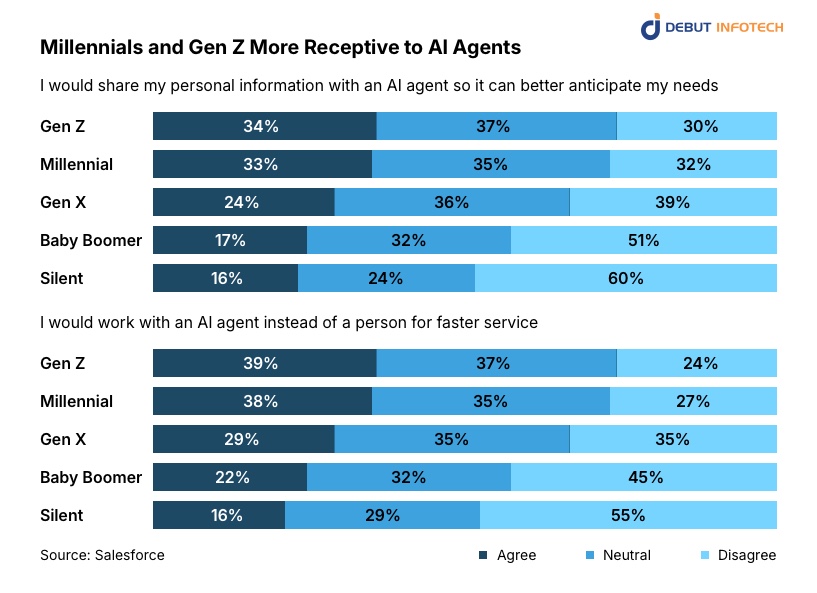
AI agents for customer support are rapidly changing the way businesses interact with their customers, delivering efficiency, speed, and personalization at scale. Unlike traditional chatbots, AI agents combine natural language processing, contextual understanding, and automation to act as intelligent digital counterparts to a human customer service agent. They manage routine queries, escalate complex cases, and ensure seamless engagement across multiple channels.
This shift reflects one of the most impactful AI trends in enterprise technology, where organizations are embracing AI agents not only to reduce costs but also to improve customer satisfaction and retention. The following statistics highlight the growing adoption and measurable value of AI agents in customer support:
Gartner predicts that by 2029, agentic AI will autonomously resolve 80% of common customer service issues without needing human intervention
Salesforce research indicates that nearly 70% of Gen Z consumers are willing to utilize AI agents as personal assistants, while 68% would rely on them for tasks such as job searching.
Deloitte predicts that 25% of companies using generative AI will launch AI agent pilots or proofs of concept by 2025, with adoption expected to grow to 50% by 2027.
McKinsey research suggests that deploying AI agents in customer support functions can reduce cost per call by about 50%, while also boosting customer satisfaction.
Understanding the Role of AI Agents in Customer Support
AI agents in customer support utilize advanced technologies to transform how businesses interact with their customers. These include natural language processing (NLP), machine learning, automation, and conversational intelligence. Unlike a traditional customer service agent, conversational AI agents are capable of understanding context, analyzing intent, and delivering accurate, human-like responses across multiple channels.
AI agents streamline customer support delivery by automating routine inquiries, providing instant answers, and escalating complex cases to human teams when needed. They enhance resolution speed, reduce wait times, and improve overall service consistency.
The ability to process vast amounts of customer data allows AI agents to provide personalized experiences and actionable insights to businesses. They assist in predicting customer needs, guiding decision-making, and boosting satisfaction levels.
AI Agent development companies play a crucial role in developing and deploying these solutions, ensuring they integrate seamlessly with enterprise workflows, CRMs, and communication platforms. By combining automation with intelligence, AI agents significantly reduce operational costs while empowering organizations to deliver exceptional customer experiences at scale.
The Role of AI Agents in Customer Support
- Act as the first line of support, handling repetitive queries and reducing the workload on human teams.
- Understand and respond in natural language, making interactions more conversational and user-friendly.
- Provide consistent service quality, eliminating errors and variability often seen with human-only support.
- Analyze customer interactions in real time, offering insights that improve service delivery and customer engagement.
- Seamlessly collaborate with human agents, ensuring complex issues are escalated without disrupting the customer journey.
- Adapt and learn over time, becoming smarter with every interaction and continuously improving performance.
Turn Every Customer Query Into a Win
Tired of long wait times and missed opportunities? With customer support AI agents, every interaction becomes faster, smarter, and more human-like.
How AI Agents Work in Customer Support?
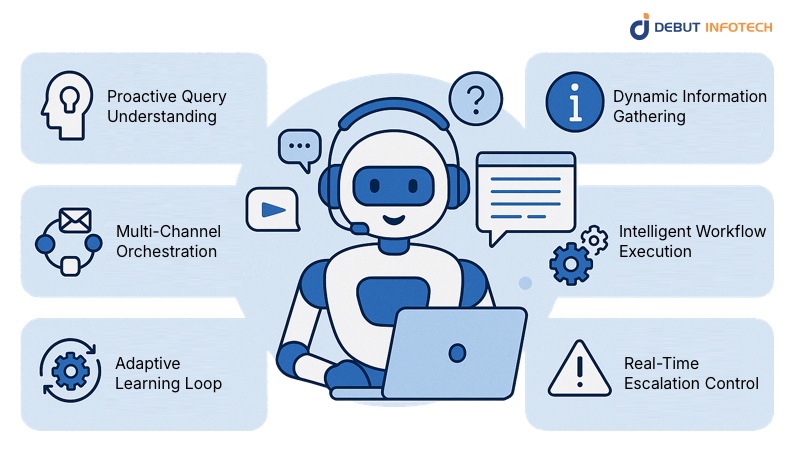
Customer service AI agents are not just chatbots answering basic questions. They are autonomous systems that understand, reason, and act on customer needs in real time. Built on advanced AI models like machine learning, natural language processing, and deep learning, these agents combine contextual awareness with decision-making skills. The result is faster, more accurate, and human-like interactions.
Proactive Query Understanding
Customer service AI agents don’t just wait for direct questions — they proactively interpret customer intent by analyzing tone, behavior, and historical data. This allows them to anticipate needs, resolve issues faster, and deliver highly relevant responses that make customers feel understood, improving efficiency and overall satisfaction.
Dynamic Information Gathering
Instead of providing incomplete answers, AI virtual agents for customer support intelligently prompt users for missing details. They use context-based questioning, ensuring they gather only the necessary information. This reduces unnecessary back-and-forth, streamlines resolutions, and ensures that customer interactions remain smooth, professional, and efficient across multiple service touchpoints.
Multi-Channel Orchestration
Through tailored AI agent development, these systems operate seamlessly across email, chat, voice, and social platforms. They synchronize data and responses across channels, ensuring customers enjoy a consistent experience no matter where they interact. This level of integration reduces friction, shortens wait times, and maintains continuity in customer journeys.
Intelligent Workflow Execution
Customer service AI agents aren’t limited to answering — they can perform backend tasks like updating orders, issuing refunds, or triggering support workflows. By combining AI models with business logic, they act as digital workforce extensions. This reduces manual intervention, accelerates ticket closure, and allows human teams to focus on complex tasks.
Real-Time Escalation Control
AI agents recognize when situations require human empathy or specialized expertise. Instead of creating frustration with endless automation loops, they smoothly escalate to human agents with all contextual information intact. This ensures continuity, avoids customer repetition, and builds confidence that their issues will be resolved effectively without unnecessary delays.
Adaptive Learning Loop
AI models powering these agents constantly learn from every interaction. They evolve to improve accuracy, personalize conversations, and align with changing business policies. Over time, this creates a self-improving support system that scales effortlessly, lowers operational costs, and continuously enhances customer engagement without the need for frequent manual updates.
Related Read: How To Enhance AI Agent Security With ZKPs
Various Benefits of Using AI Agents for Customer Support
AI agents are transforming how businesses deliver customer service. Unlike traditional tools, they combine automation, intelligence, and personalization to create scalable support systems. With the right guidance from AI consultants, companies can deploy AI chat agents that improve customer journeys, lower operational costs, and elevate the role of the customer service agent.
1. Faster Response Times
AI chat agents work around the clock, resolving common queries instantly. They eliminate waiting queues and deliver immediate answers, ensuring a seamless customer experience. By managing repetitive tasks effectively, they allow human teams to focus on higher-value interactions, which boosts both customer satisfaction and operational efficiency for support teams.
2. Enhanced Personalization
With agentic AI in customer experience, businesses deliver interactions tailored to each customer’s history, preferences, and behavior. AI agents remember past conversations and use contextual insights to provide more relevant responses. This personalized approach builds trust, strengthens loyalty, and transforms every customer interaction into a brand-positive experience that feels more human.
3. Lower Operational Costs
AI agents reduce the need for large human support teams. By handling routine inquiries autonomously, they minimize staffing expenses while improving service delivery. Combined with 24/7 availability, they create a cost-efficient support model that scales without proportional increases in headcount, directly contributing to measurable savings and improved return on investment.
4. Seamless System Integration
Through expert AI consultants, AI agents integrate smoothly with CRMs, ERPs, and ticketing platforms. This connectivity allows them to update records, process transactions, and fetch accurate information without manual intervention. Businesses benefit from streamlined workflows, fewer errors, and consistent service delivery across multiple communication channels and customer touchpoints.
5. Continuous Learning and Adaptation
AI chat agents are powered by advanced AI models that evolve with time. They learn from every interaction, refining their responses and becoming smarter with use. This self-learning ability means they adapt to changing customer expectations, industry demands, and business goals, ensuring long-term relevance and ongoing performance improvements.
6. Human-AI Collaboration
AI agents don’t replace people; they complement them. By handling repetitive issues, they free human customer service agents to focus on complex cases requiring empathy and judgment. When escalations occur, AI passes full context to humans, avoiding repetition and ensuring a smooth handoff. This synergy enhances both efficiency and customer experience.
Also Read: Emerging Frameworks for AI Agent Development
Must-Have Features of AI Agents for Customer Service
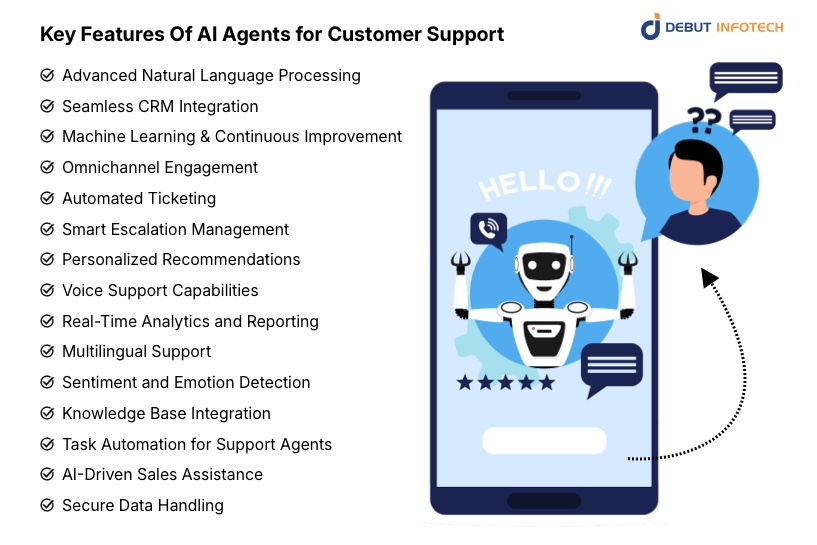
As companies increasingly embrace automation, AI virtual agents for customer support are transforming service delivery. Built on advanced AI algorithms
and supported by intelligent AI tools, these systems enhance efficiency, accuracy, and personalization. They empower businesses to resolve inquiries faster, improve customer satisfaction, and streamline the workflows of human teams.
1. Advanced Natural Language Processing
AI agents understand customer queries in everyday language, detecting context, sentiment, and intent. They interpret nuances, slang, and domain-specific terminology, enabling accurate, human-like responses across multiple channels, reducing misunderstandings, and improving first-contact resolution rates.
2. Seamless CRM Integration
The platform integrates with CRMs, ticketing systems, and enterprise databases. This ensures access to real-time customer information, purchase histories, and previous interactions, allowing faster, more accurate responses while providing a holistic view of the customer journey.
3. Machine Learning & Continuous Improvement
By analyzing past conversations and outcomes, agents continuously refine their responses. This self-learning capability enhances efficiency, reduces errors, and ensures consistent, high-quality support without constant manual intervention or updates.
4. Omnichannel Engagement
Agents operate across email, chat, social media, and voice channels. This omnichannel capability guarantees uniform customer experiences, allowing customers to switch channels seamlessly while maintaining context and continuity.
5. Automated Ticketing
AI agents generate tickets automatically in helpdesk systems, categorizing and prioritizing them based on urgency, issue type, and business rules. This reduces manual effort, accelerates resolution, and ensures no query is overlooked.
6. Smart Escalation Management
Complex or sensitive cases are automatically routed to human agents with full conversation history. This seamless handoff preserves context, reduces customer frustration, and ensures timely resolution of high-priority issues.
7. Personalized Recommendations
Agents analyze customer profiles, purchase history, and preferences to suggest tailored solutions, upsell products, or provide proactive support. This level of personalization drives customer loyalty and increases conversion rates.
8. Voice Support Capabilities
With AI voice agent services for businesses, these agents handle calls, understand speech patterns, and provide guided assistance. They can perform verification, update information, and deliver a natural, conversational experience.
9. Real-Time Analytics and Reporting
AI agents track key metrics such as resolution time, customer satisfaction, and interaction trends. Businesses gain actionable insights to improve processes, identify recurring issues, and optimize workforce allocation.
10. Multilingual Support
Agents communicate in multiple languages without additional training, enabling global support operations. This feature ensures consistent service quality for international customers and expands a company’s reach without additional staff.
11. Sentiment and Emotion Detection
By analyzing customer tone, word choice, and engagement patterns, agents detect satisfaction, frustration, or urgency. This enables appropriate responses, prioritization, and escalation, enhancing the overall experience and maintaining professionalism.
12. Knowledge Base Integration
Agents access FAQs, product manuals, and company policies in real time to provide accurate answers. Continuous updating ensures the system stays current, reducing errors and empowering both AI and human teams with verified information.
13. Task Automation for Support Agents
AI systems perform repetitive administrative tasks, such as updating records, issuing refunds, or sending follow-up notifications. This allows customer service agents to focus on high-value interactions that require human judgment.
14. AI-Driven Sales Assistance
Integrated AI sales agents help identify opportunities, suggest relevant products, and guide customers through purchases. By combining support and sales, businesses improve customer experience while increasing revenue potential.
15. Secure Data Handling
Agents comply with privacy regulations and enterprise security standards, ensuring sensitive customer data is protected during processing, storage, and integration with other systems.
Stop Losing Customers to Slow Support
Delays cost you more than money, they cost loyalty. AI agent chatbot solutions ensure instant responses that keep customers engaged and satisfied.
Transformative Use Cases of AI Agents in Customer Service
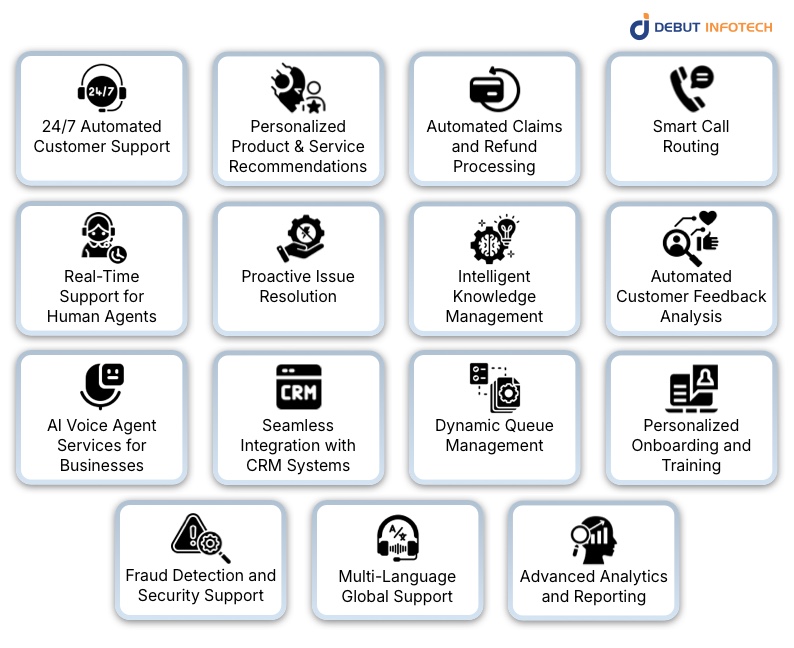
In today’s competitive landscape, enterprises need more than basic automation to meet customer expectations. AI agents provide an advanced layer of intelligence, enabling companies to manage complex customer journeys with speed and precision. Unlike traditional support tools, they don’t just respond — they analyze, predict, and act across multiple channels.
A well-structured AI agent can connect to back-end syst
ems, evaluate customer context, and execute tasks like order tracking, policy updates, or subscription management with minimal oversight. In B2B environments, where service contracts and workflows are often intricate, these agents can reduce dependencies on human teams by handling high-volume queries, generating actionable insights, and ensuring compliance across interactions.
For organizations scaling globally, AI agents also bring consistency to customer experience, making service more reliable while freeing human resources to focus on higher-value strategic initiatives.
1. 24/7 Automated Customer Support
Around-the-clock assistance is one of the most practical applications of AI agents in modern service operations. Instead of forcing customers to wait until business hours, an AI customer support agent can instantly respond at any time of day. These systems are designed to handle common queries like password resets, shipping updates, or return requests without involving human staff. The automation not only shortens response times but also ensures customers across different time zones receive consistent service experiences.
A strong example comes from H&M, the global fashion retailer, which deploys an AI chatbot on its web and mobile channels. The chatbot supports inquiries about stock availability, order tracking, and refund procedures—even during late-night sales or seasonal rushes. By deflecting thousands of repetitive tickets daily, H&M’s customer service agent team can focus on escalations while the AI maintains frontline coverage. This balance between automation and human expertise showcases how always-on agents are redefining operational efficiency in retail and beyond.
2. Personalized Product and Service Recommendations
AI agents can act as smart shopping companions by learning from customer behavior, purchase history, and browsing data to offer context-aware recommendations. Unlike generic suggestions, a support assistant agent tailors product and service options to individual users in real time. This makes interactions more engaging and increases conversion opportunities without overwhelming the customer with irrelevant choices.
Sephora, the global beauty retailer, has pioneered this approach with an interactive digital advisor embedded in its app. The system asks customers about their skin type, color preferences, and product goals. It then suggests suitable items along with tutorials, reviews, and styling tips. Instead of static catalogs, users experience a dialogue-driven discovery process that mimics personal consultations.
This use case demonstrates how recommendation engines powered by conversational intelligence enhance loyalty. Businesses in retail, travel, and banking increasingly rely on this model to upsell effectively while making customers feel understood rather than targeted.
3. Automated Claims and Refund Processing
One of the more complex applications of AI agents is streamlining claims and refund workflows. Traditionally, these processes are document-heavy, time-consuming, and prone to human error. By integrating AI tools with ticketing and financial systems, AI customer service agents can validate eligibility, process refund approvals, and issue reimbursements without manual intervention.
Lufthansa, a leading European airline, offers a strong proof point. When flights are delayed or canceled, passengers can file claims online. The airline’s AI solution verifies booking data, checks policies, and processes refunds automatically. What once took weeks of back-and-forth with a customer support agent can now be settled in hours.
This automation doesn’t just accelerate outcomes; it also reduces operational costs and ensures policy compliance. Enterprises in insurance, e-commerce, and travel are increasingly turning to custom AI Agents to replicate this speed and precision across claims-intensive services.
4. Smart Call Routing
Rather than relying on static IVR menus, AI-enabled call routing uses natural language understanding to detect intent and send callers to the right department. A modern AI voice agent can recognize phrases like “I want to change my plan” or “I need technical help” and connect customers to the correct specialist instantly.
Vodafone implemented such a system to streamline its call center operations. Instead of forcing customers to navigate multiple menu options, the AI listens actively and directs them to billing, support, or account services. This reduced average handling times and improved first-call resolution rates significantly.
This use case is particularly valuable in industries like telecom and healthcare, where customer frustration is often tied to long wait times. For AI Agents Companies, smart routing has become a priority service offering since it ensures customer issues reach the most suitable human or digital customer service agent in record time.
5. Real-Time Support for Human Agents (AI Copilots)
AI copilots function as assistants to live representatives, providing real-time suggestions, retrieving customer histories, and sourcing knowledge base entries during active conversations. This model showcases agentic AI in customer experience, where technology strengthens human decision-making instead of replacing it.
For example, financial institutions like JPMorgan Chase have experimented with AI copilots that support service desk teams. When an agent receives a complex account query, the system instantly surfaces potential answers, cross-references customer profiles, and flags compliance requirements.
This setup reduces the need for constant system-switching and helps minimize costly errors during high-pressure interactions. Many enterprises view copilots as a bridge toward the future of AI agents, creating workflows where staff remain efficient and customers receive precise, timely responses. At scale, AI copilots are becoming indispensable for industries that require accuracy, speed, and strict regulatory adherence.
Make Your Agents 10x More Productive
Don’t let your human team drown in repetitive tasks. Support assistant agents give them real-time answers and context so they can focus on what matters.
6. Proactive Issue Resolution
AI agents don’t just wait for customers to report issues; they predict and prevent them. By monitoring product usage patterns, service history, and feedback, these systems can alert customers about potential problems before they even occur. This proactive approach reduces frustration and strengthens trust.
For instance, Microsoft uses AI-driven monitoring tools across its cloud services to detect unusual account activities. Instead of waiting for users to face downtime, the system alerts customers instantly and often provides automated steps to resolve the problem.
Such foresight helps enterprises maintain strong customer relationships while lowering the load on live support teams. Businesses using AI customer service agents in this way see fewer escalations and higher satisfaction rates, proving that proactive solutions are as valuable as reactive service.
7. Intelligent Knowledge Management
AI-powered customer service agents go beyond answering queries; they actively organize, index, and retrieve knowledge across massive datasets. This ensures that both customers and support staff always get the most accurate and updated information.
Take IBM as an example. Their AI systems process complex knowledge bases and recommend context-specific answers, whether to a self-service user or a live agent. By keeping knowledge resources optimized, they make support faster and more consistent.
This approach demonstrates how AI tools can convert scattered information into a structured, accessible knowledge network. Over time, businesses using this capability report reduced handling times and improved overall service quality.
8. Automated Customer Feedback Analysis
Collecting customer feedback is easy, but analyzing it at scale is difficult. AI agents simplify this by evaluating surveys, chat logs, and call transcripts to detect sentiment, trends, and recurring issues. This empowers companies to take action quickly.
For instance, Amazon applies sentiment analysis across product reviews and support interactions to identify patterns. Instead of waiting for complaints to pile up, AI highlights problem areas so service managers can act proactively.
By doing so, organizations create a tighter loop between feedback and action. Businesses leveraging AI customer support agents for feedback management often find that customer satisfaction scores improve as issues are addressed faster and more effectively.
9. AI Voice Agent Services for Businesses
Voice-enabled AI agents allow businesses to provide support beyond chat. These systems interpret natural speech, understand intent, and respond conversationally across phone channels. This creates a seamless experience for customers who prefer calling instead of typing.
American Express, for example, uses AI voice agent services for businesses t
o manage high call volumes. The system can authenticate callers, resolve standard account queries, and escalate complex requests to human staff.
By combining natural language processing with intelligent routing, companies reduce wait times while still offering personalized interactions. This capability is particularly impactful in industries like banking, travel, and telecom, where call-based support remains a customer preference.
10. Seamless Integration with CRM Systems
AI agents are most powerful when they work hand-in-hand with existing platforms like CRMs, ticketing systems, and analytics tools. This integration ensures that customer data is centralized and accessible in real time.
Coca-Cola leverages AI integration with its CRM to streamline support for its distributors and retail partners. When a service request comes in, the AI agent instantly retrieves sales history, past tickets, and inventory data to provide faster resolutions.
This level of integration allows businesses to operate with more agility, reducing duplicate work while enabling customer service agents to make smarter decisions. For global enterprises, connected systems ensure consistent service quality across regions.
Related Read: AI Agents for Real Estate Success: A Complete Guide
11. Dynamic Queue Management
AI agents help businesses manage heavy customer support traffic by prioritizing requests based on urgency, customer profile, or issue type. This prevents bottlenecks and ensures high-value or critical cases get resolved first.
For example, Delta Airlines uses AI systems to prioritize passenger queries during peak travel disruptions. When flights are delayed, the AI automatically pushes urgent rebooking or refund requests to the top of the support queue, while routine questions are directed to self-service channels.
This kind of intelligent triaging ensures that customer support agents focus on cases that matter most. It reduces wait times for priority customers, optimizes workloads for staff, and improves overall service flow in high-pressure scenarios.
12. Personalized Onboarding and Training
AI customer service agents aren’t just for external users; they also assist with training new employees. By simulating real-world customer queries, they help recruits practice responses and learn processes faster.
Walmart has experimented with AI-driven virtual training systems that simulate customer interactions. Trainees interact with an AI agent chatbot that mimics real shoppers, providing instant feedback and guiding employees through correct responses.
This approach shortens the learning curve for new hires and ensures service quality remains consistent across teams. For businesses, it’s a scalable way to align training with actual customer expectations while reducing onboarding costs.
13. Fraud Detection and Security Support
AI agents can identify suspicious activities in real time, protecting both customers and businesses from fraud. They analyze transaction data, account behavior, and communication patterns to flag risks automatically.
PayPal integrates AI-driven fraud detection into its customer service channels. If an unusual login attempt or payment occurs, an AI customer support agent engages with the user immediately, asking for verification or guiding them through protective steps.
This proactive approach ensures threats are contained quickly while still maintaining a smooth user experience. It highlights the future of AI agents in balancing convenience with security, particularly in industries where trust is paramount.
14. Multi-Language Global Support
AI virtual agents for customer support can interact in dozens of languages without requiring separate teams for each region. This makes customer service scalable for global businesses.
Airbnb employs AI systems that translate and respond to guest and host queries in multiple languages. Instead of routing requests across regions, the system provides localized answers instantly, ensuring guests feel supported no matter where they are.
This feature helps companies enter new markets without building large multilingual teams. It also enhances accessibility for customers, making agent as a service offerings more inclusive and consistent worldwide.
15. Advanced Analytics and Reporting
Beyond direct interaction, AI agents generate detailed reports that reveal customer behavior, service performance, and operational bottlenecks. These insights help leaders refine strategy.
Nike, for example, uses AI to analyze millions of service interactions from its app and call centers. By aggregating this data, the system highlights common pain points, predicts seasonal spikes in demand, and recommends staffing adjustments.
Such analytics help organizations optimize resources while improving the experience for end users. With AI agent companies providing customizable reporting tools, businesses gain both visibility and control over their customer service operations.
Deliver Personalization That Actually Converts
Customers hate cookie-cutter replies. With agentic AI in customer experience, every interaction feels tailored, relevant, and conversion-driven.
Overcoming Barriers in AI-Driven Customer Service
Artificial intelligence has transformed customer interactions, yet its adoption comes with a set of obstacles that organizations must address strategically. From emotional recognition gaps to compliance risks, each limitation has a direct impact on customer trust and operational efficiency. Below are the primary hurdles and how modern support assistant agents and agentic AI in customer experience frameworks provide effective pathways forward.
1. Limited Emotional Recognition
Challenge: AI systems frequently miss subtle cues such as frustration, urgency, or disappointment, leading to responses that may seem impersonal during critical conversations.
AI-Driven Approach: By embedding advanced sentiment analysis and routing protocols, organizations can ensure sensitive interactions are escalated to human agents. Companies that hire AI Agent developers for continuous model refinement are seeing stronger accuracy in detecting emotional states, resulting in more empathetic and timely interventions.
2. Data Protection and Regulatory Compliance
Challenge: Handling customer data through AI platforms exposes enterprises to risks of privacy violations and regulatory breaches. Non-compliance with frameworks like GDPR or CCPA can damage both credibility and finances.
AI-Driven Approach: End-to-end encryption, secure authentication, and role-based access are now integrated within enterprise-grade agent as a service solutions. This built-in compliance reduces legal exposure and ensures customer information is safeguarded across every digital interaction.
3. Generic and Repetitive Responses
Challenge: Standardized replies often fail to address the unique circumstances of individual customers, creating a disconnect and diminishing overall satisfaction.
AI-Driven Approach: Integration with CRM platforms and purchase history enables AI service agents to tailor responses dynamically. Through an agentic AI in customer experience framework, organizations can deliver interactions that reflect prior engagements, personal preferences, and real-time context.
4. Integration Gaps Across Channels
Challenge: Many deployments operate in silos—AI chatbots working on web platforms but not extending to social, voice, or email channels. This inconsistency disrupts customer journeys.
AI-Driven Approach: Modern AI adoption emphasizes modular architecture and API-first design. Businesses that hire AI Agent developers ensure seamless synchronization across every touchpoint, building a unified and scalable support ecosystem.
5. Scalability with Global Audiences
Challenge: Serving international customers often demands multilingual support, which can be costly and resource-intensive when handled manually.
AI-Driven Approach: Multilingual support assistant agents allow companies to expand into new geographies without building large local teams. Automated translations backed by contextual learning ensure inclusivity and consistency across diverse customer bases.
6. Training and Data Dependency
Challenge: AI systems are only as strong as the data they learn from. Poor or incomplete datasets limit their accuracy, leading to irrelevant outputs.
AI-Driven Approach: Continuous retraining with high-quality datasets, domain-specific knowledge, and real-time updates ensures AI agents remain relevant. Many enterprises use agent as a service providers to maintain and fine-tune these models effectively.
7. Balancing Automation with Human Touch
Challenge: Excessive automation can create a sense of detachment, making customers feel they are talking to machines rather than a brand that cares.
AI-Driven Approach: A hybrid model, where agentic AI in customer experience supports but does not replace human representatives, helps maintain authenticity. AI copilots can suggest answers and handle routine tasks while humans manage nuanced, relationship-driven interactions.
Key Steps to Launch AI Agents in Customer Service

Implementing AI in customer operations isn’t just about plugging in a bot—it’s about creating an intelligent framework that enhances every interaction. Companies aiming to transform customer experiences should follow these essential steps:
1. Map Current Service Gaps
Begin by identifying the weak points in your workflows—whether it’s slow resolutions, costly escalation patterns, or inconsistent messaging from one customer support agent to another. This diagnostic step sets the foundation for effective automation.
2. Establish Success Benchmarks
Define clear outcomes to justify investment. Metrics like higher first-contact resolution, improved Net Promoter Scores, or measurable savings on AI development cost give leadership visibility into value creation.
3. Select a Specialized Partner
Instead of one-size-fits-all solutions, consider engaging a Custom AI Agent Development Company. These specialists ensure tailored functionality, seamless integration, and long-term scalability across multiple channels.
4. Start Small with Controlled Pilots
Introduce AI gradually, focusing on repeatable workflows such as FAQs or account updates. Use these pilots to evaluate how AI tools perform in real scenarios before expanding them to more complex operations.
5. Continuously Train with Real Data
Real-world interactions are the best source of learning. Retrain models with authentic customer conversations, feedback, and case outcomes so the system grows more accurate over time.
6. Prioritize Integration and Workflow Sync
AI agents should integrate with CRM, ticketing systems, and knowledge bases to prevent siloed responses. Seamless interoperability ensures agents have full context when engaging customers.
7. Monitor, Optimize, and Scale
Once pilots prove successful, hire AI Agent developers or extend partnerships to refine performance dashboards, retrain models, and deploy at scale. Expansion should be data-driven, ensuring the solution evolves alongside customer expectations.
Ready To Scale With Intelligent AI Agents?
From automating repetitive tasks to offering 24/7 support, our AI customer support agents transform how businesses engage with their customers.
The Future of AI Agents in Customer Service: Key Trends Reshaping the Industry
Customer support is entering a new era where customer support AI agents are no longer limited to scripted responses. They are becoming intelligent digital colleagues, capable of understanding human behavior, automating complex workflows, and delivering proactive care. The following trends highlight how agentic AI for customer support is evolving into a strategic advantage for enterprises worldwide.
1. Emotionally Intelligent Conversations
AI models are advancing to detect tone, urgency, and sentiment in real time. By adjusting responses to emotional cues, they create empathetic interactions that feel more authentic and human.
2. Multilingual Voice-Enabled Experiences
The rise of support assistant agents with natural voice recognition and multilingual capability is breaking barriers in global service delivery. Customers can engage seamlessly in their preferred language, enhancing inclusivity.
3. AI Copilots for Human Representatives
Real-time copilots now assist service staff by suggesting responses, pulling data instantly, and guiding compliance. This blended model reduces errors and accelerates resolutions while strengthening agentic AI in customer experience.
4. Deep Personalization Through Data Insights
Future-ready systems analyze behavioral patterns, purchase history, and interaction records to deliver hyper-personalized recommendations. Such tailoring drives stronger loyalty and higher lifetime value.
5. Predictive and Preventive Service Models
By applying analytics, AI agents anticipate issues before they escalate. Proactive notifications, predictive maintenance, or targeted outreach turn reactive service into preventive engagement.
6. Independent Decision-Making Capabilities
Through agent as a service models, AI can autonomously process refunds, escalate cases, and handle account updates. This reduces human dependency while improving operational efficiency.
7. Self-Evolving AI Frameworks
The best AI agents for customer support learn continuously from live interactions. Each engagement improves accuracy, tone adaptation, and efficiency, enabling businesses to scale without compromising quality.
At Debut Infotech, we’re helping enterprises embrace these emerging trends by designing AI-driven systems that balance autonomy with empathy. From emotion-aware models to predictive workflows, our solutions are setting new benchmarks in the way businesses deliver service.
Conclusion
AI agents are no longer just optional add-ons for customer support; they are becoming central to how businesses interact with their audiences at scale. By combining automation with intelligence, these systems take over repetitive tasks, personalize every touchpoint, and support human representatives with actionable insights. The evolution of customer support AI agents shows that companies can now deliver service that is always available, contextually aware, and tuned to the emotional state of the customer.
Adoption is not without challenges, including privacy concerns, integration complexities, and the risk of impersonal communication. However, with the right AI tools, careful planning, and the expertise of a Custom AI Agent Development Company, these hurdles can be turned into opportunities. Organizations that move early to build scalable frameworks, train their systems on real interactions, and focus on continuous improvement will gain a clear competitive edge.
At Debut Infotech, we believe the future of AI agents lies in creating solutions that balance autonomy with empathy, speed with personalization, and efficiency with trust. Businesses that embrace this transformation will not only cut costs but also redefine customer experiences in ways that keep them relevant, resilient, and ready for the next wave of digital innovation.
FAQ
Q. What are AI agents in customer service?
AI agents in customer service are intelligent systems designed to act as digital customer service agents. Unlike simple bots, they use NLP, contextual awareness, and sentiment analysis to manage complex conversations. A customer support AI agent can troubleshoot, guide, and escalate cases when necessary. These advanced systems boost service quality, reduce response times, and provide seamless interactions for customers across multiple touchpoints.
Q. What is agentic AI for customer experience?
Agentic AI in customer experience refers to autonomous AI systems that make context-driven decisions during interactions. Instead of offering canned replies, these AI for customer support agents analyze tone, urgency, and intent to deliver personalized resolutions.
Examples include:
* Processing refunds without human approval
* Prioritizing urgent requests automatically
* Offering recommendations based on past activity
Q. How much does it cost to build an AI agent?
The cost of building an AI agent depends on the level of complexity, personalization, integrations, and scalability. A simple AI agent chatbot for FAQs costs less, while enterprise-grade deployments with AI voice agent services for businesses, multilingual support, and predictive features require a larger investment. Partnering with AI agent companies or a custom AI development services provider ensures budgets align with long-term customer support goals.
Q. Who are the top AI agent development companies?
Several global technology leaders provide enterprise AI development services, including Microsoft, IBM, Amazon, and Google. Alongside them, many specialized AI agent companies focus on tailored solutions. Businesses looking for the best AI agents for customer support often evaluate factors like platform scalability, integration with CRMs, and ability to adapt to complex workflows before choosing the right development partner.
Q. Can AI agents connect with CRM tools?
Yes, AI customer support agents integrate with CRMs like Salesforce or HubSpot. These connections let them access histories, update records, and deliver personalized support in real time. By working as a support assistant agent, they streamline workflows, cut errors, and boost overall efficiency. This ensures service teams maintain consistency while providing smooth customer interactions that align with business goals.
Q. Are customer support AI agents safe to use?
Customer support AI agents are safe when built with proper compliance and data safeguards. Reputable AI agent companies use encryption, access controls, and GDPR-aligned processes. However, businesses must regularly monitor security frameworks to avoid risks. A well-designed AI customer support agent balances safety with performance, maintaining trust while handling sensitive customer information responsibly.
Q. Which industries use AI agents for support?
AI agents are widely used across industries because of their versatility:
1. Retail for product queries and order tracking
2. Healthcare for scheduling and patient reminders
3. Finance for fraud detection and inquiries
4. Telecom for troubleshooting network issues
5. Travel for bookings and cancellations
This broad adoption highlights how customer supportThis broad adoption highlights how customer support AI agents streamline operations while offering consistent and scalable service across diverse sectors.
Q. Can AI agents replace human support agents?
AI agents cannot fully replace human support. Instead, they complement staff by handling repetitive inquiries while people manage emotionally complex or high-value cases. Agentic AI for customer support ensures the right balance between automation and human empathy. This hybrid model allows a customer support agent to focus on complex problem-solving while AI agents cover scalable first-line interactions.
Q. How do I hire AI agent developers?
To hire AI agent developers, start by defining your service goals and required integrations. Then evaluate Custom AI Agent Development Companies that specialize in agent-as-a-service models.
Steps include:
* Define project goals and scope
* Shortlist providers with strong AI development services
* Review past projects and client feedback
* Validate skills in NLP and system integration
* Run a pilot before scaling full deployment
Talk With Our Expert
Our Related Insights


USA
Debut Infotech Global Services LLC
2102 Linden LN, Palatine, IL 60067
+1-708-515-4004
info@debutinfotech.com
UK
Debut Infotech Pvt Ltd
7 Pound Close, Yarnton, Oxfordshire, OX51QG
+44-770-304-0079
info@debutinfotech.com
Canada
Debut Infotech Pvt Ltd
326 Parkvale Drive, Kitchener, ON N2R1Y7
+1-708-515-4004
info@debutinfotech.com
INDIA
Debut Infotech Pvt Ltd
Sector 101-A, Plot No: I-42, IT City Rd, JLPL Industrial Area, Mohali, PB 140306
9888402396
info@debutinfotech.com
Talk With Our Expert
15+ years in IT
to deliver value that lasts
Over 500 success stories
including Disney, KFC, DocuSign & HDFC Bank
Team of 150 specialists
Web, mobile, Blockchain, AI & ML
Presence across 5 continents
Get Dedicated Account Managers operating in your time-zone.