
Table of Contents
Our Global Presence :


Home / Use Case /
The Role of AI in Project Management Today

What if your projects are capable of running more smoothly, more quickly and more intelligently with less manual input? Complex projects for most businesses are characterized by missed deadlines, increased costs and separated teams. However, Artificial Intelligence (AI) is coming to the rescue to address all these issues directly.
AI is reshaping project management by automating routine operations, evaluating the data set using sophisticated AI algorithms to make improved decisions, powering a new era of AI-driven project management. It is also highly effective in improving teamwork by providing immediate insights that coordinate workflow and increase project success.
Imagine a logistics company that already applied AI to make the delivery routes and resource planning more efficient. The result? Enhanced effectiveness and reduced delay in various operations.
Deloitte indicates that 83% of the companies that deployed AI found moderate to a high percentage of efficiency and decision-making gains. This increase in adoption indicates how AI can transform project implementation.
This article will discuss some major AI applications in project management, how it can be beneficial, real-life success stories, and the future of AI-led project plans.
What is Project Management?
Project management refers to the orderly procedure applied to achieve certain objectives within a defined due date, where there is efficient utilization of resources through the employment of proven processes and practices to improve project delivery. Before learning about project management it is necessary to define what a project is. A project refers to a specific type of goal-oriented effort that is definitively planned, organized, time-limited, quantifiable and flexible. These endeavors are commonly simplified into smaller and manageable functions, each keeping the single aim of producing unique products, services, processes, or intended outcomes.
The length of projects may vary, with some being completed in a matter of weeks and others taking several years and will involve a defined sequence of steps, or project life cycle. Some common projects include developing an e-commerce site, creating a new product concept, creating a corporate event, implementing a customer relationship management (CRM) system, or introducing a new supply chain process in a retail-based business, potentially enhanced by AI tools.
A project, prior to its completion, normally undergoes four main phases including initiation, planning, execution, and monitoring. These stages have to be managed to produce successful results. The study of this activity is called project management, which presupposes the involvement of professional knowledge, skills, tools, and techniques to ensure the expectations of project stakeholders and to deliver value. The project managers, who possess experience in steering the projects in their expertise, play a key role in the process of overcoming challenges and making every project come to its successful end.
Core Elements of Project Management
1. Scope: Scope is what the project involves and what it is supposed to deliver. When introducing a new customer loyalty program, scope management helps to deliver everything that is planned and does not introduce unapproved changes.
2. Risk: Risk management is the process of identifying possible uncertainties that might affect the success of the project and creating a way of alleviating these uncertainties. To give an example, during a cloud migration initiative, one should be ready to face threats like data loss, downtime, or compliance violations and provide planning and protection against those threats appropriately. AI resource management can enhance this process.
3. Time: This includes the amount of time that is available to complete the project tasks. Time management also requires one to set up workable deadlines, and ensure that the entire project structure is aligned with these deadlines.
4. Quality: Quality management is an assurance that the end product complies with the necessary standards and expectations. In terms of software products or a building project, quality assurance will provide an assurance of consistency and client satisfaction.
5. Cost: Managing project finance covers keeping track of project expenditures and budget. As an example, when creating a mobile banking app, it is critical to ensure that the cost of facilities and labor are within predetermined limits in order to prevent going over budget.
Read also – Revolutionizing Classrooms: AI Use Cases in Education
Phases of Project Management

1. Initiation: In this first phase, the project lead engages key stakeholders and sponsors to properly understand the goals of the project, project deliverables and the purpose of the project. This stage lays down the ground works and parameters of the project.
2. Planning: In the planning phase, tasks to be performed are identified, and schedules are attached to each task. Project planning with AI can enhance this process. Task dependencies are charted out and a complete documentation of the project is created to help direct the implementation. AI agents can assist in optimizing schedules and identifying potential bottlenecks. As an example, when creating a mobile app, planning would involve setting out UI/UX release points and backend integration points.
3. Execution: This phase is associated with the formation of the project team, allocation of duties, and harnessing the available budget to accomplish projects tasks. This allows the team to begin building, developing or implementing the actual elements of the project.
4. Monitoring: The project manager tracks and constantly monitors the progress which is being made on the project against the initial plan and ensures that everything is on schedule and within the scope of the project. Risks or changes are adjusted depending on the requirements.
5. Closing: The last stage is the delivery of completed work and its acceptance by the client or end users. Any loose ends, performance reviews or project lessons are closed and the project officially completed. As an example, in the case of a new company web site being deployed, a particularly important part of this process could involve providing access credentials and relating to administration, setting up analytics, and doing a final client training session.
Turn Project Chaos into AI-Driven Clarity!
Automate tasks, predict delays, and hit every deadline. Explore how our AI transforms project management from stressful to seamless.
Typical Challenges in Project Management
Project management, irrespective of size, complexity, and nature, is associated with various challenges that have the potential to affect the successful operations of projects. These difficulties cut across several areas including resource handling, risk evaluation, assuring good communication, and quality assurance. To ensure projects are delivered on time, within scope, and to the satisfaction of stakeholders, these are some of the pitfalls, which must be understood and proactively acted upon. The following is a categorization of the common project management issues and methods to solve them:
- Risk identification: By foreseeing and recognizing the threats at the initial stages of a project, it is possible to reduce the impact of interference. A risk management process that is proactive, potentially enhanced by Artificial Intelligence (AI), will help to ensure that plans to counter the risks are prepared before problems severely worsen.
- Resource allocation: Project efficiency requires the deployment of the right personnel, tools and budget on the right tasks. In absence of proper allocation, teams can end up overloaded, underutilized, or experiencing delays that can impact on the overall project performance. Exploring AI project solutions can optimize this process, ensuring resources are matched effectively to tasks.
- Communication flow: Ensuring effective communication among the involved parties can promote teamwork and cooperation. Formal communication protocols avoid miscommunications and help teams stay on the same goals.
- Performance tracking: It is important to monitor project milestones and KPIs in order to get the project on the right path. Nevertheless, the manual collection and analysis of performance data may take a lot of time and still be susceptible to errors.
- Scheduling and timeline coordination: Building a practical and effective schedule takes a lot of planning in terms of prioritizing the activities and the resources. In any design, a bad schedule may result in duplication of duties or wasted time thus slowing down productivity.
- Data handling and insights: Managing multiple projects with a lot of information involved in it like timelines, budgets, work assignments may seem overwhelming. Unorganized control of data makes it hard to notice the patterns or even make specific decisions timely. To illustrate, AI-driven project management enables examining performance metrics within systems like an internal CRM much more effectively. This helps identify inefficiencies at an earlier stage of the project lifecycle by applying Machine Learning (ML) to uncover hidden trends.
- Managing changes: Changes in project scope, needs of those involved, or external changes like regulatory changes are unavoidable. An interactive change management cycle aids in determining impacts and adjusting the project plan without destabilizing the project.
- Document control: Accountability and governance requires organizing project documentation, legal contracts, compliance records and change logs. This eliminates administrative friction and brings transparency since the documents are centrally stored and retrieved.
These mainstreamed challenges need both strategic planning, monitoring in real-time, and intelligent tools. The use of AI-powered solutions may be used to improve project management through automation of routine work, creation of meaningful insights, and assisting teams with more informed choices throughout the execution process.
AI Applications in Project Management
Artificial intelligence (AI) is transforming the methodology of handling projects by making them more orderly, improving decision making, and offering evidence-based information. AI is facilitating efficient and strategic functioning of project teams by automating repetitive operations and foreseeing threats. The following are examples of some of the major uses (AI use cases) of AI in project management with new illustrations for examples of AI in project management:
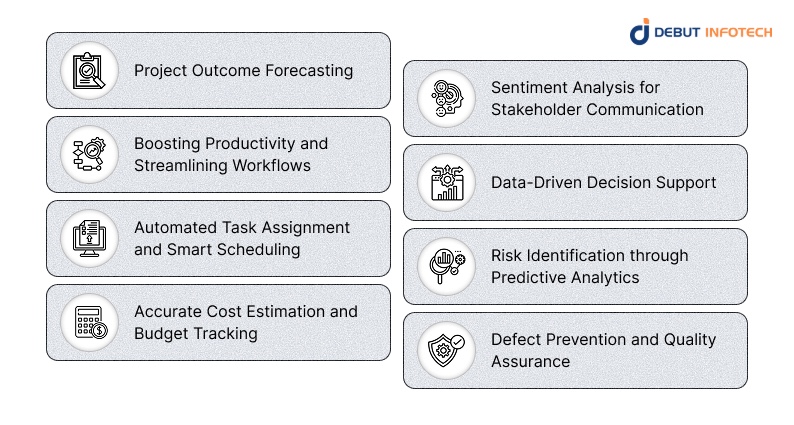
1. Project Outcome Forecasting
Machine learning enables AI to predict key project metrics such as likely completion dates, future resources required and deliverable readiness. This enables early intervention and more confident planning. For example, in aerospace engineering, predictive models can actually forecast when design review readiness will happen by using previous cycle times and current task progress.
2. Boosting Productivity and Streamlining Workflows
AI can be used to increase productivity by automating notifications, tracking tasks, and other regular communications such as reminder notice on deadlines. It can also find inefficiencies by analyzing the interactions in teams and workflow patterns. As an example, when working on a product design project, AI can bring up the insight that the prototyping stage is always slow because of miscommunication and propose changes that would increase people’s collaborative efforts.
3. Automated Task Assignment and Smart Scheduling
With AI, project managers can set up automated task assignments and schedules depending on the skills of the team members, their availability, delivery deadlines, as well as the workload capacity. This fluid system allows optimal utilization of resources as well as responsive shifts to project needs. As an example, when running a marketing campaign project, AI could automatically allocate the content writing tasks to the list of available copy writers and arrange reviews depending on stakeholder schedules to speed up the process.
4. Accurate Cost Estimation and Budget Tracking
By scrutinizing historical projects in terms of cost, change in scope, and risk categories, AI can assist in developing very accurate budgetary expectations. This will help in improved financial planning and on-time cost checking. To give an example, in terms of real estate development, AI will be able to calculate prices on the market, supplier prices, and the effect of the changing of the seasons in order to derive more exact costs of the materials and human workforce.
5. Sentiment Analysis for Stakeholder Communication
With natural language processing, AI can process emails, surveys, and meeting transcripts to measure the sentiment of the stakeholders. The information allows project managers to modify their messaging or handle dissatisfaction in the early stages. Sentiment analysis could also be used in government infrastructure projects and identify areas (environmental issues ) that people are particularly concerned about so that communication strategies can be honed.
6. Data-Driven Decision Support
Instead of following their guts, AI can guide project managers to make better decisions by processing large amounts of information and pinpointing crucial performance metrics. It is more than just automating checklists and giving strategic recommendations. Consider the example of Deloitte, who employs the help of AI systems to assist in the planning and prioritization of resources in corporate-wide projects.
7. Risk Identification through Predictive Analytics
AI applications analyze past events and current inputs in a project to predict risks e.g. scope creep or schedule overrun. These forecasting abilities of AI models make planning ahead possible. According to a report by Gartner, predictive AI has the ability to lower the risk of delivery and enhance the general level of success. In hardware development, as an example, predictive modeling can highlight any future manufacturing delays posed by supply chain problems.
8. Defect Prevention and Quality Assurance
A core aspect of AI based project management, using the previous performance records, AI models can predict possible defects such that a team can correct them before they develop into a larger problem. In the case of mobile app development, AI can be used to analyze commits and testing logs to understand which modules are likely to cause bugs, then developers can concentrate their quality work where it is most needed.
These AI applications in project management can greatly boost operational efficiency, minimize potential risks, and support smarter decision-making across diverse industries resulting in more successful and streamlined project execution.
How Debut Infotech’s AI Services Are Revolutionizing Project Management
Debut Infotech is an organization that provides innovative and advanced generative AI development services that greatly improve project management in all sectors. Through access to the proprietary data of clients, with a variety of formats, including documents, spreadsheets, database structures, and emails, Debut Infotech custom-trains large language models like GPT-4, Claude, LLaMA 2, and Mistral to create contextually aware intelligent systems adapted to organizational processes.
Project management is a dynamic field that has increasingly become a challenge to companies because of issues such as resource allocation, deadline pressure, document handling, scheduling conflicts, and data silos. The AI solutions offered by Debut Infotech assist in resolving these problems with their intelligent, no-code platform enabling teams to construct and modify processes using LLMs. They combine prompt logic, media processing and automated reasoning in simplified project pipelines, without needing deep technical knowledge.
For example, demonstrating key AI use cases in project management, a logistics firm can use Debut Infotech’s AI capabilities to automatically generate delivery schedules, forecast resource needs, and flag potential delays by analyzing internal communication, task progress, and historical data patterns. Such AI-powered tools can accommodate changing priorities and information, allowing active management of projects.
The solutions offered by Debut Infotech can assist teams with streamlining the planning process, enhancing access to the existing knowledge, defining resource allocation, and speeding up decision-making. Aspects such as real-time data analysis, risk prediction, automation of tasks and customizable dashboards enhance the accuracy and fast responsiveness of projects as well as ensuring enterprise grade security and compliance of data.
With direct integration into project management processes and AI integration project progress report, Debut Infotech gives an organization the ability to minimize overhead costs, boost teamwork, and manage project delivery with more effectiveness and ultimately lead to greater business results in an ever-changing world.
Related Read: How AI In Inventory Management Is Transforming Business Operations
Advantages of AI in Project Management
AI is transforming how organizations embrace project management through increased efficiency, effective streamlining of various workflows and better decision-making. The major impacts of AI on improved project outcomes are indicated below:
1. Workflow Optimization
AI is capable of recognizing any inefficiency or redundancies in project processes and proposing smarter solutions. This non-stop optimization enables teams to have reduced delays, fewer errors and all in all become more productive.
2. Intelligent Budget Forecasting
AI can look at historical fiscal data (with robust AI data security) and present project variables to offer a better prediction of budgets. It assists in forecasting cost overruns and recommends some changes to ensure that expenditures do not exceed the budget which enables better financial planning and control.
3. Advanced Data Analysis and Insights
AI is able to analyze sizable amounts of the data associated with a project including the previous performance rates, workloads inside the team, and milestone schedules. This allows project teams to derive trends, spot bottlenecks and make data-based decisions to enhance performance.
4. Adaptive Scheduling
AI tools are flexible enough to change project schedules in real-time, including changes in resource availability, relationships between tasks and project delays. This flexibility makes scheduling far more precise and makes teams more agile to change.
5. Enhanced Communication Tools
Assistants or bots empowered by AI, often the result of AI chatbot development, can automate frequently asked questions and reminders, maintain meeting schedules, eliminate some miscommunication and keep everyone updated without the continual need of a manual touch.
6. Enhanced Decision Support
AI gives decision-makers actionable insights by integrating real-time data and making predictions based on them. This underpins stronger, quicker, and more confident decision-making in AI project management, particularly where the project environment is complex or fast-changing.
7. Streamlined Collaboration
AI promotes collaboration through the use of features such as real-time document sharing, version control, and synchronization of tasks, making stakeholders to always be connected and stay informed even when in different locations or departments.
8. Smarter Task Prioritization
AI assists in prioritization on what is most urgent or important by looking at the dependencies, deadlines, and relatedness of their relevance to critical goals. This makes teams devoted to high value work.
9. Effective Risk Identification and Mitigation
AI is able to identify early warning indicators of project risks e.g. scope creep or resource overload, and prescribe actions to mitigate them. This enhances improved risk planning and control during the project life.
10. Cost Efficiency
The fact that AI can perform better scheduling, allocate resources more effectively, and minimize manual labor helps save costs and improve return on investment.
Traditional vs. AI-Powered Project Management Approaches
| Aspect | AI-Powered Project Management | Traditional Project Management |
| Automation | Streamlines repetitive workflows such as status updates or report generation through intelligent automation. | Depends heavily on manual processes, which can be time-consuming and prone to oversight. |
| Data Analysis | Processes and analyzes large volumes of real-time data for informed planning, forecasting, and optimization. | Uses limited data analysis based mainly on past performance or static reports. |
| Risk Management | Identifies and mitigates potential risks early using AI algorithms that evaluate patterns and anomalies. | Risk is addressed reactively, often after issues have already emerged. |
| Resource Allocation | Dynamically assigns resources based on task priorities, deadlines, and team capacity using smart algorithms. | Allocation typically depends on human judgment and manual tracking, which may not reflect real-time project needs. |
| Collaboration | Facilitates seamless collaboration with AI-assisted chat interfaces, document sharing, and real-time updates. | Team communication is often limited to emails, spreadsheets, and scheduled meetings. |
| Project Monitoring | Enables real-time dashboards and intelligent alerts, helping teams adjust before problems escalate. | Monitoring is periodic and relies on manually compiled progress reports. |
| Decision Support | Provides AI-generated insights that assist project managers in making faster, data-backed decisions. | Relies mostly on experience and available historical information, which can be incomplete or outdated. |
| Predictive Analytics | Leverages machine learning to anticipate delays, budget overruns, or resource bottlenecks. | Lacks the tools to forecast outcomes accurately, leading to reactive problem-solving. |
| Cost Efficiency | Cuts down operational costs through automation, better resource planning, and fewer project disruptions. | Inefficiencies in task management and resource use can lead to increased project costs. |
| Adaptability to Change | Reacts quickly to shifting goals, timelines, or market dynamics with minimal disruption. | Often struggles to pivot when priorities or conditions suddenly change. |
| Project Success Rate | Higher likelihood of project success due to early risk detection, proactive planning, and real-time decision-making. | Success can vary depending on the skill level of project managers and how well they manage unforeseen issues. |
AI Models and Techniques Used in Project Management
AI is transforming project management by automating processes and tasks, enhancing forecasting, and making smarter decisions throughout each step in a project. Debut Infotech, a leading AI consulting firm, assists organizations in realizing the potential of AI by providing innovative development services to minimize project risks and promote efficient operations, visibility, and efficiency across the project lifecycle.
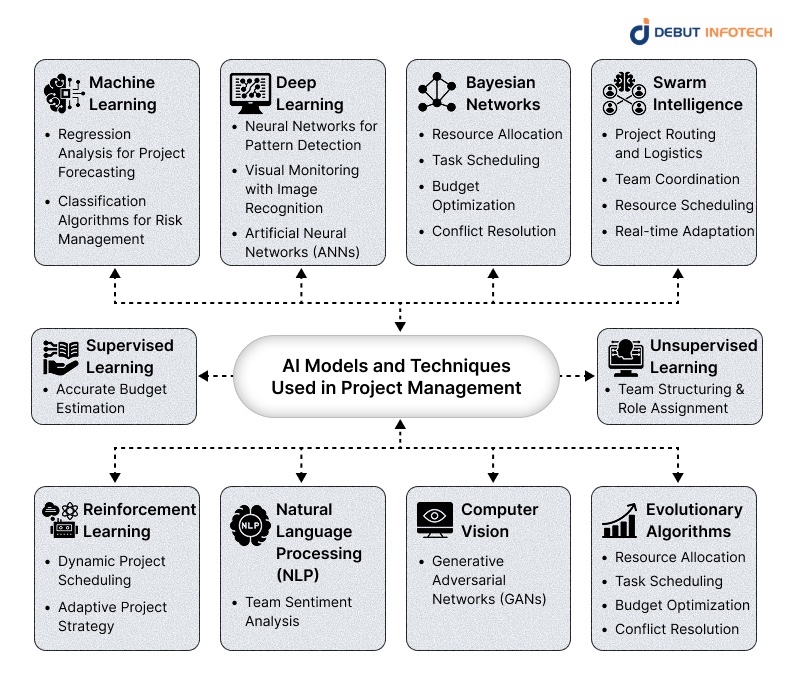
The following are the most important AI models and techniques that are having a considerable influence on project delivery and efficiency:
A. Machine Learning (ML)
1. Regression Analysis for Project Forecasting
Machine learning regression models allow previewing of schedules, budgets, and resource requirements based on the past project data. This enables teams to make informed estimates, and minimize chances of cost over-spends.
Example: Estimating the cost of construction and time of construction of new residential properties based on the historical data of construction.
2. Classification Algorithms for Risk Management
Risk identification and classification are possible by use of classification models which identify and categorize risks using past patterns and projected variables. This aids in proactive planning as it brings out high risk elements early. These models highlight the role of AI in project management, helping teams anticipate and manage risks more effectively.
Example: Sorting tasks in software development into groups depending on likelihood of delays or change in requirements.
B. Deep Learning
1. Neural Networks for Pattern Detection
Deep neural networks find patterns and associations within complex data which assist project administrators in identifying errors or waste.
Example: Detecting bottlenecks of large-scale logistics projects based on trends of workflows.
2. Visual Monitoring with Image Recognition
Visual inputs, such as photos and surveillance at project sites can be analyzed by AI to monitor project progress and compliance in a real-time manner.
Example: Managing safety on site infrastructure projects by drone imagery.
3. Artificial Neural Networks (ANNs)
ANNs assist in activities such as predicting cost over-runs, optimization of project phases, and infrastructure planning.
Example: Describing the costs of railway construction in the future using the past fluctuation patterns.
C. Reinforcement Learning
1. Dynamic Project Scheduling
Reinforcement learning is a method that allows AI to streamline project schedules through simulation and evaluation of results.
Examples: Frequent variations of manpower and equipment distribution based on on-site changing conditions.
2. Adaptive Project Strategy
These models change as project data continue to fuel adjustments in real-time, enabling project agile responses to unexpected incidents.
Example: Rescheduling dates and sequencing due to delays in the supply chain.
D. Supervised Learning
1. Accurate Budget Estimation
Supervised models rely on labeled historical data to make more accurate predictions about the cost of projects, which can improve financial planning.
Example: Analyzing previous cost and performance of teams that performed IT infrastructure projects and use this to forecast the project budgets.
E. Unsupervised Learning
1. Team Structuring and Role Assignment
Clustering algorithms can be used to group team members by work styles or communication preferences to allow more synergy and productivity.
Example: Creating automatic agile teams that can handle software creation based on technical excellence and teamwork styles.
F. Natural Language Processing (NLP)
1. Team Sentiment Analysis
NLP analyzes internal messages such as log files of chats and email messages to determine the team spirit and the quality of communication.
Example: Spotting the negative trends within engineering teams and intervening before productivity begins to drop.
G. Computer Vision
1. Generative Adversarial Networks (GANs)
GANs create simulated project scenarios that can be subjected to synthetic stress-tests to find faults in advance.
Example: Simulating disaster recovery strategies for data centers under various threat scenarios.
H. Bayesian Networks
Bayesian networks refer to probabilistic graphical models that are used to describe variables and conditional dependencies. They prove useful in managing projects to overcome uncertainty and make considerable predictions in an environment of incomplete data. As organizations explore using AI for project management, Bayesian networks offer a valuable approach to decision-making under uncertainty.
Applications in Project Management:
- Risk Assessment: Modeling and estimating the occurrence of the risk of the project based on combinations.
- Decision Support: Analysis of the most appropriate course of action in case of several ambiguous variables.
- Scenario Analysis: Analyzing possible scenarios to assist contingency planning.
- Progress Forecasting: Prediction of possibilities of project milestones achieved using real-time entry.
Example: A Bayesian network is applied in a software roll out project to evaluate the effects of delay in a given stage (e.g. UI design) on overall schedules and costs when interconnected with QA dependencies.
I. Evolutionary Algorithms
Evolutionary algorithms are optimization techniques inspired by natural selection. They iteratively evolve solutions to complex problems, making them ideal for multi-variable project optimization.
Applications:
- Resource Allocation: Find the most effective utilisation of the limited project resources.
- Task Scheduling: Changing desirable patterns of tasks processing.
- Budget Optimization: Balancing costs across competing priorities.
- Conflict Resolution: Locating compromise solutions within the dimensions of multi-stakeholder settings.
Example: An evolutionary algorithm comes into play during the process of a smart city project development and optimizes the task order and resource allocation between several parallel teams working on the infrastructure construction, integration of IoT, and the deployment of energy management.
J. Swarm Intelligence
Swarm intelligence is a model of collective behavior which is inspired by natural swarm behaviors akin to behaviors exhibited by insect colonies (e.g.: ants or bees). It is especially applicable in distributed project settings as well as coordination in large-scale environments.
Types:
- Ant Colony Optimization (ACO)
- Particle Swarm Optimization (PSO)
Use Cases:
- Project Routing and Logistics: Optimizing material delivery paths in construction or supply chain projects.
- Team Coordination: Assigning distributed teams to tasks based on availability and priority.
- Resource Scheduling: Managing shared resources across multiple projects.
- Real-time Adaptation: Reconfiguring plans dynamically in response to live project data.
Example: As part of a multi-site manufacturing endeavor, ACO algorithms can optimize routes of transporting raw materials, and dynamically respond to delivery requirements and disturbances in the road conditions.
How Companies Are Using AI to Transform Project Management
The use of AI is gaining prominence as a part of contemporary project management because it allows organizations to outsource the majority of their mundane tasks, enhance their risk management processes, and provide more time-sensitive, data-driven decision making. This is how some companies are using AI in their projects:
Amazon
Amazon integrates AI into its internal project monitoring systems to model delivery schedule, streamline resources, and limit the impacts of supply chain disruption. Based on historical data, AI models compare actual performance with planned performance and send warning signs to project teams so that they can make timely adjustments. As an example, when it comes to big logistics initiatives, AI can be used by Amazon to predict inventory requirements and assist in optimizing fulfillment approaches. This reflects a growing trend among enterprises that use AI for project management to drive efficiency.
Google is also using AI to help its productivity tools to manage projects across groups. As an example, Google Sheets applies machine learning to automatically complete data, identify anomalies and provide data visualizations that can be used to make decisions. Google Meet and Docs also use AI to provide real-time transcribing, language translation and collaborative editing, doubling usage in globally distributed teams.
Siemens
Siemens uses AI in controlling multi-faceted engineering and infrastructure projects. Their AI programs scan past project data and sensor inputs of equipment to predict forthcoming maintenance requirements and adjust project schedules as such. As an example, AI can be used in smart factory projects to synchronize schedules between hardware and software.
Accenture
Accenture applies AI to provide more effective project outputs to its clients in all industries. They use artificial intelligence tools for project management, including AI-based dashboards in their project management teams to keep track of project progress, identify scope creep, and streamline the use of resources. In one instance, AI assisted one of the clients in the energy industry to switch to delivering its projects in a decrease of 25% by analyzing the redundancy in the workflow and moving resources around in real-time. If you’re looking to implement similar solutions, consider working with leading AI development companies that specialize in enterprise-grade project management tools.
Tata Consultancy Services (TCS)
TCS uses AI in the framework of internal and client-related projects to enhance accuracy in planning and increase team efficiency. Their AI algorithms are used to forecast possible blockers of the project, delivery timeframes, and even task suggestions. In one example, AI was used in a digital transformation process with a retail client where AI happened to notice poor performing workflows in advance enough so that the team could make corrections before delays became an issue.
Future Trends of AI in Project Management
The role of AI in project management is quickly transforming the manner in which teams communicate and collaborate and deliver solutions. The following are some of the emerging trends that shows how AI will change the field of project management in the near future:
1. Personalized Project Experiences
AI promotes a more personalized experience of project management, as it can adjust dashboards, notify users, and communicate in different manners fitting various members of the team. This customization has the potential to enhance involvement and minimize friction. As an example, a design lead can be presented with visual task summaries, whereas a developer would have a detailed sprint timeline. This is just one way using AI for project management can improve clarity and workflow efficiency across departments.
2. Workforce Reskilling and Ethical AI Use
As projects are increasingly managed using AI, organizations are also focusing on reskilling its workers in data processing and AI implementations. Among them are also ethical issues such as algorithmic bias or over-trust of AI decisions. Representing a wide scope of professional fields, culturally diverse multidisciplinary teams are needed to secure ethical and successful AI implementation.
3. Automation of Repetitive Tasks
AI is quickly becoming a way of mechanizing routine tasks that are time-consuming, including producing progress updates, tracking budget adjustments, and tending to checklists of actions. This allows project managers to concentrate on strategy, team management, and client interaction at the highest level. To illustrate, AI will be able to generate consolidated weekly updates of various data sources and save hours of cumulative work.
4. Hybrid Methodologies
The integration of the agile and traditional approaches to project management is becoming a rule. Artificial intelligence facilitates this hybrid style and aligns time schedules, team activities and communications with companywide objectives. Let us say the software team adopts Agile-based sprints and the marketing takes a more linear format- AI can fill the gap between the two processes.
5. Smarter Analytics and Predictive Planning
Analytics based on AI will be instrumental in making more accurate calculations of costs, schedules, and risks. The use of predictive models can be helpful in predicting possible problems, such as exceeded budget or team burnout, sooner, to be able to intervene at a more strategic level.
6. Strengthening Cybersecurity Practices
Cybersecurity concerns are also emerging as AI can be implemented in project management. With increasing project information being accommodated online it becomes critically important to guard access rights by role based controls and detect abnormal activity. Groups will be required to implement security practices and AI-driven surveillance to protect classified data on projects.
AI project management is the future due to efficiency, adaptability, and the capability to contribute to better decision-making. The gainers will be the companies that adopt AI, especially those that hire AI developers to build tailored solutions, giving them a competitive edge as the industry shifts toward digital transformation.
Ready to Unlock AI-Powered Project Success?
Let’s build a custom AI solution that streamlines your workflows and boosts team productivity.
Final Thoughts
Artificial Intelligence is already transforming the future of project management by shifting it out of manual project work and being based on intuitive choices to a more automated system that is data-driven and based on smart, streamlined choices. Whether it is predicting the risks of a project or allocating resources in real-time, AI represents a promising toolkit that can be used to improve productivity and project success.
In this article, we have learned how artificial intelligence for project managers can solve some of the most critical project management pain points, such as taking care of routine administration tasks, perfecting cross-functional communication, or flexing schedules in line with dynamic priorities. Applying these technologies in real life scenarios such as a large international construction company using AI to actively predict and identify delays and cost increase demonstrates the quantifiable impact.
With AI maturing, there are likely to be more predictive, responsive, and agile project settings. Companies that make an effort to align their teams with the smart tools will be more prepared to grow, innovate, and dominate their markets.
Staying afloat in the current competitive environment is not the only reason to embrace artificial intelligence in project management; it is a way of surging ahead.
Looking to bring intelligence and agility to your project workflows? Partner with Debut Infotech to unlock AI-driven project management solutions powered by artificial intelligence technology that deliver results.
Frequently Asked Questions (FAQs)
Q. How is AI used in project management?
A. For project management teams, AI can streamline key task management activities like scheduling, progress tracking, and status reporting. It also enhances the efficiency and quality of customer service and support through intelligent automation.
Q. How do I use AI in my project?
A. How to Successfully Build an AI Project in 8 Practical Steps
– Set Clear Project Objectives
– Determine the Suitable AI Strategy
– Gather and Prepare Quality Data
– Choose the Right Tools and Frameworks
– Develop and Train Your AI Model
– Incorporate AI into Your Project Workflow
– Test Thoroughly and Ensure Accuracy
– Launch and Continuously Monitor Performance
Q. How many project managers use AI?
A. Seven out of ten project managers now use AI in their daily workflows, and the same number report that it’s leading to better project outcomes
Q. What is generative AI for project management?
A. Generative AI is reshaping project management by improving task automation, decision-making, risk management, and team collaboration. Yet, successful adoption requires a strategic approach, one that balances performance gains with ethical standards and regulatory compliance.
Talk With Our Expert
Our Related Insights


USA
Debut Infotech Global Services LLC
2102 Linden LN, Palatine, IL 60067
+1-708-515-4004
info@debutinfotech.com
UK
Debut Infotech Pvt Ltd
7 Pound Close, Yarnton, Oxfordshire, OX51QG
+44-770-304-0079
info@debutinfotech.com
Canada
Debut Infotech Pvt Ltd
326 Parkvale Drive, Kitchener, ON N2R1Y7
+1-708-515-4004
info@debutinfotech.com
INDIA
Debut Infotech Pvt Ltd
Sector 101-A, Plot No: I-42, IT City Rd, JLPL Industrial Area, Mohali, PB 140306
9888402396
info@debutinfotech.com
Talk With Our Expert
15+ years in IT
to deliver value that lasts
Over 500 success stories
including Disney, KFC, DocuSign & HDFC Bank
Team of 150 specialists
Web, mobile, Blockchain, AI & ML
Presence across 5 continents
Get Dedicated Account Managers operating in your time-zone.