ON THIS PAGE
Progress0%





Our Global Presence :





One of the most significant advancements in the current state of artificial intelligence is generative AI fine-tuning. As companies go toward automation that is specific to their field, tailored experiences, and AI systems that are very accurate, fine-tuning models is no longer an option; it is a must. When companies use general-purpose broad language models, they generally don’t get very accurate results. However, businesses may turn an existing foundation model into a specialized, high-performance system that is suited to their own data, workflows, and industry requirements by fine-tuning generative AI.
In this post, we discuss what fine-tuning actually means, how it works, why it matters, and how organizations can utilize it to build competitive, next-generation AI capabilities. The role of fine-tuning models will continue to grow quickly as generative AI becomes more and more integrated into customer service, automation, research, creative processes, analytics, and business operations. Everything you need to understand is laid out in this guide.
Fine-tuning AI models refers to the process of taking a pre-trained foundation model — such as a transformer-based LLM, multimodal model, GAN, or diffusion model — and retraining it using additional domain-specific data. Instead of building models from scratch, organizations “teach” existing models their proprietary knowledge, terminology, tone, workflows, and compliance needs.
Unlike general-purpose GenAI systems, a fine-tuned model delivers more precise, reliable results because it reflects your business context. This process is at the center of modern Generative AI development services. Companies across healthcare, fintech, real estate, e-commerce, supply chain, and cybersecurity now use fine-tuned models for automation and decision support.
Fine-tuning AI models also improves personalization, efficiency, content quality, and task accuracy. Whether you’re building customer service agents, research copilots, analytic engines, or automated internal workflows, fine-tuned models outperform generic LLMs by a significant margin.
The rise of Generative AI has reshaped digital transformation. But general-purpose models come with limitations: hallucinations, generic output, missing domain context, and difficulty handling organization-specific data. Fine-tuning solves these issues by creating specialized AI systems that truly understand your business.
Fine-tuning matters because it delivers several mission-critical advantages:
Higher Accuracy and Reliability:
A fine-tuned model absorbs specialized terminology, regulatory requirements, and operational logic. This makes its responses more context-aware and trustworthy — a core requirement in fields like healthcare, finance, insurance, legal tech, and compliance-heavy industries.
Lower Operating Costs:
Training a model from scratch requires enormous computational resources. Fine-tuning, however, enhances performance using a fraction of the cost. It also reduces error rates, speeds up workflows, and boosts automation efficiency, cutting operational expenses over time.
Better Brand Alignment:
Companies need AI that sounds like their company. Fine-tuned systems maintain consistent tone, adhere to internal guidelines, and follow brand-approved communication styles across content generation, customer service, and product interactions.
Competitive Differentiation:
Organizations that deploy specialized, fine-tuned AI models can outperform competitors using generic tools. Tailored reasoning, faster decision-making, and domain-specific capabilities become long-term strategic assets that strengthen product offerings and market positioning.
In a landscape where every business is adopting AI, fine-tuning is what separates industry leaders from followers — turning AI from a general helper into a high-precision, business-ready powerhouse.
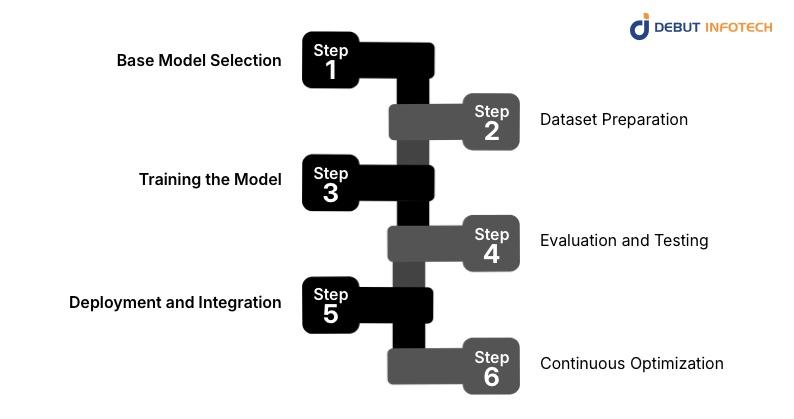
Generative AI fine-tuning follows a structured workflow that brings together machine learning expertise, high-quality datasets, and iterative optimization. The goal is to adapt a general-purpose model so it performs exceptionally well within a specific domain, use case, or business environment.
The first step involves choosing a strong foundation model — whether a transformer-based LLM, a diffusion model for image generation, or a generative adversarial network (GAN). Generative AI development companies analyze multiple factors such as the model’s size, architecture type, latency requirements, multilingual abilities, and its alignment with project goals. Selecting the right base model ensures the fine-tuning process starts on solid ground.
Fine-tuning models requires high-quality, domain-specific datasets that accurately represent the tasks the model must perform. This often includes chat transcripts, support tickets, emails, technical manuals, clinical data, financial statements, product catalogs, or compliance documents. Teams clean and label the data, remove noise, and structure it according to model requirements. Well-prepared datasets significantly improve the performance of any AI fine-tuned system.
During training, data is fed into the model in repeated cycles, gradually adjusting its internal weights. This process “teaches” the AI context, terminology, workflows, and rules specific to the business. It also refines patterns such as tone of voice, domain reasoning, and task-specific logic. Fine-tuning models may range from light-touch parameter updates to full-scale instruction tuning, depending on complexity.
Once training is complete, the model undergoes extensive testing to measure accuracy, contextual understanding, hallucination rates, ethical compliance, and safety alignment. Evaluation benchmarks include precision, recall, response structure, domain expertise, and consistency under stress tests. This ensures the fine-tuned model responds reliably in real-world conditions.
After validation, the fine-tuned model is integrated into business systems such as apps, dashboards, CRM workflows, automation agents, chatbots, analytics engines, or enterprise APIs. Generative AI Integration Services ensure seamless adoption without disrupting existing processes. Proper deployment allows businesses to start using the model immediately for tasks like customer support, document generation, predictive insights, or internal automation.
Fine-tuning is an ongoing cycle, not a one-off task. As businesses grow and market conditions evolve, data shifts — and the AI must keep up. Companies routinely update datasets, re-train models, expand use cases, and refine outputs through reinforcement techniques. Continuous improvement ensures long-term accuracy, safety, and competitive advantage.
Generative AI frameworks support multiple fine-tuning approaches, each designed to optimize performance based on the organization’s goals, data environment, and technical constraints.
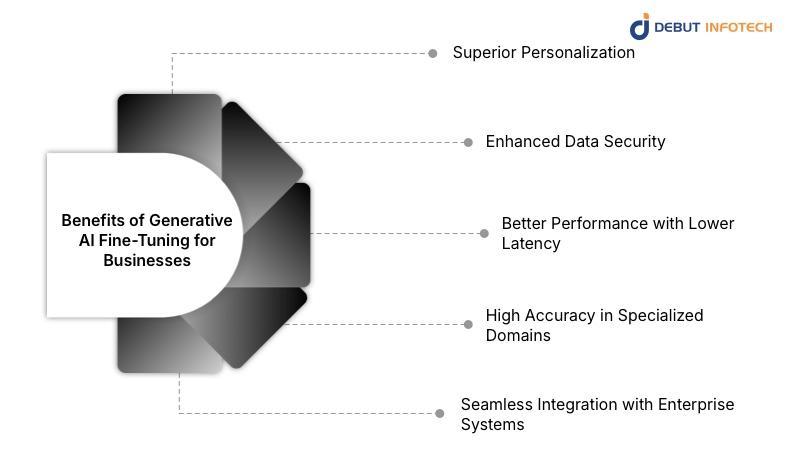
Fine-tuned models unlock business capabilities that generic AI tools can’t deliver.
1. Superior Personalization: Fine-tuned models adapt to your customer journey, brand tone, and product behavior — making them ideal for sales, support, and marketing automation.
2. Enhanced Data Security: Businesses can restrict fine-tuning to private datasets, ensuring that sensitive information never leaves their environment.
3. Better Performance with Lower Latency: A smaller, fine-tuned model can outperform a larger generic model — improving speed and reducing deployment cost.
4. High Accuracy in Specialized Domains: Sectors such as finance, medicine, law, and engineering require deep contextual understanding. Fine-tuning ensures alignment with domain regulations and workflows.
5. Seamless Integration with Enterprise Systems: With Generative AI integration services, fine-tuned models connect smoothly to CRMs, ERPs, document systems, and internal databases.
Fine-tuned generative AI models power applications across nearly every industry.
Fine-tuning generative AI models relies heavily on a powerful ecosystem of tools, libraries, and orchestration frameworks that streamline training, evaluation, and deployment. Modern generative AI development companies use a combination of these technologies to accelerate workflows, reduce computational overhead, and maintain high-quality outputs.
HuggingFace Transformers is one of the most widely adopted frameworks, offering pre-trained models and utilities that simplify fine-tuning across NLP, vision, and multimodal tasks. PyTorch Lightning and TensorFlow provide the core deep-learning infrastructure needed for training fine-tuned models at scale, while LoRA and QLoRA adapters make it possible to fine-tune large models efficiently on limited hardware.
For orchestration, tools like LangChain and LlamaIndex enable seamless integration of fine-tuned models into applications, allowing businesses to build chatbots, agents, and automation systems with contextual memory. Weights & Biases supports experiment tracking, versioning, and performance monitoring—critical for maintaining iterative AI workflows.
Finally, vector databases such as Pinecone, Milvus, and Weaviate play a key role in retrieval-augmented generation (RAG), ensuring fine-tuned models can access accurate, up-to-date information. Together, these tools form the backbone of enterprise-grade Generative AI Integration Services.
Fine-tuning isn’t required for every AI application, but it becomes a strategic priority when businesses need precision, domain intelligence, and long-term scalability. Organizations should seriously consider Gen AI fine-tuning when the following conditions apply:
Industries with specialized jargon or complex workflows—such as medicine, law, banking, aviation, manufacturing, or energy—cannot rely on generic models. Fine-tuning ensures the AI understands your exact terminology, processes, and compliance language.
If your application involves regulatory, financial, or safety-critical decisions, accuracy becomes mission-critical. Fine-tuned models dramatically reduce hallucinations and improve outcome reliability, making them essential for enterprise-grade deployments.
Businesses that deploy AI for customer service, marketing, or internal knowledge systems need consistent tone and style. Fine-tuning trains the model to speak in your brand’s voice, maintain your communication style, and follow your internal guidelines.
Fine-tuned smaller models often outperform larger general-purpose models in niche tasks. This leads to major cost savings by reducing API calls, improving inference efficiency, and optimizing compute consumption across applications.
When your AI product or platform must outperform competitors, fine-tuning provides the edge. It enables bespoke behavior, unique capabilities, and custom workflows that generic models cannot replicate—strengthening your innovation moat.
While fine-tuning offers huge advantages, it also comes with challenges:
Fine-tuning Generative AI models is far more complex than uploading a dataset and pressing a button. It requires deep expertise in machine learning, prompt engineering, data preprocessing, parameter-efficient tuning, vector database management, and secure deployment pipelines. A professional generative AI development company ensures that every stage—from dataset preparation to continuous optimization—follows industry standards, compliance rules, and best-practice engineering methods.
Debut Infotech helps businesses fine tune models, build reliable AI systems, and convert raw enterprise data into powerful, domain-tailored intelligence. Our team architect solutions that include custom GenAI copilots, workflow automation engines, multimodal model integration, and secure API deployment. We also manage the long-term lifecycle of AI systems by offering continuous monitoring, retraining schedules, performance tuning, and safety evaluations to maintain accuracy over time.
With experienced generative AI engineers guiding the process, businesses gain models that are not only accurate but also scalable, compliant, and production-ready. By leveraging advanced frameworks, optimized training techniques, and enterprise-grade infrastructure, Debut Infotech delivers fine-tuned AI systems that perform reliably in high-stakes environments such as finance, healthcare, logistics, legal operations, and enterprise automation.
Generative AI fine-tuning is transforming how businesses adopt and scale AI. Instead of relying on generic LLMs or off-the-shelf tools, companies now build specialized models that reflect their domain, workflows, and competitive strategy. By customizing foundation models with proprietary data, enterprises achieve far greater accuracy, personalization, automation, and efficiency — while reducing dependency on expensive third-party APIs.
As AI adoption accelerates globally, fine-tuning models will become one of the most important pillars of digital transformation. At Debut Infotech, we help companies harness the full power of fine-tuned AI systems through structured development, expert consulting, and secure integration practices.
Generative AI fine-tuning is not just a trend — it’s a long-term strategic advantage.
A. Generative AI fine-tuning is the process of retraining a pre-built AI model on domain-specific data so it performs better on targeted tasks. It helps businesses customize AI behavior without building models from scratch.
A. Base models are general-purpose, while fine-tuned models deliver higher accuracy, relevance, and context for industry-specific workflows. This leads to better performance and improved ROI.
A. The amount varies by use case. Some tasks need only a few hundred high-quality examples, while others require thousands. The key is clean, well-structured data.
A. Fine-tuning improves personalization, reduces hallucinations, boosts reliability, and creates AI systems aligned with brand voice, compliance rules, and domain knowledge.
A. Depending on model size, complexity, and dataset volume, fine-tuning typically takes from a few days to a few weeks. Enterprise-grade models may require additional testing and optimization.
A. Costs vary based on model size, compute requirements, and customization needs. Compared to training from scratch, fine-tuning is significantly more affordable and faster.
A. Yes. Experts ensure correct data preparation, model optimization, evaluation, and deployment. Partnering with a generative AI development company reduces risk and improves final model quality.

Our Latest Insights
USA

2501 Chatham, Rd Suite R Springfield, IL 62704
+1-708-515-4004
info@debutinfotech.com
UK

7 Pound Close, Yarnton, Oxfordshire, OX51QG
+44-770-304-0079
info@debutinfotech.com
Canada

154 Eden Oak Trail, Kitchener, ON N2A 0H9
+1-708-515-4004
info@debutinfotech.com
INDIA

Sector 101-A, Plot No: I-42, IT City Rd, JLPL Industrial Area, Mohali, PB 140306
9888402396
info@debutinfotech.com