ON THIS PAGE
Progress0%


Our Global Presence :





If you’ve ever felt like generic AI tools don’t really “get” your industry, you’re not alone. The same gap is precisely the reason why Vertical AI Agents are gaining such significance. Rather than providing general, superficial assistance, such agents are equipped to comprehend the particular processes, regulations, and issues of a given profession.
So what are vertical AI agents?
They are specialized artificial intelligence systems, created to serve industries such as finance, healthcare, manufacturing and retail and are made to make decisions, act in accordance with industry regulations and automate tasks with precision and context.
Consider them as AI experts and not generalists. They are familiar with the language, the procedures, the rules and the outcome you are looking to achieve.
And at the moment, the reason businesses are moving to vertical agents is because they can easily integrate into existing systems, decrease manual labor, and provide real, quantifiable results, not just AI-generated answers. It’s smarter automation with industry-level understanding.
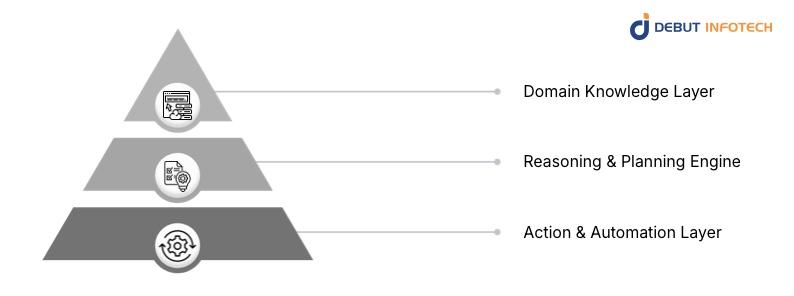
In order to get a truly clear understanding of the strength of vertical AI agents, it is beneficial to see how the technology works internally. It is actually a very simple process as most of these systems are based on a three part workflow, which is very similar to the way that trained professionals think and behave.
1. Domain Knowledge Layer
Everything begins with teaching the agent your industry’s world. It studies the same information your team relies on such as medical forms, insurance documents, legal clauses, supply-chain logs, financial statements, and more.
This is what gives the agent true industry fluency, not just generic AI knowledge.
2. Reasoning & Planning Engine
Next comes the “thinking” stage. Here, the agent takes what it knows and starts making sense of real situations. Using advanced reasoning models, business rules, and policy guidelines, it figures out what should happen next.
It’s similar to how an experienced employee makes decisions: assess the context, follow the rules, and choose the best action.
3. Action & Automation Layer
Lastly, the agent brings its decisions into action. It integrates with existing tools that you already have such as your CRM, ERP system, hospital system, banking software or warehouse tools and automatically gets things done. This is the part where you start seeing real efficiency: updates made instantly, processes handled end-to-end, and decisions executed without manual effort.
Together, these layers turn vertical AI agents into reliable, domain-aware systems that don’t just analyze information, they actually help run your operations.
When teams explore vertical artificial intelligence, they’re usually chasing one thing: real, measurable results. And that’s exactly where these agents shine because they’re built to understand the unique problems, data, and decisions inside a specific industry.
In the real world, vertical AI agents can assist enterprises in saving money, and this can be by an immense percentage. Through executing repetitive processes and linking various systems, they are able to automate complete workflows, as opposed to one-off queries. That translates to a reduction in manual processes, reduction in delays and reduction in operational headaches.
They are also smarter and context aware, as they are conditioned on the rules, terminology, and edge cases of your industry. The result? Better accuracy, fewer compliance mistakes, and much faster onboarding compared to generic AI tools that need extra tuning.
And these aren’t just theoretical wins.
A healthcare billing company in the U.S. introduced a domain-trained agent built on ICD-10 codes, payer policies, and historical claims data. Within months, they saw a 27% reduction in claim denials, simply because the AI could spot issues a human might miss.
When AI truly understands the world it’s working in, the business impact becomes impossible to ignore.
Not all AI is created equal. While horizontal AI tools like ChatGPT are versatile and great for broad tasks, they aren’t always the right fit when your goal is to build an AI agent that really understands your industry. At that point, vertical AI agents are most effective, they are built with strong, domain-specific expertise to manage the specific issues that your business is dealing with.
Here’s a quick side-by-side look:
| Feature | Horizontal AI (e.g., ChatGPT) | Vertical AI Agent |
| Domain knowledge | General-purpose | Deep industry expertise |
| Compliance | Limited | Built-in industry regulations |
| Accuracy | Broad but shallow | Context-aware and precise |
| Integration | Basic | Seamlessly works with enterprise systems |
| Use case fit | General tasks | Niche workflows with measurable outcomes |
The concept of horizontal AI is a multi-tool, it can do a little of everything. Vertical AI agents? They’re like specialized experts, built to solve the specific problems your business faces.
This section will provide you with a concrete real-life overview of the current application of vertical AI agents in industries. These examples will make you realize what you can do and provide you with a realistic roadmap in case you are going to create your own agent or research where your business lies on the broadening vertical AI market map.
Financial vertical AI agents also aid teams in preventing expensive errors by analyzing transactions in real time and attending to the slightest of the details that a human can miss. They facilitate loan underwriting, find frauds instantly and perform KYC/AML checks without slacking operations. Due to the fact that accuracy is very important in this business, companies use these agents to remain within the confines of the law, minimize mistakes, and make all their financial decisions amenable to regulators.
2. Healthcare
Healthcare vertical AI agents simplify daily clinical activities in healthcare significantly by integrating directly with electronic health records (EHRs). Under this arrangement, they will be able to process appointment booking, patient management, assist with diagnostic decision making and carry out the routine administrative tasks that tend to overwhelm medical teams. Rather than employing various personnel with various shifts, a single AI agent is capable of fulfilling all those duties with consistency and precision, resulting in reduced expenses and quick patient service.
3. Manufacturing
Vertical AI agents in manufacturing operate in the background to ensure that production lines are running smoothly. These agents will be able to detect suspicious machine behavior and anticipate equipment failure before it occurs by analyzing live sensor data. This proactive measure assists companies in saving time, cutting down on maintenance expenses and enhancing the overall output of their production process without having to be constantly attended to by humans.
4. Retail & Supply Chain
Retail vertical AI agents make complex work such as inventory tracking, personalization of customers, or supply chain coordination simpler. They keep a close watch of stock levels, modify recommendations depending on customer behavior, and products flow on a timely basis out of the warehouse to the door step. To illustrate, AI-based recommendation engines are applied by large-scale retailers to propose products, based on prior activity, assisting customers in locating the necessary item as fast as possible and increasing sales.
5. Legal & Compliance
Vertical AI agents assist legal departments in reducing massive amounts of paperwork and regulatory mandates. With these agents, lawyers can review contracts, summarize legal texts and mark risks to get an overview of all other things without wasting hours on repetitive tasks. Monitoring the latest regulations and carrying out checks on a routine basis, one agent can aid activities that used to be performed by several members of the team.
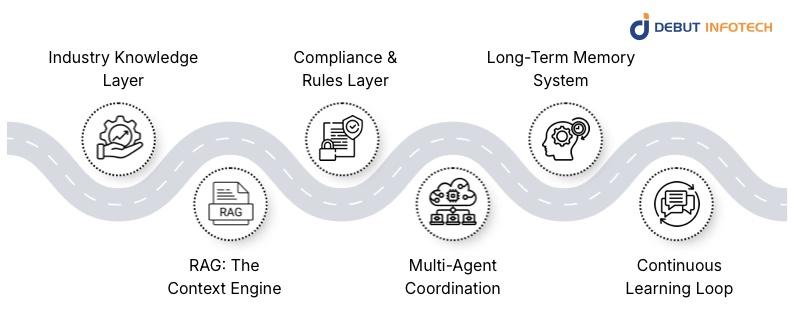
Vertical AI agents might sound complex, but the way they’re built is actually easier to understand than most people think. As opposed to a single massive system, they are driven by a blend of intelligent AI models and organised elements that support them to think, rationalise, and behave as real experts in the industry.
Here is a bare glimpse of the action that is occurring behind the scenes:
1. Industry Knowledge Layer
This is the part of the agent that “speaks the language” of a specific field. Whether it’s insurance policy terms, medical coding standards, or manufacturing workflows, this layer gives the agent the domain knowledge it needs to make sense of real-world tasks.
2. RAG: The Context Engine
Retrieval-Augmented Generation is the shortcut of the agent to correct information. When it requires responses, it retrieves the appropriate documents or information and applies them to elicit responses based on actual circumstances, not guesses.
3. Compliance & Rules Layer
Rules are common in every industry, and this layer ensures that the agent adheres to the rules. It compares decisions with the regulatory standards or internal guidelines to ensure that the AI is safe, reliable, and auditable.
4. Multi-Agent Coordination
Vertical AI agents do not work alone very often. They work together with other agents, some of which are planning agents and some of which are execution agents to process larger, more complex workflows on an end-to-end basis without human micromanagement.
5. Long-Term Memory System
This layer assists the agent to recall previous tasks, client records, exceptions, and knowledge. It does not have to start afresh each time but rather leverages the past experiences to make better decisions in the future.
6. Continuous Learning Loop
The last thing is the ability of the agent to develop. It examines results, gets acquainted with new information, and clears up its knowledge, becoming more precise and more useful in the process of interaction with your business.
Combinations of all these layers result in a vertical AI agent that is not as much of a tool but as a trained, flexible professional specifically designed to serve your industry.
Vertical AI agents are evolving fast, and the next wave of innovation is going to change how entire industries work. As businesses adopt smarter AI tools, these agents are becoming more autonomous, more specialized, and far more capable than the chatbots we’ve known in the past.
Here’s a look at where things are heading:
1. Fully autonomous enterprise workflows
We’re moving toward agents that don’t just assist, they handle complete processes. From generating reports to verifying documents, tasks that once needed manual effort will quietly run in the background.
2. Digital teams powered by multi-agent collaboration
Companies will use a number of specialized agents that complement each other instead of a single all-purpose agent. Consider it as a virtual group where agents each have a job to play and they collaborate in accomplishing tasks.
3. Increasing industry-specific language model needs
Vertical AI agents will be constructed over time to be trained to a single niche, such as healthcare, insurance, law, manufacturing, and become more accurate, compliant, and real-world.
4. A move to privacy-first, on-device intelligence
More agents will run on edge devices to keep sensitive information local. This approach improves performance and helps businesses meet strict privacy and regulatory requirements.
5. Automation of routine knowledge work
AI will creep in and replace routine processes such as verifying claims, reviewing contracts, scheduling, and compliance checks. Human teams will pay attention to strategy, creativity, and oversight instead.
6. New policies defining the functioning of AI agents
Industry organizations and governments are hastening to outline what safe and responsible automation should be. These regulations will affect the decision-making process of agents, data storage, and the integration of critical systems.
With industries still moving toward more intelligent automation, vertical AI agent is emerging as one of the most notable means through which businesses can automate operations, cut down on manual work, and take superior decisions supported by real data. Their advantage is that they are specialized to know the specifics of business processes, regulations, or even the intricacies of a particular industry, and are much more reliable than general AI tools in actual business work.
However, to transform this potential into actual impact, one will need more than merely implementing AI tools, it will need the appropriate expertise and implementation. That is the reason why collaborating with Debut Infotech, also known as a custom ai agent development company, can make this difference. Our team’s profound knowledge of AI engineering and enterprise integrations can enable businesses to create, tailor and expand vertical agents that represent their specific needs and provide quantifiable outcomes.
When your company is prepared to leave the experimental stage behind and embrace AI that will actually succeed, Debut Infotech is the team that can provide you with the advice and technical know-how you need to make it happen. By finding the right partner, it is not only possible, but feasible, to embrace the future of intelligent, industry-focused automation.
Vertical artificial intelligence (AI) is defined as AI systems that are industry-specific. In comparison to general-purpose AI, which is useful in a wide range of applications, vertical AI is designed to learn the needs, language, and processes of a specific field.
It trains on industry-specific data, picks up on specialized jargon and also becomes part and parcel of business processes. This specialization enables it to execute its duties with much more precision and efficiency.
As an illustration, an AI with a vertical financial orientation can be used to underwrite loans, whereas a medical-oriented AI could be used to aid in medical diagnosis.
Vertical AI can be defined as AI systems that are designed to handle a particular industry or task. Examples include:
Healthcare: AI tools for medical billing, clinical documentation, and patient triage.
Finance: AI for fraud detection, compliance monitoring, and risk assessment.
Manufacturing: AI that predicts equipment failures and schedules maintenance.
These AI agents are created to comprehend and automate the processes in their respective fields. They may be used in such industries as insurance, law, retail, etc., and make complex processes quicker and more precise.
Vertical AI is drawing the interest of venture capitalists and experts in the industry. This is because it has high potential to produce return on investment (ROI).
It also fits the market well and has a good value proposition. Vertical AI, as opposed to general or horizontal, is industry-specific. This area of specialization makes it more efficient in solving actual business problems and providing quantifiable outputs.

Our Latest Insights
USA

2501 Chatham, Rd Suite R Springfield, IL 62704
+1-708-515-4004
info@debutinfotech.com
UK

7 Pound Close, Yarnton, Oxfordshire, OX51QG
+44-770-304-0079
info@debutinfotech.com
Canada

154 Eden Oak Trail, Kitchener, ON N2A 0H9
+1-708-515-4004
info@debutinfotech.com
INDIA

Sector 101-A, Plot No: I-42, IT City Rd, JLPL Industrial Area, Mohali, PB 140306
9888402396
info@debutinfotech.com