


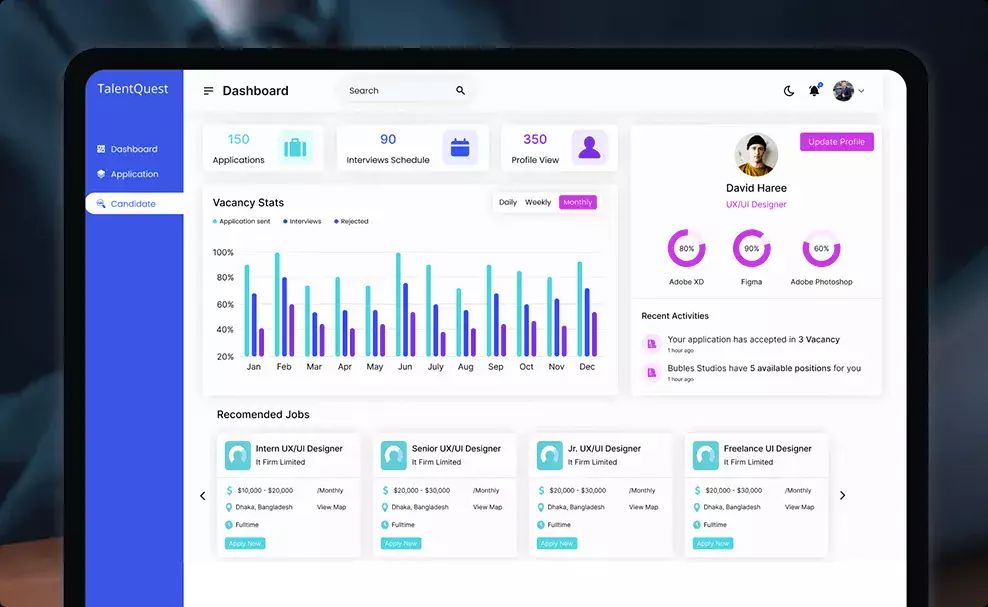
 Recruitment
TalentQuest
A Deep Learning Solution for Smarter Candidate Search
750,000
candidate matches facilitated
30%
Increase in recruitment efficiency
Our Global Presence :


Build custom machine learning solutions that transform business data into actionable intelligence and automate complex workflows. From predictive analytics and recommendation engines to computer vision and intelligent automation, we help enterprises improve efficiency, reduce costs, meet compliance requirements, and make faster, data-driven decisions.
15+ Years
Engineering Experience
500+ Solutions
Delivered across sectors
Full Lifecycle
Discovery through support
NDA-First
Confidential engagement
Global Offices
USA, UK, Canada, India
Our machine learning development services cover the complete ML lifecycle. We support initial assessment, data preparation, model development, proof-of-concept validation, deployment, monitoring, and continuous improvement.

We begin by evaluating the business problem, available data, existing systems, and expected outcomes. Our AI consultants then define suitable use cases, success metrics, the technical approach, and a practical implementation roadmap.

We prepare the data Engineering foundations required for reliable machine learning. Our services include data integration, cleansing, transformation, labelling, feature engineering, ETL and ELT pipelines, data lakes, data warehouses, and governance controls.

We design, train, and validate machine learning models that analyse historical and real-time data to generate predictions, classifications, and forecasts. This includes use cases such as demand forecasting, customer behaviour prediction, financial modelling, and operational risk analysis.

We build natural language processing systems that understand, classify, extract, summarize, and generate information from text and speech. We also develop AI agents that connect models with business systems, APIs, tools, and workflows to automate multi-step tasks with governance and control.

We deploy, integrate, and operationalize machine learning models within enterprise environments. This includes integration with applications, cloud platforms, databases, CRM/ERP systems, and IoT environments, along with MLOps practices such as monitoring, versioning, retraining, and performance management.

We build proof-of-concept and pilot solutions to validate feasibility and business impact before full-scale deployment. We also develop decision intelligence systems that combine predictive modelling, optimization, and scenario analysis, and continuously improve model performance through optimization and refinement.
Every industry presents different data, compliance, and operational challenges. We adapt model architecture, validation methods, deployment strategies, security controls, and system integrations to support the specific business and regulatory requirements of each sector.

Clinical, operational, and patient intelligence.In healthcare, machine learning can assist with imaging analysis, patient-risk prediction, documentation, capacity planning, and care prioritization. Human review remains central when model outputs may affect clinical or patient outcomes.

Risk, fraud, pricing, and customer decisioning.Financial institutions can use machine learning to identify suspicious activity and improve risk-based decisions across lending, insurance, payments, and customer operations.

Quality, maintenance, throughput, and energy optimization.Manufacturers use sensor, image, and production data to detect defects, predict failures, and improve throughput. These systems help reduce downtime and maintain more consistent product quality.

Forecasting, routing, fulfillment, and fleet intelligence.Machine learning helps logistics teams improve routing, ETA accuracy, warehouse planning, and fleet utilization. Recommendations can account for real-time conditions and operational constraints.

Personalization, demand forecasting, and inventory intelligence.Machine learning helps retail optimize product recommendations, forecast demand, personalize customer experiences, detect fraud, improve pricing strategies, and automate inventory planning across online and omnichannel commerce operations.

Connected vehicles, predictive maintenance, and manufacturing intelligence.Automotive companies apply machine learning to vehicle telemetry, quality inspection, warranty analysis, and production operations. These systems support earlier fault detection and more efficient maintenance.

Property intelligence, valuation, and operational optimization.Machine learning turns property, market, tenant, and portfolio data into better valuation and investment decisions. It can also support occupancy planning, document processing, and maintenance operations.

Content intelligence, audience analytics, and personalization.Machine learning enables personalized content recommendations, audience segmentation, content moderation, advertising optimization, demand forecasting, and media analytics to improve engagement and operational efficiency.

Personalized learning, assessment, and student success.Machine learning helps educational institutions deliver adaptive learning, automate assessments, predict student performance, improve retention, optimize resource allocation, and provide intelligent learning recommendations.

Document intelligence, contract analytics, and risk assessment.Machine learning streamlines legal operations by classifying documents, extracting contract information, identifying compliance risks, supporting legal research, and improving review efficiency while maintaining governance and auditability.

Need a Custom Machine Learning Solution for Your Business?
Our machine learning engineers can assess your data, workflows, technical environment, and business requirements to define the right solution architecture and implementation roadmap.
As a custom machine learning development company, we design each solution around the business decision, available data, cost of error, and production environment. The final system combines models with software, integrations, business rules, and operational workflows.

We build recommendation systems that rank products, services, content, offers, and next-best actions based on customer behaviour, preferences, context, and business priorities. These solutions help improve engagement, conversion rates, retention, and customer lifetime value.
We develop systems that monitor transactions, account activity, claims, payments, and behavioural signals to identify suspicious patterns. Risk scoring, alerts, and investigation workflows help businesses detect fraud earlier and reduce financial losses.
We create predictive analytics solutions that analyze equipment data, maintenance records, and operational signals to identify failure risks before disruption occurs. These systems help reduce unplanned downtime, improve asset utilization, and prioritize maintenance activities.
We build churn prevention solutions that identify customers, users, or subscribers who are likely to disengage. The system can prioritize at-risk accounts, recommend retention actions, and support targeted interventions before customers leave.
We develop pricing solutions that evaluate demand, availability, customer behaviour, market conditions, and commercial rules to recommend suitable prices. These systems help businesses respond to market changes while protecting revenue and profitability.
We create risk scoring solutions for credit assessment, insurance, compliance, customer onboarding, supplier evaluation, and operational decision-making. These systems help teams prioritize cases, standardize assessments, and make faster risk-informed decisions.
We build Gen AI solutions that recommend appropriate stock levels, replenishment quantities, reorder points, and product allocation. These systems help reduce excess inventory, avoid stockouts, and improve working-capital efficiency.
We develop intelligent Robotic Process Automation (RPA) bots that identify unusual behavior, performance deviations, process failures, and emerging operational risks. Automated alerts and prioritization workflows help teams respond to exceptions before they cause wider disruption.
RecruitmentTalentQuest
750,000
candidate matches facilitated
30%
Increase in recruitment efficiency
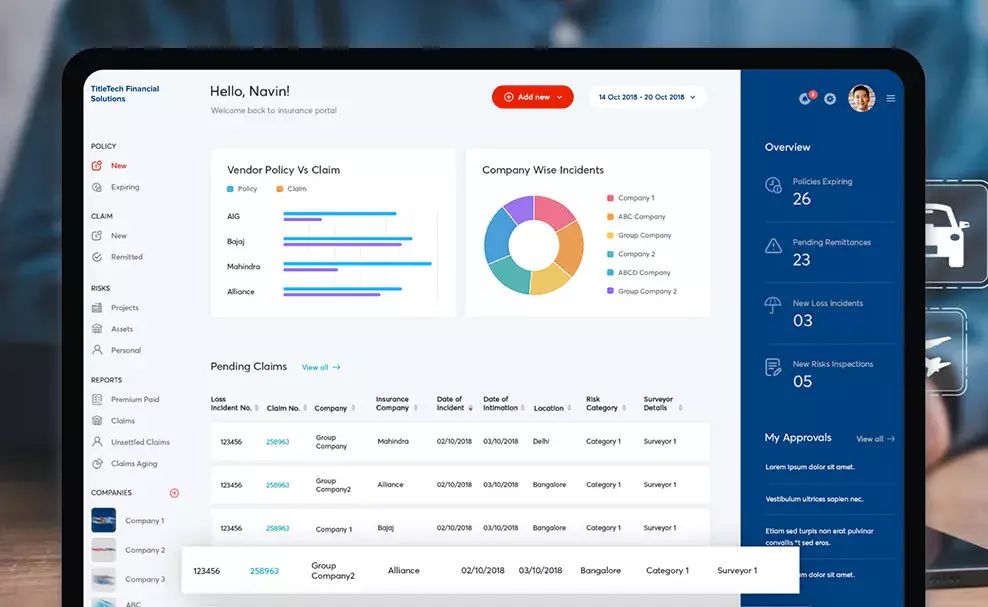 Title Insurance
TitleTech
100,000
Processed land deed documents
40%
Increase in extraction accuracy
 Supply Chain & Logistics
Lummid Group
35%
Faster quote turnaround
50%
Lower manual workload
 Enterprise IT
Aithentic
10,000+
Assets Managed Per Deployment
85%
Improvement in Asset Tracking Accuracy
"Working with Debut Infotech has been a game-changer for NDAX. Their unparalleled expertise in blockchain, DeFi, and crypto wallet development, allowed us to build a seamless, robust platform that enhances user experience and security. Their team's dedication, innovative approach, and attention to detail were evident throughout the project."

 Video Testimonial
"Debut Infotech played a pivotal role in bringing my vision for iFinca to life. Their blockchain expertise and innovative approach have significantly enhanced the transparency and traceability of the coffee supply chain. Thanks to them, coffee farmers now have access to a platform that not only connects them directly with buyers but also ensures they receive fair pricing."

"Partnering with Debut Infotech has been a transformative experience for KoreConX. Their expertise in blockchain technology helped us create a secure and efficient ecosystem for managing private capital markets. The collaboration has enabled us to deliver unparalleled value to our clients, streamlining investor relations, compliance, and corporate governance on a global scale."

 Video Testimonial
"Working with Debut Infotech was instrumental in developing Integra Ledger, our blockchain-based digital signature platform. Their dedication to innovation and attention to detail ensured that we could create a product that rivals industry giants in both quality and affordability. The security and reliability they built into our platform have set a new standard in the e-signature landscape."

Our machine learning development process connects business objectives with data engineering, model validation, software integration, MLOps, and operational governance. Each stage has defined outputs and production-readiness criteria.
1

2

3
4
5
6
7
PHASE 01
ML Consulting & Discovery
Successful machine learning initiatives begin by understanding the business decision before selecting models or technologies. We define the problem to solve, identify stakeholders, establish measurable success criteria, evaluate constraints, and assess whether the available data can support the desired outcome.

Define the business decision, users, and expected outcomes.
Establish baseline performance and measurable success metrics.
Identify operational, technical, and regulatory constraints.
Assess available data sources and expected business value.
We also determine whether machine learning is the appropriate approach and establish the implementation scope before development begins.
Deliverables
We select machine learning development technologies based on business objectives, existing data architecture, scalability requirements, deployment environment, governance needs, integration complexity, and long-term operational costs, ensuring every technology choice supports reliable performance, maintainability, and enterprise-scale growth.
Model Development

PyTorch

TensorFlow

Scikit-learn

XGBoost

LightGBM

JAX

OpenCV

Ray
Data Engineering

Apache Spark

Kafka

Airflow

dbt

Snowflake

Pandas

Dask

PostgreSQL
MLOps & Deployment

MLflow

Kubeflow

Docker

Kubernetes

GitHub Actions

Jenkins

Model registries
Cloud Platforms

AWS

Amazon SageMaker

Microsoft Azure

Azure Machine Learning

Google Cloud

Vertex AI
Data Stores & Search
PostgreSQL

MongoDB

Redis

Elasticsearch

Pinecone

Milvus

Weaviate
LLM Orchestration Frameworks

LangChain

LlamaIndex

Hugging Face

Model Context Protocol

Commercial model APIs where relevant

Planning an Enterprise ML Initiative?
Work with our ML experts to define a scalable technology stack aligned with your data environment, deployment requirements, governance standards, and long-term growth plans.
Machine learning systems often process sensitive data and support critical business decisions. We embed security, governance, compliance, and intellectual property protection throughout the development lifecycle to help organizations deploy production-ready ML solutions with confidence.
Governance controls are tailored to each engagement’s regulatory requirements, data sensitivity, deployment environment, and risk profile.
 GDPR
 UK GDPR
 CCPA / CPRA
 PIPEDA
 LGPD
 HIPAA
 HITECH
 SOC 2
 ISO 27001
 NIST
 CIS
 OWASP
 PCI DSS
 GLBA
 SOX
 EU AI Act
 ISO 42001
 NIST AI RMF
 Audit Logging
 Access Control
 Data Governance
 IP Protection
Every asset developed specifically for your engagement is assigned to your organization, giving you long-term control over the technology, documentation, and intellectual property created during delivery.


Layered safeguards protect sensitive business and customer data across development, storage, processing, model access, integration, and production operations.


Responsible AI controls improve transparency, support human accountability, reduce operational risk, and help maintain reliable model behavior throughout the production lifecycle.


Core principles applied across discovery, development, deployment, and long-term support.

Successful machine learning initiatives depend on far more than building accurate models. They require reliable data engineering, scalable architecture, production deployment, governance, and continuous optimization. As a machine learning development company, we combine these capabilities into a single engineering program that helps organizations move from experimentation to measurable business outcomes.
Every engagement begins with business objectives rather than algorithms. We identify the decisions your models need to support, evaluate available data, define measurable success criteria, and recommend an implementation approach aligned with business priorities.

Our multidisciplinary teams deliver the complete machine learning lifecycle, from data engineering and model development to application integration, cloud deployment, MLOps, testing, and long-term production support through a single delivery partner.

Enterprise ML requires more than model accuracy. We incorporate architecture reviews, governance, security controls, validation, deployment planning, and operational monitoring to reduce implementation risk and improve long-term reliability.

Machine learning systems continue evolving after deployment. We establish processes for monitoring, automated retraining, performance optimization, and infrastructure management to help maintain model quality as data and business conditions change.


Want to Improve Business Performance With Machine Learning?
Identify the right machine learning opportunities for your business and define a practical path from operational challenge to measurable outcome.
Machine learning supports better decision-making across every business function by identifying patterns, predicting outcomes, and automating repetitive analysis. We develop custom ML solutions that align with each department's workflows, helping teams improve efficiency, reduce operational risk, and make faster data-driven decisions.
Improve revenue through better forecasting, lead targeting, & pipeline visibility.

Improve revenue through better forecasting, lead targeting, & pipeline visibility.
Improve campaign results through predictive insights and personalization.
Strengthen financial planning, fraud prevention, and operational risk management.
Increase operational efficiency by reducing manual work and improving planning accuracy.
Deliver faster, more personalized customer service with intelligent automation.
Improve inventory planning, logistics, and supply chain resilience.
Support better hiring, workforce planning, and employee retention decisions.
Provide leadership teams with predictive insights for strategic decision-making.
Extend your machine learning capabilities with complementary AI and data engineering services that strengthen data foundations, accelerate deployment, improve model performance, and enable secure, scalable integration across enterprise systems and operational workflows.
Not Sure Where Machine Learning Can Create the Biggest Impact?
Every organization has different data, processes, and business priorities. Our machine learning consultants assess your operational challenges, existing systems, and available data to identify the highest-value ML opportunities and define a practical implementation roadmap.
The timeline depends on the complexity of the use case, data quality, system integrations, and regulatory requirements. A proof of concept can often be completed within 6–10 weeks, while enterprise-grade machine learning solutions typically require 3–6 months or longer. Proper testing, MLOps implementation, and user validation are essential before production deployment.
Off-the-shelf AI tools provide pre-built capabilities for common tasks and can be deployed quickly with minimal customization. Custom machine learning development, however, is designed around your organization's data, business processes, compliance requirements, and performance objectives. It offers greater flexibility, accuracy, scalability, and competitive differentiation for complex enterprise use cases.
Data security is maintained through encryption, secure cloud infrastructure, role-based access controls, isolated development environments, and strict access management. Sensitive information is protected throughout the training lifecycle, while governance policies, audit logging, and compliance practices help ensure data confidentiality, integrity, and regulatory adherence during model development and deployment.
A business should consider machine learning when it regularly processes large volumes of data, relies on repetitive decision-making, or needs more accurate predictions and automation. Organizations with measurable business objectives, reliable data, and clearly defined success metrics are typically well positioned to generate meaningful value from machine learning initiatives.
Machine learning delivers measurable value across industries including healthcare, financial services, manufacturing, retail, logistics, insurance, telecommunications, energy, and education. Common applications include predictive analytics, fraud detection, demand forecasting, preventive maintenance, customer personalization, quality inspection, intelligent automation, and operational optimization tailored to industry-specific business requirements.
Return on investment is measured by comparing business outcomes before and after deployment. Organizations typically evaluate improvements in operational efficiency, cost reduction, forecasting accuracy, automation rates, customer satisfaction, revenue growth, and decision quality. Establishing baseline metrics before implementation enables a more accurate assessment of long-term business value.
The right machine learning developers should have expertise in data science, model development, MLOps, cloud platforms, and enterprise software integration. Evaluate candidates based on their technical capabilities, domain experience, production deployment expertise, security awareness, and ability to collaborate with engineering, data, and business stakeholders throughout the project lifecycle.
Yes. Post-launch support typically includes model performance monitoring, retraining, infrastructure maintenance, security updates, MLOps management, issue resolution, and continuous optimization. As business requirements and data evolve, ongoing support helps maintain model accuracy, system reliability, regulatory compliance, and long-term operational performance in production environments.
Machine learning development commonly uses Python, TensorFlow, PyTorch, Scikit-learn, XGBoost, Hugging Face, OpenCV, MLflow, Kubeflow, Docker, Kubernetes, and major cloud platforms. The final technology stack depends on model requirements, data architecture, deployment environment, scalability, governance, integration complexity, and long-term maintenance needs.
Machine learning can be integrated into existing applications through APIs, microservices, event-driven pipelines, embedded models, or cloud-based inference services. The process typically includes assessing the current architecture, preparing data flows, deploying the model, connecting business systems, implementing security controls, and establishing monitoring for performance and reliability.
USA
2501 Chatham, Rd Suite R Springfield, IL 62704
+1-708-515-4004
info@debutinfotech.com
UK
7 Pound Close, Yarnton, Oxfordshire, OX51QG
+44-770-304-0079
info@debutinfotech.com
Canada
154 Eden Oak Trail, Kitchener, ON N2A 0H9
+1-708-515-4004
info@debutinfotech.com
INDIA
Sector 101-A, Plot No: I-42, IT City Rd, JLPL Industrial Area, Mohali, PB 140306
9888402396
info@debutinfotech.com