ON THIS PAGE
Progress0%






Our Global Presence :





As digital transformation accelerates across industries, companies face rising pressure to build products faster, modernize legacy systems, and innovate continuously. But rapid growth often exposes skill gaps, bandwidth limitations, and productivity bottlenecks. That’s why many organizations choose to hire full stack developers to streamline development and accelerate delivery. Full stack talent brings end-to-end expertise across both frontend and backend, helping businesses scale without constantly juggling multiple specialized roles.
In today’s global, remote-first engineering landscape, hiring remote full stack developers provides even greater advantages. Scalability, cost flexibility, and access to worldwide expertise enable teams to stay competitive. As a technology leader and custom software development company, we’ve seen firsthand how businesses benefit from expanding their capabilities with the proper development talent. This guide explores when startups and enterprises should scale their teams, why full stack developers are essential, and how remote hiring can significantly strengthen product delivery.
Scaling a development team isn’t just about adding more people — it’s about expanding capacity, improving efficiency, and making sure your engineering resources match your product’s growth curve. As your startup or enterprise begins building more features, handling more traffic, and entering more competitive markets, your existing team may hit bandwidth limits. This is where scaling becomes strategic rather than optional: the right developers, added at the right time, can dramatically improve output, innovation, and long-term stability.
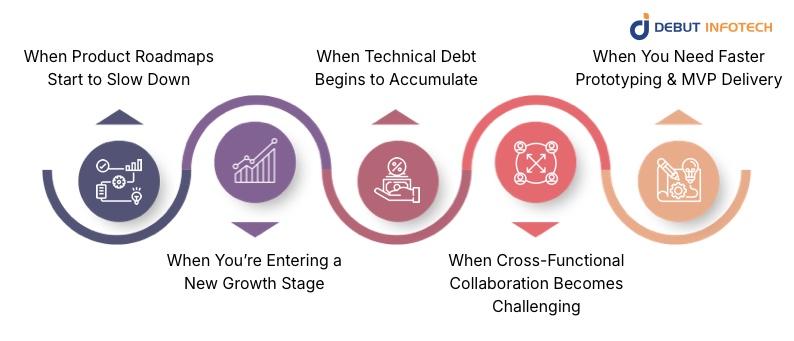
1. When Product Roadmaps Start to Slow Down
Startups and growing product companies often plan ambitious roadmaps. But when deadlines start slipping, and releases stretch longer than expected, it’s a clear sign your team is stretched thin. Backlogs pile up, feature requests wait weeks or months, and experimentation slows. Bringing in a full stack developer restores cadence because they can handle both frontend and backend tasks without dependency bottlenecks. Instead of waiting for a frontend specialist or backend engineer to free up, you have a versatile resource who can ship faster.
2. When You’re Entering a New Growth Stage
A surge in users or the launch of a major product update calls for architectural improvements, new modules, better scalability, and consistent code standards. A full stack developer for growing teams helps manage this transition by optimizing application architecture, reducing latency, and supporting performance improvements across the entire stack. They essentially act as a force multiplier during high-pressure expansion periods.
3. When Technical Debt Begins to Accumulate
Every growing product eventually faces technical debt — outdated components, unoptimized logic, hard-to-maintain code, or inefficient database queries. These issues slow future development and can introduce reliability problems. Full-stack developers excel at bridging the backend logic with the frontend experience, allowing them to refactor and modernize systems holistically rather than in isolated pieces.
4. When Cross-Functional Collaboration Becomes Challenging
Misalignment between frontend and backend teams often causes delays, inconsistent user experiences, and duplicated work. A full-stack developer reduces this friction by serving as a connector who understands both sides deeply. They can unify workflows, prevent integration issues, and ensure features behave consistently across the entire system.
5. When You Need Faster Prototyping and MVP Delivery
Startups mainly depend on rapid experimentation. When validating an idea, speed is everything. Full stack developers for startups can design the UI, build backend logic, integrate APIs, and deploy MVPs much more quickly than specialized teams. This shortens the path to user testing, revenue insights, and investor pitching.
Full stack developers are uniquely positioned to manage complex engineering challenges while simplifying workflows. Here are some full-stack web developer benefits:
End-to-End Ownership: A full-stack engineer manages everything from UX to server logic, which ensures a coherent, consistent product experience.
Improved Efficiency: By reducing the need for multiple specialized roles, full stack engineers minimize communication delays, eliminate handoff inefficiencies, and speed up release cycles.
Cost Advantage: Hiring a full stack developer often costs less than maintaining several niche engineers. This is critical when monitoring your web application development cost or scaling while controlling budgets.
Better Problem-Solving Skills: Because full stack developers work across multiple layers of technology, they make informed architectural decisions and resolve issues more holistically.
Versatility Across Projects: From progressive web development to enterprise software development, full stack engineers flexibly support evolving business needs.
The global shift toward remote-first engineering has made it far easier to access world-class expertise.
As companies evolve, their development needs shift dramatically. Startups often look for versatility and speed, while growing teams prioritize scalability, specialization, and long-term stability. Full stack developers fit into both scenarios but deliver different kinds of value depending on where the business is in its lifecycle. Understanding these differences helps leaders decide when to hire full stack developers and how to integrate them into their broader technology strategy.
Startups operate in environments where speed and adaptability matter more than anything else. Their primary focus is validating ideas, launching MVPs fast, and staying lean.
A full stack developer for startups contributes by:
In this stage, the most considerable value lies in versatility. A single product-ready full stack engineer can own significant portions of the tech stack and move quickly without bureaucratic delays.
As companies scale, the focus shifts from experimentation toward stability, performance, and sustainable architecture. Systems become more complex, user bases expand, and development projects require stricter coordination.
A full stack developer for growing teams supports this evolution by:
Here, full stack developers become integrators and system thinkers. They reinforce the engineering structure by making sure all moving parts work together smoothly.
| Criteria | In-House Full Stack Developer | Remote Full Stack Developer |
| Hiring Cost | Higher (salary, benefits, office space) | Lower (global talent pool, reduced overhead) |
| Talent Availability | Limited to local candidates | Access to worldwide full stack experts |
| Scalability | Slow and expensive to scale | Rapid scaling with flexible hiring models |
| Technical Diversity | Often limited to one tech stack | Wide range of skills across modern stacks |
| Onboarding Time | Longer onboarding and setup | Faster onboarding with pre-vetted experts |
| Team Flexibility | Fixed working hours | Coverage across global time zones |
| Project Delivery | Dependent on local constraints | 24/7 development cycles are possible |
| Operational Costs | Office costs, equipment, and insurance | Minimal operational overhead |
| Best For | Companies with a long-term, office-based structure | Startups scaling quickly, agile product teams |
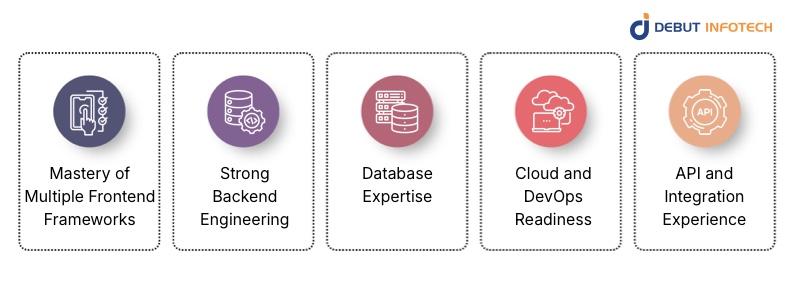
High-performance full stack developers stand out for their rare blend of versatility, architectural understanding, and end-to-end product thinking. Their ability to work across the entire development spectrum—frontend, backend, databases, cloud, DevOps, and integrations—helps startups and enterprises deliver products faster and more efficiently. Below are the essential skills that define world-class full stack engineers and why these capabilities matter when you hire full stack developers or scale a dedicated full stack development team.
Top full stack developers are fluent in modern frontend technologies such as React, Vue.js, Next.js, Angular, and Svelte. Mastery of these frameworks enables them to build intuitive, responsive, and high-performance interfaces that align with progressive web development standards. They understand component-based architecture, real-time rendering, state management, and performance optimization — all essential for delivering seamless user experiences that adapt well across devices.
Equally important is backend expertise. Skilled developers are proficient in environments such as Node.js, Python/Django, PHP/Laravel, Ruby on Rails, Java Spring, and .NET. Their deep understanding of backend logic ensures secure authentication systems, reliable APIs, optimized server performance, and scalable architectures. Whether building enterprise software development systems or powering high-traffic apps, backend fluency ensures the product can handle real-world load and complexity.
Full stack engineers must work intuitively with both SQL (PostgreSQL, MySQL) and NoSQL (MongoDB, Redis, DynamoDB) databases. They know how to design schemas, optimize queries, index intelligently, and build scalable data storage solutions. This balance between structure and flexibility is critical for controlling web application development cost while maintaining application reliability as user numbers grow.
Cloud-native operations are now standard, so developers must operate comfortably within AWS, Google Cloud, or Azure, along with modern DevOps tools. High-performance developers understand CI/CD pipelines, Docker containers, Kubernetes orchestration, serverless computing, and automated monitoring. These skills help teams accelerate deployments, enhance product reliability, and support continuous delivery—all of which are foundational to scalable full stack development services.
Modern applications rely heavily on interconnected systems. Skilled developers understand REST APIs, GraphQL, microservices, and third-party integrations. They can architect clean, stable communication layers between frontend and backend components and integrate services like payment gateways, CRM systems, authentication modules, or AI engines. For startups building rapidly evolving products, this integration capability ensures long-term flexibility and faster release cycles.
A dedicated full-stack development team acts as an extension of your internal workforce, bringing cohesion, speed, and specialized expertise to your product roadmap. Unlike freelancers or short-term contractors, a dedicated team stays aligned with long-term business goals and continuously iterates on features, performance, and architectural improvements. This stability helps companies scale without losing momentum or wasting resources on repeated onboarding cycles.
Because full stack developers understand both frontend and backend logic, they eliminate bottlenecks between departments and accelerate development cycles. They can take ownership of entire product modules, resolve issues faster, and maintain consistent code quality across the whole stack. For startups, this means quicker MVP validation. For growing enterprises, it translates into faster modernization, stronger system integration, and reduced dependency on fragmented teams.
A dedicated full stack team also optimizes operational efficiency. Companies benefit from predictable development velocity, streamlined communication, and round-the-clock progress when working with remote or distributed teams. Over time, this approach leads to lower development costs, better scalability, and a more resilient digital infrastructure.
We provide scalable full stack development services tailored to startups, enterprises, and fast-growing digital companies. Our engineers offer deep experience across frontend, backend, databases, cloud systems, DevOps, and enterprise software development.
We help companies:
Our dedicated full stack development team ensures high-quality output, faster roadmaps, and scalable architecture planning.
Scaling your development team is a strategic step that determines how well your business adapts to market needs, user demand, and competitive pressure. Whether you’re a startup seeking rapid growth or an enterprise pursuing digital transformation, the decision to hire full stack developers can dramatically influence your product velocity and operational efficiency.
Remote full stack developers, in particular, empower organizations to grow flexibly, tap into global expertise, and unlock faster product innovation. With the right talent and the right development partner — such as Debut Infotech — your company can build scalable, resilient, and future-ready digital ecosystems that support long-term success.
Startups should hire full stack developers when they need end-to-end product development, faster iteration cycles, or cannot yet afford separate frontend and backend specialists. Full stack developers help reduce early-stage hiring costs while accelerating MVP delivery.
Growing teams benefit from full stack developers because they bring cross-domain expertise, improve collaboration, reduce dependency on multiple specialists, and enable faster releases. They also help maintain continuity across the project lifecycle.
Companies hire remote full stack developers to access global talent, reduce operational costs, speed up development, and scale quickly without long recruitment cycles. Remote engineers offer flexibility while delivering high-quality engineering support.
You likely need to scale your team if development slows down, feature backlogs keep growing, your in-house team is overloaded, or your product roadmap requires faster delivery. Scaling ensures consistent output and supports long-term growth.
Yes. A full stack developer reduces overall web application development cost because they handle both frontend and backend tasks, minimizing the need to hire multiple developers. They are especially cost-efficient for startups and medium-sized teams.
A strong remote full stack developer should understand frontend technologies (React, Vue, Angular), backend frameworks (Node.js, Django, Laravel), databases, cloud services, DevOps basics, APIs, and modern tech stack for web development.
Debut Infotech offers scalable full stack development services and provides vetted, product-ready full stack engineers. Whether you need a dedicated software development team or remote full stack developers, we match you with talent that fits your project requirements and growth plans.

Our Latest Insights
USA

2501 Chatham, Rd Suite R Springfield, IL 62704
+1-708-515-4004
info@debutinfotech.com
UK

7 Pound Close, Yarnton, Oxfordshire, OX51QG
+44-770-304-0079
info@debutinfotech.com
Canada

154 Eden Oak Trail, Kitchener, ON N2A 0H9
+1-708-515-4004
info@debutinfotech.com
INDIA

Sector 101-A, Plot No: I-42, IT City Rd, JLPL Industrial Area, Mohali, PB 140306
9888402396
info@debutinfotech.com