ON THIS PAGE
Progress0%






Our Global Presence :





In the event that you are looking to develop a blockchain project in 2026, you will already be aware of how important it is to hire smart contract developers who do know what they are doing. The skilled blockchain talent is in high demand yet it is not that simple to locate developers who will be able to create secure, efficient, and scalable smart contracts.
That’s where this guide comes in. Be it creating a DeFi platform, an NFT marketplace or tokenizing assets, we will guide you through everything you need to know, including the most important skills to look and how to filter candidates, cost breakdowns and successful hiring tactics supported by real world project experience.
By the end, you will have a clear idea of how to attract the right smart contract talent to your company and how to position your blockchain project to succeed in the long term.
India has quickly become one of the world’s hottest hubs for blockchain development, with companies across fintech, gaming, and real estate racing to integrate smart contracts into their products. But as the demand grows, so does the challenge of finding developers who can actually deliver secure, efficient, and scalable code.
Unclearly written contracts have already led to significant losses in the blockchain industry, the 2024 Curve Finance exploit is a sore reminder of what could go wrong when code is not airtight. This is why it is so essential to collaborate with experienced developers who are familiar with such tools as the Ethereum Virtual Machine (EVM).
By contracting the correct smart contract developers in India, you are not only recruiting coders, but professional minds capable of strategizing, avoiding weaknesses and enabling your blockchain initiative to compete well in a competitive international marketplace.
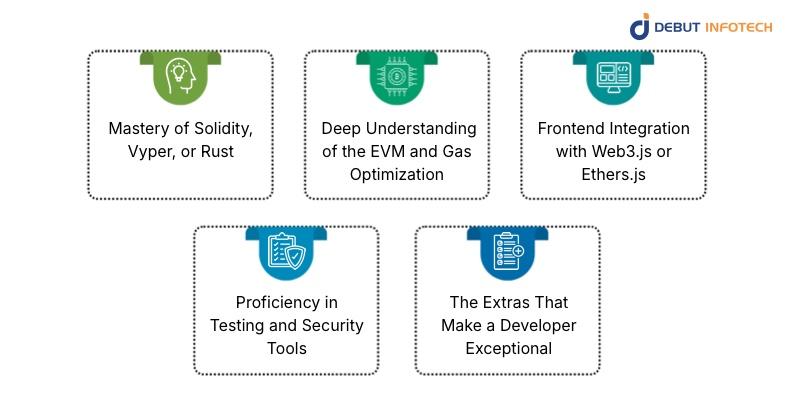
To know what makes a good blockchain developer different from a great one, before you plunge in interviews, or even compare offers, it is good to know some of the differences. The distinction usually depends on the combination of technical expertise and practical experience, the one that can only be gained by creating and implementing real-world projects.
Now, let us breakdown the key capabilities that you would expect your perfect smart contract developer to bring to the table:
They are the fundamental languages that are employed in writing smart contracts on the popular blockchain networks such as Ethereum, Solana, and Polkadot. Ethereum uses solidity, whereas high-performance blockchains, like Solana, use Rust. When a developer is good at more than one language, they have the ability to move between environments of varying blockchain ecosystems with relative ease, which is extremely beneficial in the event that your project may cross chains in future.
Each execution of a smart contract requires gas and that means cost. Developers that know how to use the Ethereum Virtual Machine (EVM) can optimize your contracts to spend less money and perform better. Efficient code is not only cleaner but it is also cheaper and faster to run.
Smart contracts don’t live in isolation. They often connect to user-facing dApps, and that’s where Web3.js or Ethers.js come in. A skilled developer should know how to link your contract to a web or mobile interface so users can interact seamlessly, from minting NFTs to making DeFi transactions.
The cost of a small bug can result in a huge loss of finances. This is why to build the best code, the best developers use tools such as Hardhat, Foundry, MythX, and Slither to test and audit their work. Any trusted developer will not simply roll your contract out; he will validate it in all possible conditions before it ever goes onto the blockchain.
What really sets apart a great hire are the “bonus” skills that go beyond coding: a grasp of NFT standards like ERC-721 and ERC-1155 for token creation, a working knowledge of tokenomics to align contract design with your business model, and the ability to integrate oracles such as Chainlink or Band Protocol so your contracts can pull in real-world data.
When you hire a smart contract developer who combines these skills with a solid portfolio, think of real deployments on testnets, open-source contributions, or completed DeFi projects, you’re not just hiring a coder. You’re bringing on a partner who can transform your blockchain idea into a secure, high-performing reality.
Facing a challenge of finding the best smart contract developer in India is not just a question of who “knows blockchain”, but rather a question of who has developed, tested and deployed projects that are functional in reality.
The best place to begin will be GitHub. Imagine it as a real, more or less live portfolio that demonstrates how developers think, code and collaborate. Look at their repositories to see whether they have made active contributions, commits that are clean, and significant discussion points that can, many times, tell more than any polished resume.
Then examine their project history. A person with experience in platforms that support DeFi has probably read all about liquidity pools and security layers, whereas a developer of NFT marketplaces has probably learned all about token standards and metadata management on the inside.
You need to also assess their smart contract auditing experience. Audit-driven developers also develop cleaner and safer code, the kind that you will be glad to have in a later day.
Finally, examine their public code. Quality smart contract developers in India often showcase transparent, modular code with clear comments. If you can read it easily, it’s a good sign they build for maintainability and collaboration, not just speed.
The initial choice that you will make when hiring smart contract developers in India is how to recruit talent. Both alternatives have advantages and disadvantages, so it is useful to consider what is actually important to your project.
1. In-House Developers
By hiring smart contract developers as full-time employees, you retain full control of the project and provide certain security to your intellectual property. The trade-off? It is more costly and typically it is reasonable in case of businesses that intend to have a long-term plan of using blockchain.
2. Outsourcing to a Development Company
Collaborating with a smart contract development service company can prove to be a game-changer in case you require speed, experience, and scalability. These firms offer pre-built teams that are able to adjust to your project needs. The only setback is a bit of reduced control, however when it comes to fast MVPs or launching a DeFi, it is the wiser decision to make.
3. Freelancers
Freelancers are cheap and convenient to hire and can be employed to do small, one-time jobs. Nonetheless, the quality may not be consistent, and it is necessary to thoroughly check their experience before trusting them with important smart contract tasks.
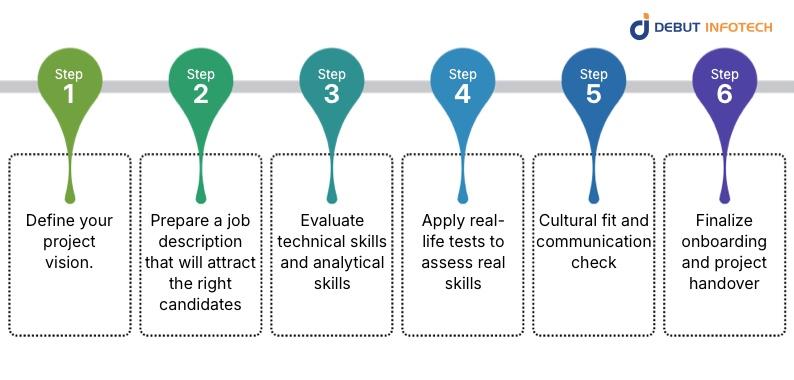
Getting the right smart contract developers in India may be the turning point of your blockchain project. As India becomes a pioneer in blockchain technology, the nation presents the opportunity to access the highly qualified developers that comprehend both technical and strategic aspects of how to write smart contracts. The following are the steps of hiring the right talent and developing a good foundation to your project:
1. Define your project vision.
It is best to begin by defining what you want to do. Are you building a DeFi app, an NFT marketplace, or an enterprise solution powered by blockchain? Understanding your purpose, your favorite network (Ethereum or Polygon), and the desired outcomes will assist you in identifying the developers that will really fit your requirements.
2. Prepare a job description that will attract the right candidates
Do not simply place a generic job advertisement, but address the type of professionals you would like. Highlight the skills that matter: Solidity programming, experience with smart contract auditing, and knowledge of EVM-based development. This assists you in attracting serious developers with a clue on how to develop safe and scalable blockchain applications.
3. Evaluate technical skills and analytical skills.
The finest developers do not simply write code, they think deeply in the design of contracts, security and optimization. See their GitHub activity, look at any contract that has been deployed on Etherscan, and inquire how they have solved future blockchain problems in the past.
4. Apply real-life tests to assess real skills.
Ask applicants to do a brief coding exam, examine a contract to find weaknesses, or discuss with them on how they would save on gas in Ethereum operations. These practical tests distinguish theory and actual expertise.
5. Cultural fit and communication check.
Communication is essential because most blockchain projects imply remote cooperation. Find responsive, transparent and time-zone comfortable developers. Effective communication ensures easier processes and reduced miscommunications in the future
6. Finalize onboarding and project handover
After finding the developer you want, sign NDAs, create milestones and schedules. A formalized process of onboarding will ensure that all hands are on board on the first day and your project will remain safe and on course.
Now, let’s discuss numbers since budgeting is a large factor when planning a blockchain project. The price of hiring smart contract developers may fluctuate a lot, according to their location, level of experience, and the complexity of your project.
When recruiting locally in the US, you will likely spend between $100-$180 an hour. In Eastern Europe, the average rate that developers charge is about $60-$120 per hour, whereas highly skilled teams in India and other Asian regions tend to cost between $40-$90 per hour, providing good technical skills at a cheaper cost.
To put that into perspective:
Finally, you are not only paying for the code, but also the skill of the developer to code secure, efficient and audit ready smart contracts to support real-world transactions safely. That way, you can save money by investing in the right talent now, so that you will not commit costly mistakes later.
In hiring smart contract developers, one can easily be impressed by flashy portfolio or sales pitch but the fact is that the true assessment is in the details. The following are five red flags that are likely to make you pause before signing a contract:
1. No audit experience
A developer that has never conducted a smart contract audit might not understand the full scope of how to perform vulnerability identification and remediation. Audits are necessary in order to detect the problems before they lead to actual losses.
2. Copy-pasted smart contract templates
Use of open-source templates without modifying it to your own logic may subject you to security threats and performance problems. Solidity code is written or modified by great developers to meet business-specific requirements.
3. No GitHub history
Transparency matters. When a developer has no or an inactive GitHub, it might indicate that he or she does not have any real-world experience or does not wish to publicize his or her work, which are both negative indications.
4. Vague timelines and overpromises
When a person says that they can create a sophisticated DeFi protocol or NFT marketplace within a week, be cautious. Trustworthy developers provide feasible time frames, define achievable milestones, and devote time to make tests and optimization.
5. Unclear IP ownership and deployment rights
Do not forget to verify the owner of the end code and deployment. In the absence of this comprehensibility, there is the likelihood that you will be purchasing software which is not legally yours.
Your blockchain project’s success in 2026 hinges on one key factor, who you hire. The right smart contract developers don’t just write code; they build secure, efficient, and scalable solutions that can thrive in the real world. Be it a platform in DeFi, an NFT marketplace, or a business dApp, but with the help of seasoned developers, you will not make expensive errors, and you will maximize your output.
Debut Infotech is one of the top blockchain development companies based in India with a successful background in providing audited and high-performance smart contracts on Ethereum, Polygon, and others. Our team combines technical expertise with real-world insight to turn your blockchain ideas into reality.
Ready to bring your project to life? Hire smart contract developers at Debut Infotech today and start building with confidence.
The cost of a SOC 1 audit usually ranges between $5,000-$50,000 plus. The price itself is determined by a number of factors. These are the size and complexity of your organization, the scope of the audit, and the number of locations, applications and services covered.
Some conditions may add up to the cost. To illustrate, when your company has 24/7 operations, all shifts must be audited, and it takes more time and resources, increasing the price in general.
Yes, Solidity is in hot demand. To a great extent, this can be attributed to the fact that the sphere of Web3 and blockchain are rapidly developing.
Firms are in search of experienced Solidity developers to develop smart contracts. These contracts are decenterized applications (dApps), DeFi, non-fungible tokens (NFTs), and other blockchain applications.
This has ensured that qualified Solidity professionals are in high demand and have many opportunities in this rapidly expanding sector.
The cost to run a smart contract depends on the number of gas units required and the current price of gas, which fluctuates with network activity. The gas cost is calculated by multiplying the total gas units by the price per unit, and a simple transaction might cost less than a complex one.

Our Latest Insights
USA

2501 Chatham, Rd Suite R Springfield, IL 62704
+1-708-515-4004
info@debutinfotech.com
UK

7 Pound Close, Yarnton, Oxfordshire, OX51QG
+44-770-304-0079
info@debutinfotech.com
Canada

154 Eden Oak Trail, Kitchener, ON N2A 0H9
+1-708-515-4004
info@debutinfotech.com
INDIA

Sector 101-A, Plot No: I-42, IT City Rd, JLPL Industrial Area, Mohali, PB 140306
9888402396
info@debutinfotech.com