



Table of Contents
Home / Blog / Cryptocurrency
How Escrow-Based P2P Exchanges Reduce Fraud and Disputes

by

December 3, 2025
by
December 3, 2025
If you’re a crypto exchange founder or P2P crypto platform executive, here are some common things you don’t want your platform to experience:
- A successful trade gone wrong
- A user crying “scam”
- A reputation hanging by a thread.
Yet here we are in 2025, with investors already having lost nearly $3.1 billion to cryptocurrency scams and hacks, according to Ledger reports.
To drastically reduce this number, many platforms are turning to Escrow and p2p crypto exchange services, where automated crypto escrow services act as digital referees, locking funds until both parties play by the rules.
But beyond reducing fraud, cryptocurrency escrow services are quietly reshaping the business economics of crypto platforms — cutting overhead, boosting compliance, and winning user confidence. This article breaks down how escrow works, why it matters, and what smart executives need to know before building their next exchange.
Build Trust Into Every Transaction
Empower your platform with secure, automated escrow systems that eliminate fraud and inspire confidence. Our experts specialise in P2P crypto exchange development, delivering tailor-made escrow solutions that scale with your business.
Understanding Escrow in Crypto Transactions
If there’s one truth the crypto industry keeps proving, it’s this: trust is the hardest currency to earn.
Every time two people trade crypto directly — whether it’s Bitcoin for cash or stablecoins for goods — they face a single question: “Can I really trust the person on the other side?”
That’s exactly where crypto Escrow and p2p crypto exchange come in.
At its simplest, an escrow is a trusted middle layer. In traditional finance, this might be a bank or a legal firm that temporarily holds funds until all parties honour their commitments. Once both sides have met the agreed terms, the escrow releases the funds.
Now, in crypto, this concept gets a digital makeover. Unlike traditional finance, where the escrow services are provided by a human intermediary, escrow in crypto transactions relies on smart contracts. These (smart contracts) are self-executing programs that are only triggered when the predetermined conditions of a crypto transaction are met.
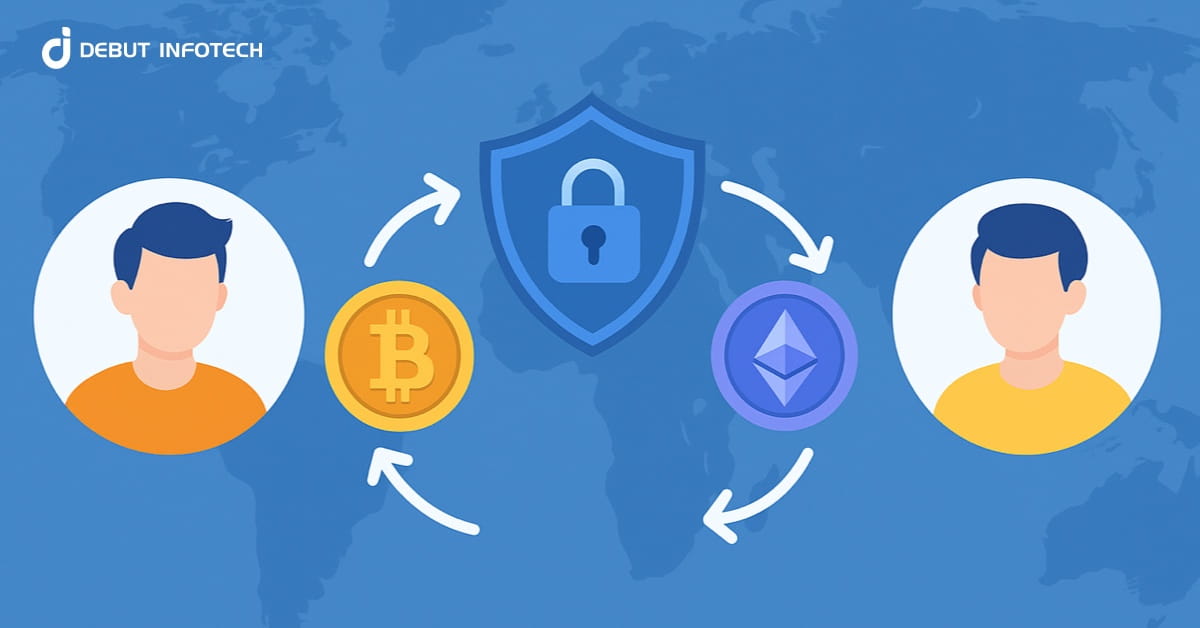
Here’s a more graphic description:
Firstly, you should be aware that crypto traders exchange crypto and fiat currencies directly with one another on P2P crypto exchanges worldwide. So, let’s say a buyer wants to purchase cryptocurrency from a seller on any of these P2P platforms. After both parties agree on a price, the buyer is expected to send the payment, while the seller deposits the agreed crypto amount into a cryptocurrency escrow service.
Remember, both parties probably don’t know where the other party is, and they don’t need to. However, when they both make their initial transfers, neither the crypto funds nor the fiat currencies are deposited directly into the other person’s account. Instead, the escrow service locks the funds until the smart contract verifies that both actions — i.e., the payment sent and the crypto deposited — have occurred as required.
This is when the smart contract automatically releases the crypto to the buyer and vice versa.
So, what if something goes wrong in the process?
For instance, if the buyer claims non-receipt or the seller fails to deliver.
In this case, the system pauses. As a result, the escrow crypto contract holds the funds until the issue is resolved, preventing an impulsive release or fraudulent reversal.
This mechanism is why so many crypto traders around the world feel confident enough to trade huge sums on P2P marketplaces without even knowing who they are transacting with.
Unlike traditional escrow, where humans can delay or manipulate outcomes, a cryptocurrency escrow service works purely on logic. There’s no emotional bias, no backdoor interference — only code that executes as written. That transparency is why more exchanges and crypto platforms are integrating crypto escrow services directly into their architecture.
For platform builders and exchange executives, this model isn’t just about preventing scams; it’s about creating predictable trust at scale. Users feel safe trading when they know their assets are governed by impartial code.
Read: How P2P Cryptocurrency Exchange Development Works: A Comprehensive Guide
The Trust Deficit in Traditional P2P Exchanges
Peer-to-peer crypto trading was built on the major powerful idea of removing middlemen. But in removing intermediaries, many platforms also removed the safeguards that make transactions trustworthy.
Here’s an example: without crypto escrow services, users are left to rely purely on mutual trust. And that’s where problems begin.
In most traditional P2P exchanges, a trade follows a simple pattern: the buyer pays, and the seller releases the crypto. The flaw is obvious — what happens if one side doesn’t follow through?
Common scenarios include:
- Payment fraud: Buyers send fake payment confirmations or reverse bank transfers after receiving crypto.
- Non-delivery scams: Sellers accept payments but never release the assets.
- Identity manipulation: Fraudsters impersonate verified users to exploit newcomers.
Platforms try to address these issues with manual dispute teams or support tickets, but these systems are slow, subjective, and expensive to maintain. A single dispute can lock up funds for days — sometimes weeks — damaging user trust and liquidity.
For exchange operators, every unresolved dispute isn’t just a bad user experience; it’s a business risk. Reputational hits translate to user churn, lower trading volumes, and eventually, declining revenue.
The market is clear on one thing: trust cannot be optional. And that realisation is what’s driving the industry’s shift toward escrow mechanisms for cryptocurrency. They are automated, transparent, and tamper-proof solutions that, by design, make fraud nearly impossible.
In essence, whereas traditional P2P models rely on good faith, Escrow and p2p crypto exchange systems rely on verified actions. This difference between trust and proof is what defines the next generation of exchanges.
So, how do escrow-based P2P exchanges address the trust deficit in traditional P2P exchanges?
Let’s find out in the next section as we address the core benefits of escrow-based exchanges.
Related Read: Regulatory Compliance and Legal Essentials for Building a P2P Exchange Platform
Core Benefits of Escrow-Based P2P Exchanges
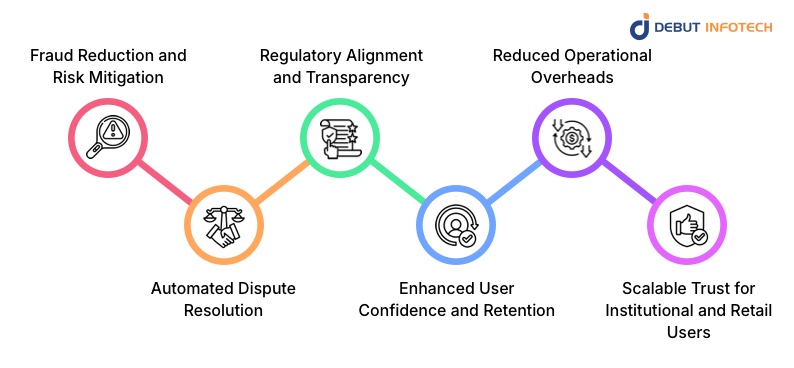
Using Escrow and p2p crypto exchange services is more than a security feature. In fact, you can say that it is the core trust engine of any serious peer-to-peer crypto exchange. And when implemented correctly, cryptocurrency escrow services don’t just prevent fraud; they fundamentally improve platform reliability, compliance, and user growth.
Let’s unpack the following core benefits.
1. Fraud Reduction and Risk Mitigation
Fraud remains one of the top three concerns among crypto traders. According to Chainalysis, over $40.9 billion was received by illicit addresses known today in 2024, accounting for a staggering 0.14% of total on-chain transaction volume.
Escrow mechanisms directly address this.
By locking funds in a crypto escrow smart contract, neither party can manipulate or reverse a transaction once initiated. This simple step eliminates the most common scam pattern, in which one party disappears after receiving payment.
Every transaction is recorded on-chain, timestamped, and verifiable. That transparency deters malicious actors. They know the system isn’t negotiable: funds are released only when all predefined conditions are met.
In effect, escrow crypto systems don’t just make fraud harder; they make it uneconomical.
2. Automated Dispute Resolution
Traditional exchanges rely on human moderators to resolve disputes, which can take days and frustrate users. But with cryptocurrency escrow services, much of that friction disappears.
Smart contracts act as impartial judges, releasing or refunding funds automatically once certain proofs are verified. This could be payment receipts, wallet confirmations, or API-triggered events.
Furthermore, some advanced platforms also incorporate oracles and AI-based verification, further minimising human involvement. The result? Disputes that once took 48 hours can now be resolved in minutes.
That’s a massive operational advantage for exchange operators. Faster resolution leads to higher liquidity, lower support costs, and a better user experience, all key to scaling a P2P business.
Related Read: Top Crypto Derivatives Exchange Platforms
3. Regulatory Alignment and Transparency
Executives often view “decentralization” and “compliance” as opposites. Escrow architecture bridges that gap.
Because crypto escrow services log every action immutably, exchanges can easily generate audit-ready transaction records. When integrated with KYC/AML modules, compliance reporting becomes not just possible but efficient.
Global regulators are moving in this direction. For example, the Financial Action Task Force (FATF) recommends traceable transactions as part of its “Travel Rule.” Escrow-enabled platforms naturally meet these expectations since every trade leaves a verifiable digital footprint.
For business leaders, that’s a strategic differentiator. You’re not just protecting users, but you’re protecting your license to operate in a tightening regulatory environment.
4. Enhanced User Confidence and Retention
Trust drives volume. Data from Kraken’s latest findings show that 79% of crypto exchange users would rather pay slightly higher fees on a platform they trust than save money on one they don’t. Escrow-backed exchanges tap directly into that user psychology. When traders know their assets are protected by automated escrow logic, they’re far more likely to complete larger or repeat trades.
This confidence compounds. More trust attracts more liquidity, which attracts even more traders — creating a positive network effect.
It’s no coincidence that leading P2P platforms like Paxful, LocalBitcoins (before its closure), and Binance P2P all built their models around escrow protection. The correlation between escrow cryptocurrency infrastructure and sustained user retention is no longer theoretical — it’s proven by market behaviour.
5. Reduced Operational Overheads
Every manual dispute handled by a human support agent costs time and money.
However, by automating verification and release through Escrow and p2p crypto exchange services, platforms can drastically cut that expense. Support teams shrink, response times improve, and human error is minimised.
Over time, this operational efficiency compounds into higher profit margins — especially as transaction volumes scale.
6. Scalable Trust for Institutional and Retail Users
Finally, escrow systems make P2P exchanges institution-ready. Institutional participants such as OTC desks, brokers, and payment processors demand Provable trust before executing high-volume trades.
A robust cryptocurrency escrow platform satisfies that requirement, offering:
- Multi-signature controls for added governance.
- Audit trails for transparency.
- Automated arbitration for high-value transactions.
For retail users, the benefits are similar but emotional, offering peace of mind, predictability, and confidence that their funds won’t vanish in transit.
In short, escrow transforms the exchange from a trading interface into a trust platform capable of serving both casual users and institutional players under a single secure logic.
Also Read: Essential Features for Developing a P2P Crypto Exchange Platform
Business Case: Why Executives Should Invest in Escrow-Based Exchange Development
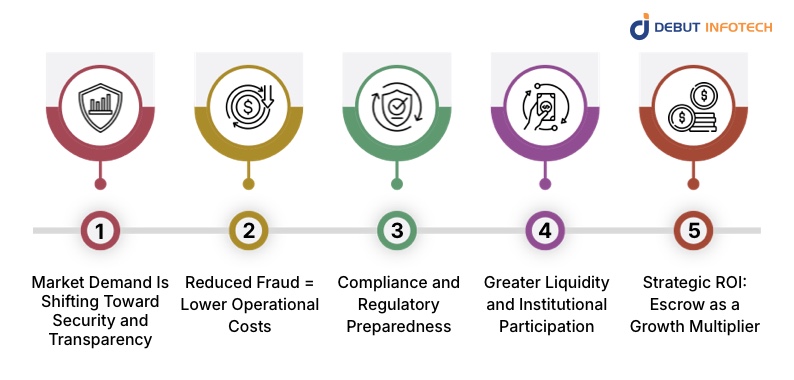
The core benefits highlighted above have probably made a strong case for investing in Escrow and p2p crypto exchange development. However, to put it more succinctly, the following are some reasons why you, as an executive building a crypto exchange, should strongly consider investing in escrow services:
1. Market Demand Is Shifting Toward Security and Transparency
The data couldn’t be clearer: users now choose platforms based on safety, not hype.
The 2025 Kraken Crypto Safety Survey we referenced above already shows that 79% of crypto exchange users would rather pay slightly higher fees on a platform they trust than save money on one they don’t. And with over 1 in 5 U.S. crypto holders having been targeted by fraud or theft, a further 36% worry they could be next. As such, it is your duty to put their minds at rest if you want them to trade on your platform.
These concerns represent a massive opportunity for both new entrants and established players. Exchanges that integrate cryptocurrency escrow services position themselves as “trust-first” platforms—a message that resonates deeply in a post–FTX world.
By embedding crypto escrow at the core of the trading process, you turn security into a brand advantage rather than just a technical checkbox.
2. Reduced Fraud = Lower Operational Costs
Fraud isn’t just a security problem — it’s a financial drain. According to Mastercard, each dispute costs financial institutions $9.08 to $10.32 on average to process, including support and arbitration overhead.
However, automating trust through escrow crypto systems reduces these disputes by design. Funds are released only when both sides fulfil the trade requirements. The system handles what would normally require human judgment, instantly, and without error. Those savings can be redirected into growth, marketing, or product innovation.
3. Compliance and Regulatory Preparedness
In 2025, compliance is no longer optional, especially for platforms operating across multiple jurisdictions.
Here’s where escrow cryptocurrency solutions become strategic assets:
- Every action is recorded on-chain, creating an immutable audit trail.
- Smart contracts can enforce KYC/AML requirements before escrow release.
- Regulators can easily verify transactions without requiring invasive data sharing.
This architecture aligns naturally with FATF’s Travel Rule and MiCA (Markets in Crypto Assets) regulations. These are both frameworks that emphasise traceability and consumer protection.
When your exchange architecture supports these principles by design, compliance becomes a competitive differentiator rather than a burden.
4. Greater Liquidity and Institutional Participation
Institutional players such as brokers, OTC desks, and funds are entering the digital asset space, but only under strict conditions, including security, verifiability, and risk controls.
A robust crypto exchange escrow service provides exactly that. With multi-signature wallets, conditional fund release, and transparent logs, institutions gain the auditability they require to meet fiduciary standards.
Retail users, too, benefit from the same assurance, especially when they know their trades are governed by impartial smart contracts, not promises.
In other words, escrow bridges retail freedom with institutional discipline. It’s the design pattern that makes P2P exchanges both inclusive and credible.
5. Strategic ROI: Escrow as a Growth Multiplier
From a business perspective, the return on implementing cryptocurrency escrow services compounds over time:
- Reduced fraud losses → higher net revenue.
- Faster dispute resolution → improved liquidity.
- User confidence → higher transaction volume.
- Regulatory readiness → easier partnerships and listings.
Exchanges built with escrow logic at their core see tangible growth, including more users, longer retention, and stronger investor confidence.
Secure Your Exchange with Intelligent Escrow Solutions
Connect with our team to explore a customised P2P crypto exchange development strategy designed to reduce fraud, boost trust, and accelerate growth.
Conclusion
Escrow-based P2P crypto exchange platforms have proven that secure, transparent transactions aren’t just possible; they’re profitable. From fraud reduction to regulatory readiness, cryptocurrency escrow services redefine how exchanges earn user confidence.
Therefore, leaders who are ready to build safer, smarter platforms need to partner with a seasoned crypto exchange development company offering p2p crypto exchange development services which ensures your escrow system is not only robust but also future-ready. Because in the world of digital assets, trust engineered right is the ultimate competitive edge.
Frequently Asked Questions (FAQs)
Q. What does “escrow” mean in a P2P crypto exchange?
A. In a peer-to-peer cryptocurrency exchange, escrow is a process in which funds or digital assets are held in reserve by an impartial system (often a smart contract) until predetermined terms of trade are met. The escrow automatically releases assets after the buyer and seller fulfil their responsibilities, lowering risk and enhancing transaction confidence.
Q. How does a cryptocurrency escrow service reduce fraud on P2P platforms?
A. Assets are secured by a crypto escrow service until both parties fulfil their obligations. Common scam vectors, such as payment reversals and non-delivery of cryptocurrency, are avoided since funds cannot be released unilaterally. The inherent “pause then release” reasoning significantly reduces the likelihood of fraud.
Q. Can an escrow crypto system comply with regulatory requirements such as KYC/AML?
A. Indeed. Before assets are delivered, escrow crypto systems can be designed to incorporate KYC/AML procedures and preserve unchangeable on-chain logs for auditing purposes. For platforms that operate in various jurisdictions or target institutional customers, these characteristics facilitate regulatory harmonisation, which is essential.
Q. What business advantages do escrow-based P2P crypto exchanges offer?
A. Escrow-based P2P cryptocurrency exchanges enable higher user trust, lower dispute-resolution costs, and more predictable risk control. These platforms attract higher-value trades and institutional liquidity due to their greater reliability and compliance, providing a competitive edge in the cutthroat cryptocurrency exchange market.
Q. How do I evaluate a development partner for building an escrow-enabled P2P exchange?
A. Start by asking for evidence of KYC/AML integration, escrow process design, smart contract audit, and prior platform launch experience when choosing a partner. Make sure they can provide scalable escrow modules for both institutional and retail consumers, and that their design supports the keyword crypto escrow service.
Our Latest Insights


Leave a Comment