
Table of Contents
Our Global Presence :


Home / Blog / Cryptocurrency
Revenue Models for P2P Crypto Exchanges in Brazil

by

January 15, 2026

by
January 15, 2026
Peer-to-peer trading plays a central role in how Crypto Exchanges in Brazil generate revenue amid rising adoption and trading activity. In 2025, Brazil’s total crypto transaction volume expanded by 43 % year-over-year, and the average investment per user surpassed $1,000, highlighting deeper market engagement and broader participation across age groups and asset types. These trends reflect a maturing environment where monetization models must extend beyond simple trading fees to include escrow charges, PIX payment fees, premium services, and compliance-related revenue streams.
As local payment systems and regulatory frameworks evolve, platforms that balance competitive pricing with diversified monetization stand to thrive, supporting both traders and institutional participants in Brazil’s expanding crypto landscape.
Build Your Own P2P Exchange
Launch a custom P2P crypto platform in Brazil with features that maximize revenue from trading, fees, and subscriptions. Our team handles everything from development to deployment.
Overview of P2P Crypto Exchange Monetization in Brazil
Peer-to-peer crypto exchanges in Brazil operate within a payment-driven, compliance-heavy environment shaped by high retail participation and strong adoption of instant payment systems like PIX.
Monetization is not limited to transaction fees. It spans escrow services, liquidity spreads, premium access, and compliance-driven offerings. A sustainable revenue structure must balance affordability for users with operational resilience for platforms.
Brazilian traders are price-sensitive but volume-oriented, which pushes exchanges to diversify income sources rather than rely on a single fee stream.
Effective monetization in this market depends on aligning revenue mechanisms with local payment habits, regulatory expectations, and trust-building measures that reduce friction across trades.
Read also this – Essential Features for Developing a P2P Crypto Exchange Platform
Why P2P Crypto Exchange Monetization Matters in Brazil
Monetization shapes how P2P exchanges survive in Brazil, covering compliance costs, user protection, payment infrastructure, and competition while keeping trading affordable for a price-sensitive audience.
1. Expanding Financial Access Beyond Traditional Banking
Brazil has a significant population that remains underbanked or underserved by traditional financial institutions. P2P crypto exchanges fill this gap by enabling direct value exchange using local payment rails.
Effective monetization enables platforms to maintain infrastructure, support fiat on-ramps, and sustain services for users excluded from conventional banking systems.
2. Sustaining High-Volume Retail and Merchant Trading Activity
The Brazilian crypto market records consistently high peer-to-peer trading volumes, driven by retail participation and merchant activity.
Monetization allows exchanges to capture value from this activity without over-relying on a single fee source.
Diversified recurring revenue business models support operational stability while accommodating frequent, smaller transactions common among Brazilian traders.
3. Monetizing Instant Payments Enabled by PIX
PIX has transformed payment behavior in Brazil by enabling instant, low-cost transfers. This speed increases transaction frequency on P2P platforms. Monetization strategies built around PIX interactions help exchanges generate revenue from high turnover while keeping individual fees reasonable and aligned with user expectations around fast settlement.
4. Funding Compliance and Regulatory Readiness
Regulatory oversight in Brazil continues to mature, placing compliance, reporting, and verification obligations on crypto platforms. Monetization directly supports these operational requirements. Revenue from structured fees enables exchanges to invest in compliance systems, legal frameworks, and monitoring tools that protect both users and platform continuity.
5. Maintaining Competitive Pricing in a Fee-Sensitive Market
Brazilian P2P traders are highly cost-aware and actively compare platforms. Excessive or poorly structured fees can drive users elsewhere. Thoughtful monetization matters because it allows exchanges to remain competitive while still covering costs. Balanced pricing reinforces trust and supports long-term user retention in a crowded market.
6. Strengthening Trust Through Paid Security Mechanisms
Trust remains a central concern in peer-to-peer trading environments. Monetization tied to escrow, verification, and dispute handling helps fund protective mechanisms that reduce fraud and transaction risk. Users are more willing to pay modest fees when those charges clearly support safer trading experiences and reliable platform governance.
Crypto Exchange Monetization Models in Brazil
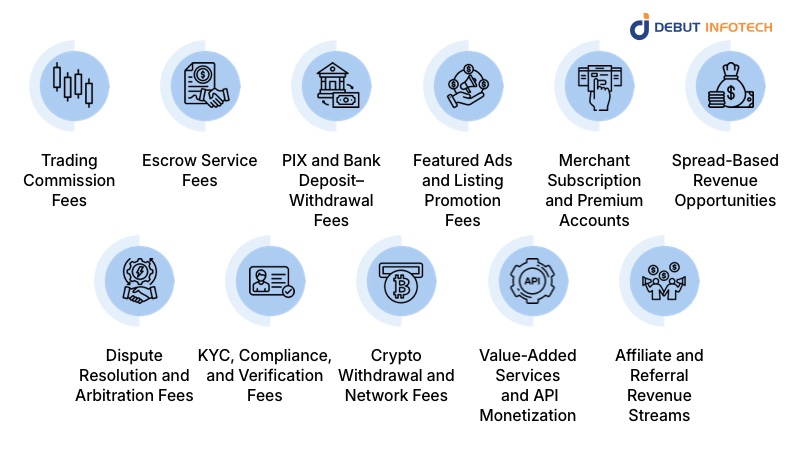
Brazilian P2P platforms earn revenue through commissions, escrow fees, PIX transactions, subscriptions, advertising, and value-added services designed to scale with trading volume and trust
1. Trading Commission Fees
Trading commission fees remain the most direct monetization method for P2P crypto exchanges in Brazil. Platforms typically charge a small percentage on completed trades, often split between buyers and sellers or assigned to one party.
Given Brazil’s high trade frequency and price-sensitive users, commissions must stay competitive. When structured properly, these fees scale with volume, provide predictable income, and support white label crypto exchange platform maintenance without discouraging consistent trading activity across retail and merchant users.
2. Escrow Service Fees
Escrow service fees monetize trust, which is central to peer-to-peer trading. Brazilian users rely on escrow mechanisms to lock crypto assets until payment confirmation is completed. Exchanges charge a fixed or percentage-based fee for this protection. These fees fund secure custody systems, transaction monitoring, and automated release processes. Users generally accept escrow costs because they directly reduce counterparty risk and enhance confidence during high-frequency or high-value trades.
3. PIX and Bank Deposit–Withdrawal Fees
PIX and local bank transfers dominate fiat settlements in Brazil’s P2P crypto market. Exchanges monetize these payment flows by charging modest processing or convenience fees on deposits and withdrawals. These fees help offset integration costs, reconciliation processes, and fraud monitoring tied to instant payments.
When transparently communicated, PIX-related fees align with user expectations, especially given the speed, reliability, and constant availability these payment channels provide.
4. Featured Ads and Listing Promotion Fees
Featured advertising allows merchants to pay for increased visibility within the P2P marketplace. Exchanges monetize premium placement by promoting selected listings at the top of search results or highlighting verified merchants. This model benefits high-volume traders seeking faster deal flow while preserving organic listings for regular users.
Advertising fees create a non-transactional revenue stream that scales with marketplace activity and does not interfere directly with trade execution.
5. Merchant Subscription and Premium Accounts
Merchant subscriptions and premium accounts offer recurring revenue through tiered access models. Brazilian P2P exchanges often provide paid plans that include higher trading limits, advanced analytics, automated pricing tools, priority support, and improved listing exposure. This monetization approach targets professional traders and OTC-style merchants. Subscription income stabilizes cash flow and reduces reliance on transaction-based fees alone, especially during market slowdowns.
6. Spread-Based Revenue Opportunities
Spread-based monetization enables exchanges to earn indirectly by managing the difference between buy and sell prices displayed on the crypto trading platform. In Brazil’s active P2P market, even small spreads can generate consistent revenue at scale. This model requires careful execution to avoid reducing price transparency. When managed responsibly, spread-based income complements commission models while remaining largely invisible to users focused on execution speed.
7. Dispute Resolution and Arbitration Fees
Dispute resolution fees apply when trades escalate beyond automated processes and require manual intervention. Brazilian P2P exchanges often charge for arbitration services to cover staffing, investigation, and resolution costs. These fees discourage frivolous disputes while funding structured conflict-handling systems. Users generally accept arbitration charges because they provide a formal path to resolve payment issues, fraud claims, or miscommunication during complex peer-to-peer transactions.
8. KYC, Compliance, and Verification Fees
Compliance-related monetization supports identity verification, transaction monitoring, and regulatory reporting obligations. Exchanges may charge enhanced KYC fees for merchants requesting higher limits, faster approvals, or corporate verification. In Brazil’s evolving regulatory environment, these fees help recover compliance costs while maintaining platform integrity. Monetizing advanced verification ensures serious traders contribute proportionally to the operational burden created by higher-risk activity levels.
9. Crypto Withdrawal and Network Fees
Crypto withdrawal and network fees compensate exchanges for blockchain transaction costs and infrastructure usage. Brazilian platforms typically pass on network fees with a small markup to cover processing and wallet management expenses. Transparent withdrawal pricing is critical to user trust.
When clearly disclosed, these fees are widely accepted as a standard crypto exchange cost of moving assets off-platform and maintaining secure custody systems.
10. Value-Added Services and API Monetization
Value-added services provide advanced users with tools beyond basic trading. Brazilian P2P exchanges monetize APIs, trading bots, analytics dashboards, reporting features, and integration services for merchants and partners. These offerings appeal to professional traders and fintech companies seeking automation and data access. Monetizing auxiliary services diversifies revenue while positioning the exchange as an infrastructure provider rather than only a marketplace.
11. Affiliate and Referral Revenue Streams
Affiliate and referral programs monetize platform growth by incentivizing users to bring in new traders and merchants. Exchanges reward referrers with commissions tied to trading activity or subscription purchases. In Brazil’s community-driven crypto market, referrals scale efficiently through social networks. This model lowers customer acquisition costs while aligning marketing spend directly with performance and long-term platform engagement.
Factors To Consider Before Choosing a Crypto Exchange Monetization Model in Brazil
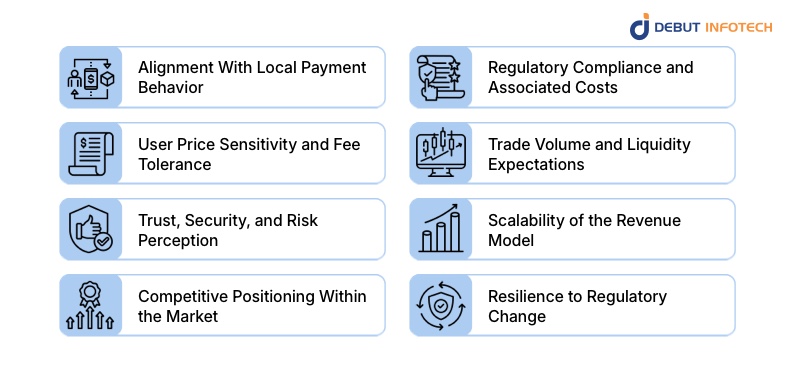
Choosing the right monetization approach in Brazil depends on regulation, payment habits, liquidity expectations, user trust, competition, and how well fees scale with growth.
1. Alignment With Local Payment Behavior
Understanding local payment behavior is critical when selecting a monetization model in Brazil. PIX, bank transfers, and cash-based methods shape user expectations around speed and cost. Monetization must align with these habits to avoid friction. Fees linked to payments should be proportional, transparent, and justified by factors such as convenience, reliability, and settlement speed across different trading scenarios.
2. Regulatory Compliance and Associated Costs
Regulatory compliance requirements significantly influence monetization decisions for crypto exchanges operating in Brazil. Costs tied to KYC, AML monitoring, reporting, and audits must be recovered sustainably. A viable revenue model accounts for these obligations without overburdening users. Poor alignment between fees and compliance expenses can unnecessarily weaken margins or expose the platform to regulatory risk.
3. User Price Sensitivity and Fee Tolerance
Brazilian P2P traders are highly price-sensitive and quick to compare platforms. Monetization strategies must reflect this reality by keeping fees competitive and predictable. Sudden or complex charges often trigger churn. A sustainable peer-to-peer business model balances affordability with profitability, ensuring that revenue generation does not undermine user trust or long-term trading activity across varying market conditions and volatility cycles.
4. Trade Volume and Liquidity Expectations
Expected trade volume and liquidity depth directly affect how monetization models perform. High-volume environments favor low-margin, scalable fees, while thinner markets require diversified income streams.
Brazilian P2P platforms must evaluate user flow carefully. Monetization should support liquidity growth rather than discourage participation through restrictive pricing or excessive transaction costs that reduce overall order-matching efficiency.
5. Trust, Security, and Risk Perception
Trust and security expectations strongly influence user willingness to accept fees in Brazil’s P2P crypto market. Users tolerate monetization when it clearly supports escrow, verification, and dispute protection. Fee structures must communicate value, not punishment. Poorly justified charges weaken confidence and increase platform abandonment, especially during periods of heightened fraud awareness and transaction-related uncertainty levels.
6. Scalability of the Revenue Model
Scalability determines whether a monetization model can grow alongside platform adoption. In Brazil’s fast-moving crypto market, revenue mechanisms must handle rising volumes without operational strain. Fee structures should remain efficient at scale. Models that rely heavily on manual processes often struggle as user numbers, disputes, and compliance demands increase beyond initial growth phases significantly overall.
7. Competitive Positioning Within the Market
Competitive positioning shapes how much pricing flexibility a Brazilian P2P exchange can maintain. Platforms entering crowded segments must adopt conservative monetization. Established brands may introduce premium fees gradually. Understanding market position helps prevent overpricing. Misjudging competitive dynamics often results in reduced liquidity, weaker engagement, and declining user acquisition efficiency across both retail and merchant segments.
8. Resilience to Regulatory Change
Brazil’s crypto regulations continue to evolve, making adaptability a key consideration. Monetization models should withstand rule changes without requiring constant restructuring. Flexible fee systems reduce disruption. Exchanges that plan for regulatory shifts protect revenue continuity and user confidence. At the same time, rigid pricing structures risk sudden losses, compliance gaps, or forced service limitations over extended operating periods.
Read more – Regulatory Compliance and Legal Essentials for Building a P2P Exchange Platform
Partner With a Trusted Development Team
Get your P2P exchange live faster with expert guidance. We handle development, compliance, and monetization strategies, helping you turn ideas into profit.
Challenges of P2P Crypto Exchange Monetization in Brazil
P2P exchanges in Brazil face monetization pressure from regulation changes, intense competition, fraud risks, and the constant need to justify fees without damaging user confidence.
1. Navigating Regulatory Uncertainty and Policy Shifts
Regulatory ambiguity remains a persistent challenge during p2p crypto exchange development in Brazil. Shifts in compliance requirements can affect allowable fee structures and increase operational costs. Monetization models must remain flexible enough to adapt without disrupting user access or undermining revenue consistency.
2. Operating Within a Highly Competitive Market
The Brazilian P2P market is highly competitive, with multiple platforms offering similar services. This limits pricing freedom and compresses margins. Exchanges must design monetization strategies that generate revenue without discouraging participation or triggering rapid user migration to lower-cost alternatives.
3. Balancing Security Costs With User Fee Acceptance
Fraud prevention and dispute management require ongoing investment in technology and human oversight. These costs directly impact profitability. Monetizing security-related services is necessary, but fees must be carefully positioned to avoid the perception that safety is being sold rather than provided as a baseline expectation.
4. Preserving User Trust During Fee and Policy Changes
User trust is fragile in peer-to-peer environments, especially during periods of market volatility. Any changes to fees or monetization policies can trigger skepticism. Exchanges face the challenge of maintaining transparency while evolving revenue models in ways that do not erode confidence or platform credibility.
Building P2P Exchanges That Fit Brazil
Debut Infotech provides cryptocurrency exchange development services for Brazilian businesses. We support crypto exchanges entering Brazil with development practices built around compliance, security, and scalable monetization.
Our company designs P2P platforms that integrate PIX, escrow automation, KYC workflows, and audit-ready reporting from day one. Our approach prioritizes regulatory alignment without sacrificing user experience or revenue flexibility.
By embedding compliance logic directly into platform architecture, we help exchanges operate confidently, adapt to regulatory change, and implement sustainable monetization models suited to Brazil’s market realities.
Conclusion
Revenue models for P2P platforms must reflect how best Crypto Exchanges in Brazil actually operate within a payment-driven, regulation-aware market. Sustainable monetization depends on combining transaction fees, escrow services, PIX-related charges, premium offerings, and compliance-based revenue.
Exchanges that diversify income while keeping pricing transparent are better positioned to manage competition, regulatory costs, and user trust. A well-structured approach supports long-term growth without sacrificing accessibility or operational stability.
FAQs
Q. What are the primary revenue streams for P2P crypto exchanges in Brazil?
A. Most P2P exchanges in Brazil make money through trading fees, withdrawal and deposit charges, and listing new coins. Some also earn from premium features, affiliate programs, and advertising. Basically, anything that users pay for while buying, selling, or promoting crypto adds to their revenue.
Q. Are there government regulations that impact revenue models for P2P exchanges in Brazil?
A. Yeah, Brazilian regulations affect how these platforms charge fees and report transactions. Exchanges must comply with anti-money laundering rules, KYC requirements, and tax reporting requirements. Ignoring these can lead to fines or shutdowns, which obviously hit their revenue streams and growth potential.
Q. How do fluctuations in crypto trading volumes affect P2P exchange profits?
A. When trading volumes spike, exchanges make more from fees. When volumes drop, revenue dips too. P2P platforms rely heavily on activity, so slow markets can seriously hit profits. At the same time, busy trading periods can boost cash flow and overall financial health.
Q. What financial risks affect revenue models for P2P crypto exchanges in Brazil?
A. Revenue can take a hit from volatile crypto prices, hacking incidents, or sudden regulatory changes. Low liquidity and market downturns also reduce trading activity, directly cutting fee income. Basically, anything that shakes user activity or trust affects how much money these platforms actually make.
Q. How do P2P crypto platforms in Brazil compare with centralized exchanges in terms of revenue potential?
A. P2P platforms usually make less per transaction than centralized exchanges. Still, they have lower overhead and appeal to users wanting direct trades. Centralized platforms earn more from extra services like staking or lending, but P2P models can still pull solid revenue if volumes and trust are high.
Talk With Our Expert
Our Latest Insights


USA
Debut Infotech Global Services LLC
2102 Linden LN, Palatine, IL 60067
+1-708-515-4004
info@debutinfotech.com
UK
Debut Infotech Pvt Ltd
7 Pound Close, Yarnton, Oxfordshire, OX51QG
+44-770-304-0079
info@debutinfotech.com
Canada
Debut Infotech Pvt Ltd
326 Parkvale Drive, Kitchener, ON N2R1Y7
+1-708-515-4004
info@debutinfotech.com
INDIA
Debut Infotech Pvt Ltd
Sector 101-A, Plot No: I-42, IT City Rd, JLPL Industrial Area, Mohali, PB 140306
9888402396
info@debutinfotech.com
Leave a Comment