



Table of Contents
Home / Blog / Cryptocurrency
When Should a Startup Use a White Label Crypto Wallet Instead of Building In-House

by

December 30, 2025

by
December 30, 2025
Choosing the right wallet strategy is one of the most essential infrastructure decisions a blockchain startup will ever make. With the introduction of white label crypto wallet solutions, founders now face a strategic decision: build a wallet from scratch or adopt a pre-built platform that’s ready for customization. Because wallets underpin authentication, asset control, transactions, and user security, the choice directly affects product speed, cost, and scalability.
For early-stage startups, this decision can determine whether they go to market in a few weeks or spend months building their own system. As blockchain adoption expands—alongside multi-chain capabilities, non-custodial security, AI-integrated smart crypto wallet features, and interoperability—understanding when to use a turnkey wallet solution becomes essential for strategic planning. In this guide, we explore when a startup should choose a white-label solution, when in-house development makes sense, and how Debut Infotech helps brands strike the right balance.
Ready to Launch Your Crypto Wallet Faster?
We help startups deploy secure, scalable white label crypto wallets in record time.
Understanding White Label Crypto Wallets
A white label crypto wallet is a fully developed, ready-to-deploy wallet platform that businesses can brand, customize, and integrate into their ecosystem. Unlike an app built from scratch, a pre-built crypto wallet drastically reduces development time while offering enterprise-grade security and features. These solutions support customization of the wallet UI, wallet integration services, and feature extensions tailored to a startup’s target market.
White-label options can include non-custodial wallet models, centralized wallet systems, multi-currency wallet capabilities, yield-farming dashboards, NFT support, and an integrated crypto payment gateway.
For startups entering the market quickly—or looking to validate their product idea with minimal upfront investment—white-label crypto wallets offer a cost-effective, highly scalable option.
When Should Startups Choose a White Label Crypto Wallet?

1. When Speed-to-Market Is Critical
Startups competing in the blockchain space rarely have the luxury of long development cycles. A turnkey wallet solution lets them launch in weeks instead of months. Early entry is especially important in markets such as DeFi, token launches, gaming, and cross-border payments, where timing defines market share.
A pre-built platform skips the slow stages of architecture design, core feature development, testing, and compliance baseline setup. Founders can immediately begin onboarding users, validating revenue models, and refining their go-to-market strategy.
2. When Budget Constraints Are High
Building a custom crypto wallet in-house can be expensive due to:
- developer salaries
- infrastructure and node setup
- security audits
- support for multi-chain integration
- ongoing maintenance
The crypto wallet development cost for a custom solution is often prohibitive for early-stage startups. White label crypto wallets solve this challenge by offering enterprise-grade capabilities at a predictable, lower fee. With wallet customization options, founders can gradually layer enhancements as their user base grows.
3. When Security Requirements Are Strict
Security is one of the most complex parts of wallet development. Features such as private key management, MPC cryptography, biometric authentication, encryption layers, and fraud-prevention modules require significant technical expertise.
Turnkey wallets provide tested, audited security—often stronger than what a small internal dev team can produce in early phases. For startups dealing with custodial wallet development, yield farming integrations, or complex settlement flows, a white-label solution helps mitigate early security risks.
4. When Multi-Chain Support Is Needed
Modern users expect support for:
- Bitcoin
- Ethereum
- Polygon
- BNB Chain
- Solana
- Avalanche
- Bitcoin L2 networks
- And emerging chains
Multi-chain support is one of the hardest technical challenges in custom crypto wallet development. Pre-built wallets already include multi-chain support, alongside upgrades that track new network expansions, new token standards, and scalability enhancements—saving startups time and engineering costs.
5. When Startups Lack Internal Blockchain Expertise
Startups often do not have in-house blockchain developers who understand key elements such as:
- wallet architecture
- blockchain protocols
- key management systems
- smart contract integration
- yield farming dashboards
- liquidity routing
- DeFi protocol interactions
A white label crypto wallet solves this gap by outsourcing complexity to a product that is already battle-tested. Meanwhile, startups can focus on branding, customer acquisition, and business strategy.
6. When Compliance and Security Certifications Are Needed
Crypto products require compliance alignment in several areas depending on region:
- identity verification
- AML/KYC requirements
- custodial standards
- transaction monitoring
- data privacy regulations
White label systems typically include compliance-ready modules, making it easier for startups to meet regulatory needs without building everything from scratch.
7. When You Need a Scalable Wallet Platform
Wallet scalability benefits become essential as user volume grows. A pre-built crypto wallet comes with ready infrastructure:
- load balancing
- horizontally scalable backend
- high-volume transaction processing
- push notification layers
- performance-optimized APIs
Building such infrastructure in-house requires months of work and costly DevOps expertise. White label platforms eliminate this burden, delivering scalable performance from day one.
When Should a Startup Build a Custom Wallet In-House?
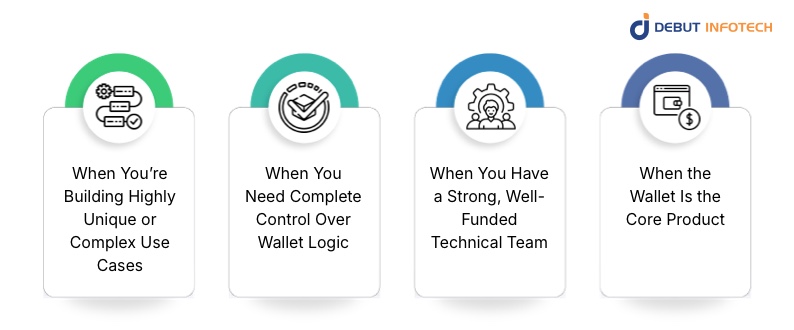
While a white label crypto wallet is ideal for speed, affordability, and market-ready functionality, there are situations where building a proprietary wallet is the smarter long-term strategy. Startups with ambitious product visions or deeply specialized requirements may need full ownership of their wallet’s architecture, logic, and future evolution.
1. When You’re Building Highly Unique or Complex Use Cases
If your platform depends on features that don’t exist in turnkey wallet solutions—such as advanced DeFi modules, AI-driven automation flows, proprietary yield farming engines, or fully customized transaction routing—an in-house build becomes necessary. A custom wallet gives the freedom to implement unconventional mechanics without being restricted by pre-built frameworks.
2. When You Need Complete Control Over Wallet Logic
Some projects depend heavily on proprietary logic, novel cryptographic workflows, or particular compliance rules. In these cases, startups require direct access to every layer of the codebase, from key management to smart contract interactions. Building the wallet internally ensures that no third-party architecture limits customization or innovation.
3. When You Have a Strong, Well-Funded Technical Team
Developing a secure wallet is resource-intensive. Startups with senior blockchain engineers, security experts, and product architects can manage the complexity of building, auditing, scaling, and maintaining their own wallet infrastructure. This path requires a serious time and budget commitment, but it offers unmatched flexibility.
4. When the Wallet Is the Core Product
If your business model revolves around offering wallet technology—such as becoming a B2B wallet provider, launching a new decentralized wallet brand, or offering enterprise crypto wallet solutions—then building in-house is the only strategic choice. It allows you to define your roadmap, customize every feature, and implement long-term scalability without depending on third-party updates.
White Label vs Custom Wallet: Quick Comparison
| Feature | White Label Wallet | Custom Wallet (In-House) |
| Development Time | Weeks | 6–12 months |
| Cost | Low to Medium | High |
| Security | Pre-audited security modules | Requires audits |
| Customizability | Moderate to High | Full control |
| Scalability | Built-in | Must be architected |
| Maintenance | Provider-managed | In-house DevOps |
| Best For | Startups, MVPs, fast launches | Enterprise-grade or unique systems |
Here is a new, short, clean section you can add — focused on why startups may choose a custom crypto wallet and the key advantages it offers, without repeating previous content:
Why Startups Choose Custom Crypto Wallets
A custom crypto wallet gives startups complete freedom to shape their product around their business model rather than adapting to a pre-built framework. Unlike white-label solutions that come with predefined structures, a custom wallet is engineered from the ground up to meet exact use-case requirements, long-term scalability goals, and proprietary features.
Key Advantages of a Custom Crypto Wallet
Full Feature Ownership: A custom-built wallet ensures that every function—whether it’s advanced DeFi modules, AI-powered automation, staking mechanics, or multi-chain routing—is explicitly designed for your ecosystem. Startups gain the freedom to innovate without technical constraints.
Unique Brand Identity: Custom UI/UX allows startups to create a highly differentiated experience. Wallets can be built with brand-native flows, theme systems, animations, and onboarding journeys that stand out in a crowded market.
Enhanced Security Architecture: Rather than relying on generic modules, startups can integrate custom encryption, proprietary key management systems, hardware wallet compatibility, and enterprise-grade authentication.
Future-Proof Scalability: Custom crypto wallets are easier to evolve as user demands grow. Teams can add new chains, integrate liquidity engines, build internal APIs, and optimize performance without depending on third-party updates.
Competitive Differentiation: When your wallet does something no other wallet does—whether that’s automated yield routing, embedded AI copilots, gamified savings, or unique interaction flows—it becomes a competitive moat. Custom development unlocks this possibility.
Debut Infotech helps startups design and build these highly tailored systems, ensuring each wallet is secure, scalable, compliant, and optimized for long-term innovation.
Key Features White Label Crypto Wallets Offer
White label cryptocurrency development wallet solutions often come with all essential core features, including:
- Multi currency wallet support: A white label wallet allows users to store, send, and receive multiple cryptocurrencies in one place. This expands user flexibility and enables startups to reach global audiences without building multi-chain support from scratch.
- Custodial & non-custodial models: Startups can choose whether they want full control over user keys (custodial) or give users complete ownership of their private keys (non-custodial). Each model supports different business and regulatory goals.
- Encrypted private key management: Advanced encryption ensures private keys remain secure against hacks, breaches, or unauthorized access. This is crucial for enterprise crypto wallet deployments.
- Yield farming dashboards: Some pre-built wallets include dashboards that track DeFi yields, allowing users to monitor farming returns without third-party tools.
- Staking modules: Integrated staking tools let users lock tokens and earn rewards directly inside the wallet, improving engagement and platform retention.
- Crypto payment gateway development: White label wallets often include built-in payment processing for merchants, enabling instant crypto payments and settlements.
- Swappable UI/UX templates: Customizable design templates give startups flexibility to brand the wallet without redesigning the interface from scratch.
- QR code payments: Supports faster and more secure wallet-to-wallet payments, widely used in retail or point-of-sale setups.
- AI-integrated smart crypto wallet features: AI tools provide fraud detection, real-time analytics, transaction insights, and automated recommendations, improving the user experience and safety.
- NFT support: Allows users to store, view, and manage NFTs, which is essential for platforms entering gaming, digital collectables, or Web3 ecosystems.
- Wallet backup & recovery: Seed phrase backups or encrypted cloud-restore options help users regain access if they lose devices or authentication keys.
- Secure authentication layers: Includes PINs, biometrics, MFA, and device authorization to protect accounts and prevent unauthorized transactions.
- Compliance modules (KYC/AML): Regulatory tools ensure the wallet complies with identity verification and anti-money laundering requirements, especially for startups launching in multiple jurisdictions.
Many of these features take months to build individually, which is why startups frequently choose a turnkey solution.
The Hidden Operational Costs Startups Overlook When Building Wallets In-House
Most startups underestimate the long-term operational demands of maintaining a custom ewallet app development. While development costs are often calculated upfront, ongoing operational expenses can exceed the initial build cost — making a white-label crypto wallet a more practical choice in many scenarios.
One of the highest overlooked costs is continuous security management. Because crypto wallets interact with live blockchains, the threat landscape is constantly evolving. Teams must perform recurring audits, run penetration tests, patch vulnerabilities, and monitor on-chain behaviors at all times. This requires dedicated engineers, security analysts, and compliance specialists.
Another hidden cost is the ongoing cost of feature updates. The crypto ecosystem evolves rapidly: new blockchains emerge, token standards change, regulations shift, and UX expectations accelerate. A custom wallet demands frequent updates to support new chains, integrate DeFi protocols, add staking modules, enable NFT features, or adopt AI-enhanced experiences. These enhancements require continuous R&D, backend modifications, and front-end redesigns.
Startups also often overlook infrastructure and DevOps overhead. Managing nodes, maintaining uptime, performing load balancing, ensuring scalability, and integrating monitoring systems are full-time operational tasks. Each component — from cloud hosting to API rate management — adds to the monthly burn rate.
Finally, compliance introduces ongoing responsibilities. As global authorities tighten rules on KYC/AML, data storage, and custodial regulations, startups must regularly update their processes and architecture to remain fully compliant. This can be expensive, especially without an internal legal or compliance team.
For startups without the resources to sustain such ongoing commitments, adopting a ready-to-launch, turnkey wallet solution is far more cost-effective and efficient than managing the ongoing overhead of in-house development.
How Debut Infotech Helps Startups Choose the Right Wallet Strategy
Debut Infotech supports startups by evaluating their product vision and guiding them toward the most efficient wallet approach—whether that’s a white label crypto wallet or a fully custom build. As one of the top crypto companies specializing in crypto wallet development services, we assess your wallet platform needs, long-term scalability targets, user experience expectations, and security requirements.
Our team also reviews your compliance readiness and crypto wallet development cost to ensure the chosen solution aligns with regulatory and financial constraints. With deep expertise in white-label wallet deployment, custom crypto wallet architecture, DeFi integrations, and enterprise-grade Web3 solutions, we help founders move forward with a wallet strategy that is secure, scalable, and built for future growth.
We help startups evaluate:
- wallet platform requirements
- scalability goals
- user experience needs
- security architecture
- crypto wallet development cost
- compliance readiness
Whether you choose a pre-built wallet or a proprietary in-house build, our team ensures your product is secure, scalable, and future-ready.
Need a Custom Wallet Built from Scratch?
Work with our expert blockchain developers to build a powerful, future-ready crypto wallet tailored to your product vision.
Conclusion
Choosing between a white label crypto wallet and custom in-house development is a strategic decision that should align with your startup’s goals, resources, and time-to-market expectations. A white-label crypto wallet is ideal when your priorities are speed, security, and cost control—especially in theearly stages. It gives startups immediate access to enterprise-grade wallet features, compliance-ready systems, and multi-chain capabilities without large upfront investments.
On the other hand, custom wallet development is best suited for specialized products, long-term proprietary systems, or highly innovative blockchain applications requiring deeper customization. Understanding these two paths empowers founders to build smarter, scale faster, and innovate without compromise.
Debut Infotech helps businesses make this crucial choice by offering expert guidance, wallet customization options, and robust crypto wallet development services built for global scalability.
Frequently Asked Questions
Q. What is a white label crypto wallet?
A. A white label crypto wallet is a pre-built wallet solution that businesses can brand and customize as their own. It significantly reduces development time while offering secure crypto storage and transaction features.
Q. When should a startup choose a white label wallet over building in-house?
A. A startup should choose a white label crypto wallet when speed, lower development cost, and access to ready-made security features are top priorities. It’s ideal for teams without the technical bandwidth to build from scratch.
Q. Are white label wallets secure enough for large-scale use?
A. Yes. High-quality turnkey wallet solutions include audited smart contracts, multi-layer encryption, and secure key management. They also support custodial or non-custodial configurations depending on business needs.
Q. Can a white label wallet be fully customized?
A. Absolutely. Startups can customize UI, features, asset support, integrations, and branding. Many providers also offer wallet customization options such as AI-assisted transactions or DeFi integrations.
Q. What blockchains do white label crypto wallets support?
A. Most enterprise crypto wallet platforms support major chains like Bitcoin, Ethereum, BNB Chain, Polygon, Tron, Solana, and custom networks. Startups can also request additional chain integrations.
Q. How much does crypto wallet development cost?
A. The cost varies depending on complexity and features. White label wallet adoption is usually more affordable than building from scratch because the core architecture is already developed and tested.
Q. Can a white label wallet integrate with other crypto platforms?
A. Yes. These wallets often include built-in APIs that support integration with crypto payment gateways, exchanges, DeFi protocols, enterprise systems, and yield farming platforms.
Our Latest Insights




Leave a Comment