ON THIS PAGE
Progress0%






Our Global Presence :





Is your enterprise software project more complex than it needs to be?
Transforming a big idea into a secure and reliable system can be an overwhelming task, and you are not alone in that task.
The thing is, there are numerous moving parts to the enterprise software development process. Once those bits fail to fit, projects become stagnant, budgets become elastic and teams become agitated. However, when properly approached, it does not necessarily feel like chaos.
This guide breaks the process into straight and manageable steps such as early discovery and design through development, testing, deployment and long term support. In the process, it sheds light on pitfalls such as scope creep and integration problems in the system and gives you tips that will work to avoid them.
If you’re looking for a clearer, more confident way to navigate the enterprise software development process, you’re in the right place. Let’s walk through each phase and see what actually works in real-world projects.
The enterprise software development process is the path organizations follow to turn complex ideas into systems their teams can actually rely on. It assists in organizing the planning, construction, and implementation of enterprise software throughout the business, so the system does not collapse as it expands.
The stakes in enterprise application development are very high compared to small projects. The software is regularly used by hundreds or thousands of users, integrated with existing tools, and works with sensitive business data. It implies that performance, security, and reliability are not optional, they are anticipated.
Each organization functions in a different way; thus, there is no universal method. The most effective teams are those that aim at designing systems capable of scaling, remaining secure and changing with time. Regardless of the initiative to start a new platform or to update an older one, adhering to an established and successful enterprise software development process can minimize risk and produce long-term value.
Enterprise level software development is not only a technical process, but a coordinated effort that integrates business objectives, human beings and technology. With proper attention to each step, complex systems would be simpler to scale, secure, and modify with the growth of the organization.
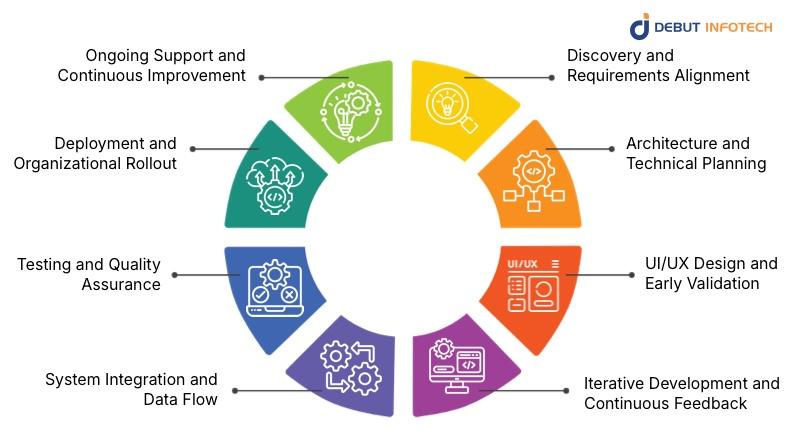
Although each business has its requirements, effective projects typically have a well-defined set of steps. Here’s how those stages work in the real world.
Related Read: 15 Top Custom Software Development Companies for Business Leaders
1. Discovery and Requirements Alignment
Listening is the starting point of the process. Teams collaborate with the stakeholders to get a clear view of what the business really needs and not what it thinks it needs. This involves the review of the current systems, workflow mapping, and the identification of security, performance, and compliance requirements.
Strong discovery sets the path of the whole project and aids in preventing expensive changes in the future.
2. Architecture and Technical Planning
With clear requirements, teams determine the way the system will be organized. This phase involves the definition of the system components, data flow, and the integration of the software with the existing tools and platforms.
Proper architectural choices here will see to it that the software is designed to scale in a graceful manner, and that it can support business needs in the future.
3. UI/UX Design and Early Validation
Even the strongest enterprise system is able to fail when it is difficult to use. In this phase, designers develop prototypes and wireframes which show actual user behavior. Stakeholders have the opportunity to observe the way the system will operate and offer feedback prior to the development process.
This initial form of validation makes it easier to use, increases adoption, and decreases rework.
4. Iterative Development and Continuous Feedback
Development occurs in small manageable cycles instead of developing everything at once. Teams provide features at a time, test them in the shortest time possible and refine them according to the feedback provided by the actual users.
This strategy makes the project responsive and the final solution remains in line with business priorities.
5. System Integration and Data Flow
Enterprise systems do not exist in isolation. New software should be able to integrate with legacy applications, databases and third-party tools. This step is concerned with ensuring that all things collaborate to ensure they do not interfere with the day-to-day activities.
Effective integration enhances efficiency and a smooth flow of data within the organization.
6. Testing and Quality Assurance.
The system is also tested extensively before launch to ensure that it will work reliably under real world conditions. This involves functional testing, performance testing and security reviews.
High quality assurance minimizes the effects of downtime, data complications, and post-launch surprises.
7. Deployment and Organizational Rollout
Enterprise software implementation must be well coordinated. Regardless of whether the deployment is done in phases or at once, the goal is to ensure that disruption is as minimal as possible and that users are able to settle down. Training, documentation, and support play a big role here.
A roll out that is well managed develops confidence and will promote adoption by teams.
8. Ongoing Support and Continuous Improvement
The job does not end when it is launched. To be effective and secure, enterprise software requires constant monitoring, updating, and upgrading. In the long run, the modernization process allows the system to develop with the business.
Companies that provide long term support receive enhanced performance, increased software life and enhanced returns on investment.
Also Read: GoodFirms Places Debut Infotech Among the Top 20 Software Development Companies in the US
Despite having a good plan, enterprise application development may still have to toss a couple of curveballs. The large systems, changing business requirements, and rigid technical requirements may make the process seem like a high stakes juggling act. However, these challenges can be dealt with the appropriate approach.
Scope Creep
Scope creep is one of the largest obstacles. When there are several departments and stakeholders, priorities may change, and new needs may appear in the course of the project. Without the appropriate controls, it can cause delays, increased budget and an end product that does not exactly match the initial vision.
Integration with Legacy Systems
Many businesses continue to use older infrastructure which was not intended to support modern applications. It takes a thorough technical knowledge and long-term thinking to make sure that all the pieces fall into place without making the process intrusive.
Security and Compliance
There is no bargain when it comes to security and compliance. Enterprise applications should safeguard confidential information, fulfill industry standards, and resist the changing cybersecurity risks. That translates to the fact that security must be integrated at the very beginning-not added at the end.
Scalability
As your business expands, your enterprise application must be able to support more users, transactions and data. Designing with scalability in mind can save you expensive rework and performance problems in the future.
With these challenges identified early, and properly planned, you are bound to be in a far better position to go through the enterprise application development process with success.
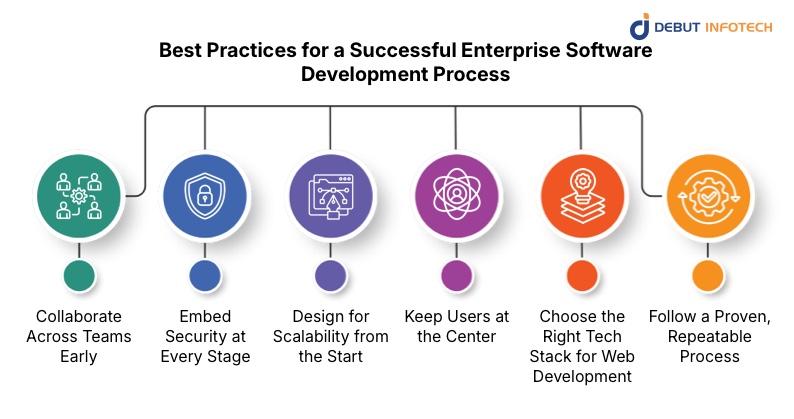
Knowing how to make enterprise software work is not only about writing some code but also about aligning people, strategy and technology all the way across. Adherence to best practice enhances the probability of coming up with software that genuinely contributes to business value. Here’s a practical breakdown:
Enterprise software impacts various departments, such as IT, operations, and leadership. Engaging stakeholders early on will guarantee that the system addresses the technical requirement and a larger business goal. Early coordination helps to minimize the misunderstandings and avoid the possibility of costly changes in the future.
Enterprise systems are frequently dealing with sensitive data or operations. Security will allow you to minimize the number of risks, avoid breaches, and remain in compliance with the industry standards such as GDPR, HIPAA, or SOC 2, by utilizing the security concept in architecture, design, development, and deployment.
Enterprise worlds expand. New integrations, more users and more data are unavoidable. Designing scalability into your software early in its development means that your software is able to scale as your organization grows without significant redesigns and performance concerns.
Even technically flawless software can fail if it’s hard to use. Carry out user testing, prototyping and repeat designs to make sure that the system is easy to use, effective and popular throughout your organization.
It is vital to choose the appropriate tech stack for web development such as tools, structures, and platforms. An effective tech stack can ensure your future growth, make it easier to maintain, and keep it in line with the long-term goals of your organization. It is also faster to develop and it eliminates headaches in integration.
Although all enterprise projects are different, a step-by-step approach, with its disciplined approach to complexity and risk minimization, is used. It promotes innovation but at the same time makes sure that your software produces sustainable value throughout the organization.
A new era is emerging in enterprise software development. It is no longer about the delivery of a functional system but rather the development of software that is capable of expanding, developing, and remaining pertinent as businesses, technologies, and regulations keep changing. Businesses that are future-oriented create systems that not only facilitate operations, but also propel change.
Enterprises in the modern world are no longer doing single deployments but rather adopting software ecosystems to support continuous change. Cloud-native designs, components, and API-based systems enable the addition of new capabilities without interruption of the current operation. Proactive custom software development solutions are based on flexibility at the outset, so the systems can adapt to the new-technologies.
In future-ready enterprises, data is treated as a living resource, not a static archive. Development of software platforms is based on smart data governance that changes in real time to manage access, track usage, and safeguard sensitive information automatically. The method enables organizations to expand the use of data with the confidence of not compromising on the level of security and trust.
Rather than responding to regulatory change, next-generation enterprise software foresaw it. With the rules of compliance being hard coded into workflows, permissions, and even system logic, enterprises in regulated industries are able to remain compliant whilst still moving fast. Innovation and regulation do not compete anymore, they coexist.
The best process of enterprise software development does not stop at the point of launch. Systems are built in such a manner that they are continuously optimized based on user behavior, system performance, and business achievements. This constant evolution keeps the enterprise software safe, scalable and business goals aligned.
When you break down the enterprise software development process into specific, well-considered phases, establishing enterprise software becomes much easier. Requirement and design, development, testing, and continued support are all steps that will assist in ensuring that your application is secure, scalable, and is capable of supporting complex business operations.
New methods such as agile development and cloud solutions can simplify the process of adapting to the growth of your business, whereas bespoke applications like ERP and CRM provide more efficiency across departments. Debut Infotech, a leading custom software development company, helps enterprises turn ideas into reliable, future-ready software.
Ready to build enterprise software that actually works? Talk to Debut Infotech today and get started.
A. Enterprise software development involves custom application development in large organizations. In contrast to consumer software, it is developed to automate processes, simplify workflow, and handle data among several departments. Examples include ERP, CRM, and SCM systems. They are scalable, secure and integrated, enabling core business functions and aiding leaders to make strategic choices.
A. Enterprise Resource Planning (ERP), Customer Relationship Management (CRM), and Supply Chain Management (SCM) are the three primary forms of enterprise software. ERP combines business processes such as finance, operations and inventory into one system. CRM assists in customer communications, sales pipeline, and customer support. SCM manages the movement of products between the suppliers and customers. Other significant types are Business Intelligence (BI), which involves the analysis of data and Human Resource Management (HRM), which deals with staff and payroll.
A. Software is any application such as a photo editor or mobile application. Enterprise software, however, is implemented by large organizations. It supports numerous users, deals with complex business processes, and needs a high degree of security and customization. Whereas ordinary software is used by individuals or small teams, enterprise applications such as ERP systems or CRM systems ensure smooth operations of an organization as a whole.

Our Latest Insights
USA

2501 Chatham, Rd Suite R Springfield, IL 62704
+1-708-515-4004
info@debutinfotech.com
UK

7 Pound Close, Yarnton, Oxfordshire, OX51QG
+44-770-304-0079
info@debutinfotech.com
Canada

154 Eden Oak Trail, Kitchener, ON N2A 0H9
+1-708-515-4004
info@debutinfotech.com
INDIA

Sector 101-A, Plot No: I-42, IT City Rd, JLPL Industrial Area, Mohali, PB 140306
9888402396
info@debutinfotech.com