ON THIS PAGE
Progress0%






Our Global Presence :





Web development is one of those careers that keeps popping up on “high-paying tech jobs” lists and for good reason. Almost everything we do today happens online. From browsing a website to shopping on an eCommerce store or using a web app at work, there’s always a web developer behind the scenes making it all work smoothly.
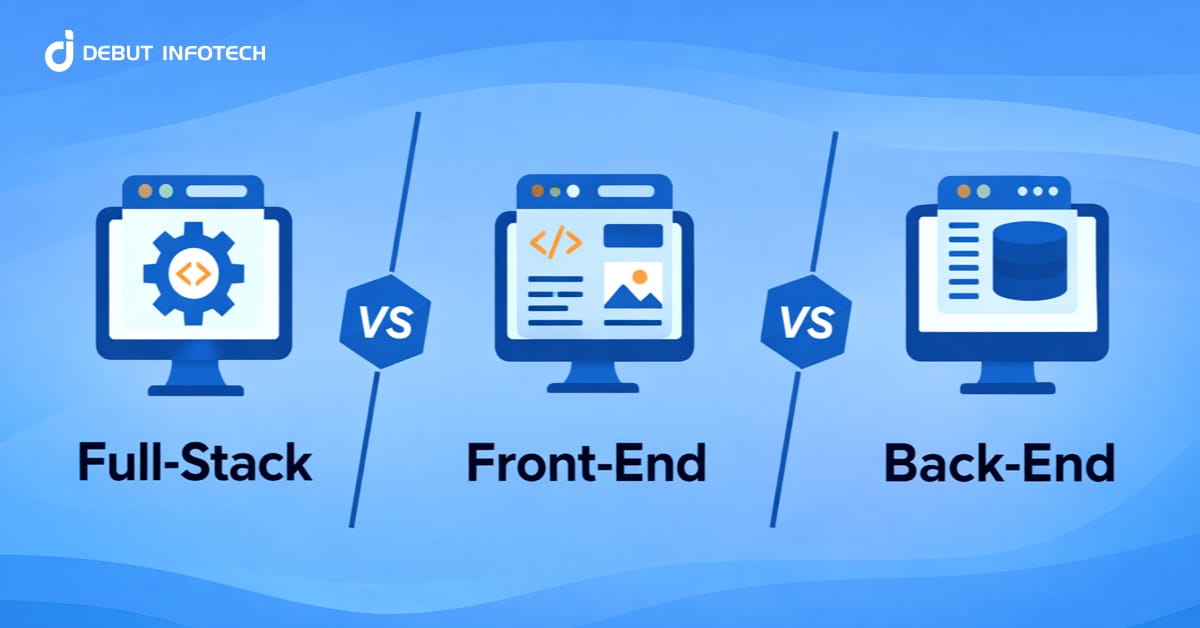
When considering becoming a web developer, you have likely realized that full stack developer positions are frequently posted in job advertisements. However, that normally leads to a larger (and more relevant) question, which is what is the actual difference between front end vs back end vs full stack development and which way really is the most reasonable to go as a developer?
It is always good to know what each of the positions really entails before deciding which position is best to take. It is also good to know how each position interrelates with the other position and where your strengths would fit in best.
The U.S. Bureau of Labor Statistics predicts that web developer jobs are going to increase by 16% in the next 10 years, which is far greater than the average increase in most occupations, so it is a good opportunity to seek advice before taking the plunge.
In this guide, we’ll break down front end vs back end vs full stack development in plain language, what each role focuses on, how they differ, and how to decide which one aligns with your career goals.
When users comment on a website or application appearance or feel, what they actually refer to is frontend development. The interface is the aspect of the product that end users themselves view and engage with, the buttons they press, the layouts they scroll over, and the animations that give everything a nice and user-friendly feel.
As the back end runs data and logic on the background, the frontend developers worry about taking those background systems and making them something that the user can readily comprehend and enjoy. A simple interface, quick loading, and a responsive design are all contributing factors that determine how long the person will remain on a site or not.
At its core, frontend development is built on three fundamentals:
From there, the majority of front-end developers add the latest tools and frameworks to their arsenal. Libraries such as React, Angular, or Vue.js are used to manage multi-faceted interfaces, and Sass simplifies the process of styling and Git makes projects hierarchical and collaborative.
Front-end work does not simply involve writing code. Developers also need to consider the way designs will respond to various browsers, screen sizes, and devices. This is why they usually collaborate with UI/UX designers extensively, and why the knowledge of usability, the basics of the SEO, and accessibility norms is equally crucial to technical expertise.
Concisely, it is in front-end development that technology is exposed to human experience and this is one of the main components of the overall comparison of front-end vs back-end vs full stack roles.
Any site or web application that you love to use involves a lot of activity behind the scenes, this is where the back-end development comes in. Although the users might be engaged with the buttons, forms, and structures on the front-end, the back-end is silently running the logic, data and processes that ensure the front end actions actually take place. This is the layer that makes everything stable, secure and even operational in the front-end vs back-end vs full stack comparison.
The back-end developers take care of data storage, processing and delivery. When an individual logins, enters details or executes a transaction, it is the back end that is doing the hard work. It is particularly crucial when it comes to custom software development where programs must accommodate targeted business guidelines, complicated business cycles, and expanding clientele.
Typical back-end responsibilities include:
They have technologies they work with such as Python, Java, PHP, Node.js, C#, and Ruby- but the job is much more than just coding. Back-end developers also create stable system design, implement security and access controls, correct errors whenever there are problems and streamline applications to increase users without degrading.
In simple terms, the back end is the engine of a web application. Users may never encounter it, but without it, even the most beautiful interface would not even work.
When individuals discuss full stack development, they mean versatility. Full stack developers do not only work on the front-end, or the back-end of a web application, but the full web application, including what the user can see (on-screen) and what is behind the scenes in terms of logic and data.
It implies that they feel at ease using HTML, CSS and JavaScript to construct user interfaces, and languages such as Python, PHP or JavaScript to perform server-side programming. To add to that, they know the storage and retrieval mechanism of databases such as MySQL, MongoDB or PostgreSQL. The result? A single developer with the big picture and the ability to view all the moving parts.
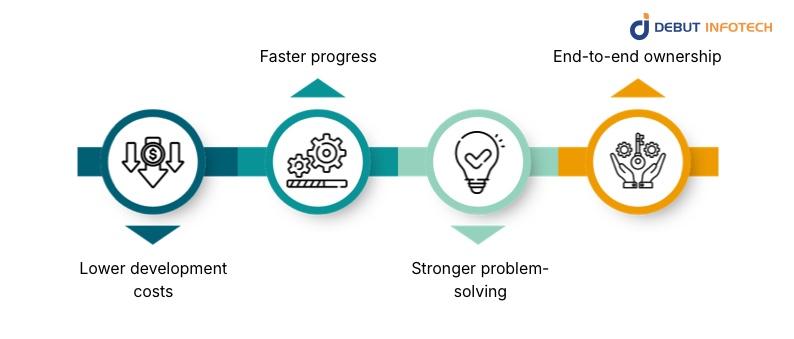
Such a wide range of skills has certain definite benefits, particularly in the terms of front-end vs back-end vs full stack positions:
Due to this fact, full stack developers tend to become problem solvers in a team. Their ability to adapt, take ownership, and support multiple areas of a project also translates into greater career flexibility and long-term job security.
Wondering how front end, back end, and full stack roles actually differ? It’s easier than it sounds. Here’s a straightforward side-by-side view so you can quickly see the focus, skills, and tools for each type of web developer. This also brings out the front-end and the back-end language you will normally work with.
| Role | What You Do | Tools & Languages | Career Flexibility | Typical Salary |
| Front End | Build the parts of a website or app users see and interact with | HTML, CSS, JavaScript, React, Vue, Angular | Great for design-focused roles; can transition into UX/UI or mobile development | $60k – $100k |
| Back End | Handle servers, databases, APIs, and logic behind the scenes | Node.js, Python, Java, PHP, SQL, NoSQL | Ideal for system architecture or cloud roles | $70k – $120k |
| Full Stack | Do a bit of both—front end and back end | MERN, MEAN, LAMP stacks; HTML, CSS, JS, Node.js, Python | Highly versatile; perfect for startups or bridging teams | $75k – $130k |
A couple of front end vs back end vs full stack myths are a-fluttering about and it is high time we put the record straight. The myth about full-stack developers is that they are supposed to be all-knowledgeable. In practice, a full-stack developer is generally familiar with front-end and back-end technologies, although they usually specialize in particular domains. Believing in the contrary is just creating impractical expectations.
Another myth is that front-end development is easier. The reality is that the front-end work involves designing smooth, responsive and eye-catching experiences that entails the combination of technical expertise, aesthetic sense and details. On the other hand, others believe that back-end developers do not have to consider user experience. But a well-crafted back end has a direct effect on how the load times are, and how well the user is satisfied with the system in general, so the interaction points between the user and an application are not to be ignored, regardless of the fact that the work occurs behind the scenes.
Regardless of whether you need to hire full stack developers to be part of your team or you are just planning your own career route, being aware of these realities may assist you in establishing the proper expectations and preventing unjustified disappointment.
Front-end, back-end, full stack development boundaries are becoming increasingly thin-and the next several years will speed up that transition even faster.
On the front-end, AI-based tools are already transforming the functionality of interfaces construction. As the popularity of rapid web applications development tools surges, more refined, responsive interfaces are being created more quickly, yet careful human consideration remains the only way to create a usable product versus a great one.
Meanwhile, back-end development is quietly becoming more automated. Serverless architectures and managed cloud services are reducing the need to manually handle infrastructure, allowing backend developers to focus on data flow, security, and scalability rather than server maintenance.
For full stack developers, this shift is especially significant. As tools handle more of the setup work, full stack roles are evolving beyond “someone who can do both.” Many are stepping into product-focused roles, helping shape features end to end, making technical decisions faster, and bridging the gap between business goals and development.
In short, the future isn’t about choosing the “better” role in the front-end vs back-end vs full stack debate, it’s about adapting how each role delivers value as development becomes faster, smarter, and more product-driven.
When it comes to front end vs back end vs full stack development, there’s no one-size-fits-all path. The strengths of each of the roles are different and the correct option is indeed dependent on what you love creating and how you want to develop in your profession.
Nonetheless, full stack development retains its uniqueness in terms of its versatility, particularly in those teams where speed, flexibility, and end-to-end ownership are important.
The need to have developers who know the interface and the back end of the digital product continues to increase as companies create more complex products. That is why a lot of progressive companies resort to such experienced partners, Debut Infotech, a software development company providing scalable and high performance web-solutions, both front-end and back-end development, and full stack development.
Ultimately, the front end vs back end vs full stack is not just about creating a selection of roles, it is about viewing how these skills can be combined to create a better product and improved digital experiences.
A. Yes—frontend development has a strong future, but it’s evolving quickly. AI is assisting developers to create interfaces in a shorter time and provide more customized interactions. Meanwhile, the essentials such as performance and accessibility are as important as ever. Instead of taking the place of the frontend developers, it is turning out to be a tool, which assists the developers to design more upscale and user-oriented web apps.
A. There’s no single “better” choice between front end, back end, and full stack development, each serves a different purpose. Front-end developers are concerned with user interfaces and experience and address HTML, CSS, JavaScript, and frameworks such as React. Servers, databases, and application logic are dealt with by back-end developers who can work with Python, Java, Node.js, and SQL. Full stack developers are involved in both and this provides flexibility and control of end-to-end projects. The most appropriate choice is based on either liking visual design, system logic, or creating full-fledged applications from start to finish.
A. Front-end and back-end developers are both demanded. Front-end jobs are also more likely to be open because it requires user-friendly interfaces. Back-end positions tend to be more remunerated, because they require complicated systems such as databases and APIs. Trends change depending on market requirements. The existence of powerful cloud tools and BaaS platforms has pushed the need of front-end developers to a greater demand, whereas expert knowledge in the back-end expertise is very sought-after.

Our Latest Insights
USA

2501 Chatham, Rd Suite R Springfield, IL 62704
+1-708-515-4004
info@debutinfotech.com
UK

7 Pound Close, Yarnton, Oxfordshire, OX51QG
+44-770-304-0079
info@debutinfotech.com
Canada

154 Eden Oak Trail, Kitchener, ON N2A 0H9
+1-708-515-4004
info@debutinfotech.com
INDIA

Sector 101-A, Plot No: I-42, IT City Rd, JLPL Industrial Area, Mohali, PB 140306
9888402396
info@debutinfotech.com