ON THIS PAGE
Progress0%






Our Global Presence :



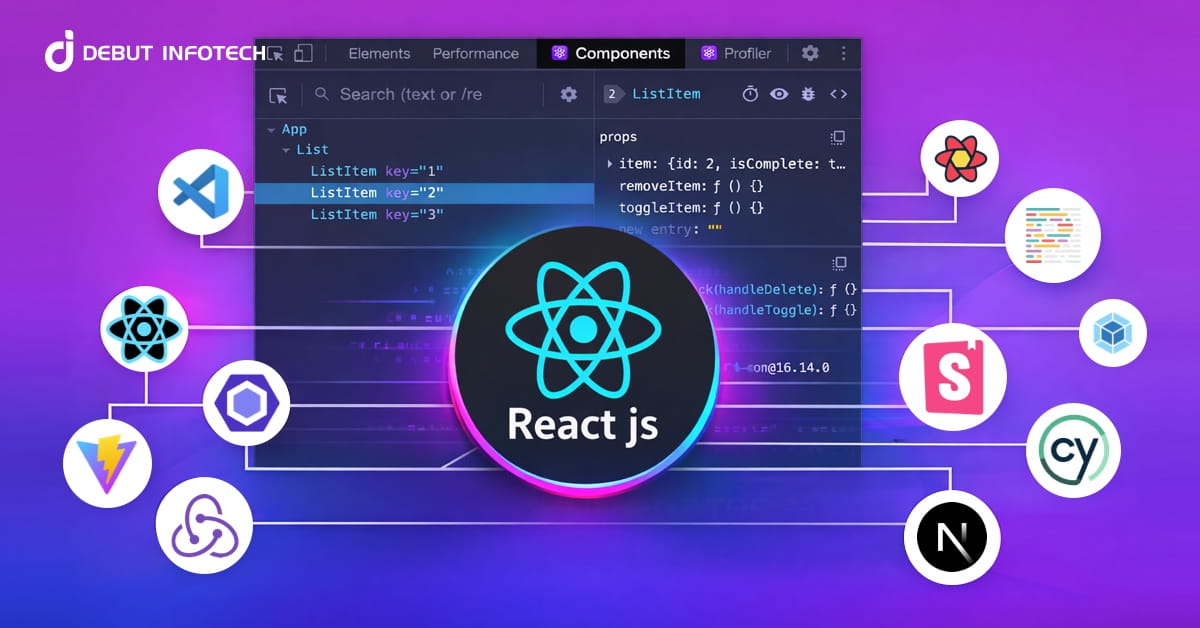


Front-end development is a constantly growing sector, and React remains one of the most popular libraries for building interactive user interfaces. As apps get more complex, developers rely on React JS development tools to write clean code, debug quickly, test thoroughly, and deliver products that can scale rapidly. The React ecosystem will only get more advanced than ever in 2026, with a wide range of tools to help at every step of development.
At Debut Infotech, we work closely with businesses building production-ready React applications across industries. Over time, we have seen that proper tooling can reduce development friction, control web application development costs, and improve long-term maintainability. This guide explores the top tools for React.js developers in 2026, explaining what they do, why they matter, and how they fit into a modern tech stack for web development.
React itself is only the core library. Real-world applications depend on many surrounding tools to function efficiently. From code editors to testing frameworks, each tool plays a specific role in improving productivity and code quality.
Today’s teams also face tighter deadlines and higher performance expectations. Companies focused on progressive web development and rapid web application development tools cannot afford inefficient workflows. The right developer tools for React JS help teams:
As React adoption grows across enterprises and startups alike, tooling has become just as important as the framework itself.
Before diving into individual tools, it helps to understand how ReactJS development tools are grouped and how each category supports a specific phase of the development lifecycle. Rather than working in isolation, these tools combine to form a structured workflow that guides a project from initial setup to production and long-term maintenance.
Each category plays a specific role in the React ecosystem. When combined, these tools create a strong foundation that supports efficient development, high-quality code, and long-term application stability
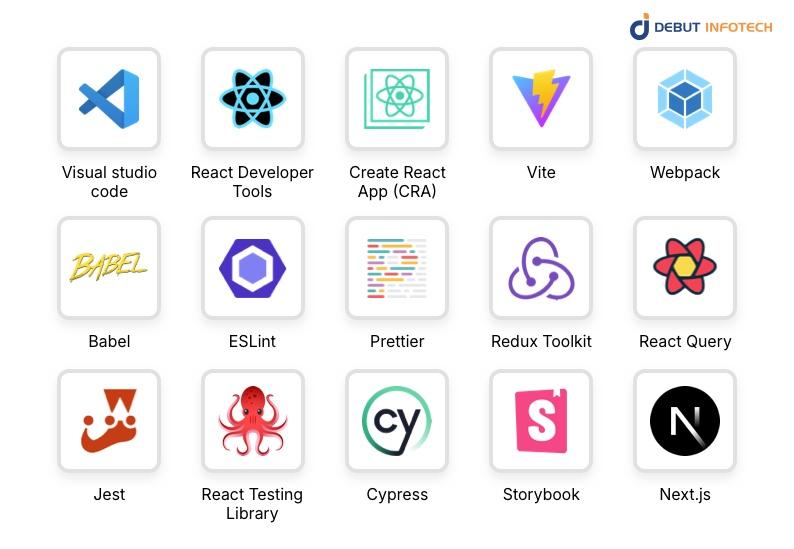
Visual Studio Code remains the most widely used React JS code editor in 2026. Its lightweight design, rich extension ecosystem, and strong community support make it a default choice for many teams.
For React developers, VS Code offers intelligent autocompletion, JSX syntax highlighting, and seamless integration with Reactjs dev tools. Extensions like ESLint, Prettier, and React snippets improve code consistency and readability.
Its flexibility makes it suitable for both solo developers and large React JS development companies working on complex applications.
React Developer Tools is one of the most essential react js developer tools available. It allows developers to inspect component hierarchies, view props and state, and analyze render behavior in real time.
In 2026, this tool will have evolved with better performance profiling and deeper integration with modern React features such as hooks and concurrent rendering. It plays a key role in debugging UI issues that are otherwise difficult to track.
For teams offering web development services, this tool is often indispensable during both development and maintenance phases.
Although many new frameworks have emerged, Create React App remains relevant for quickly bootstrapping React projects. It abstracts configuration complexity and lets developers focus on building features.
CRA remains useful for internal tools, MVPs, and reactjs online prototypes where speed matters more than custom configuration. It supports modern JavaScript, testing, and production builds out of the box.
For rapid development scenarios, CRA continues to support reactjs benefits such as simplicity and ease of onboarding.
Vite has become one of the top tools for React.js developers who care about speed. Its lightning-fast development server and optimized build process significantly reduce startup and reload times.
In 2026, Vite will be widely adopted for large-scale applications and progressive web development projects. It integrates smoothly with React, supports modern bundling techniques, and improves developer experience across environments.
Many React.js development companies now prefer Vite over traditional bundlers for its performance advantages.
Despite newer alternatives, Webpack remains a core tool in many React production environments. It offers deep control over how assets are bundled, optimized, and deployed.
For teams with complex requirements, Webpack allows fine-tuned customization that simpler tools may not support. It plays a vital role in enterprise-grade custom software development projects.
When configured properly, Webpack helps control performance and manage large codebases efficiently.
Babel remains a foundational tool in the React ecosystem. It ensures modern JavaScript and JSX code runs smoothly across browsers.
As JavaScript evolves, Babel helps teams adopt new language features without breaking compatibility. It fits naturally into any React build pipeline and supports long-term project stability.
For businesses managing long-lived applications, Babel remains a silent but critical dependency.
Code quality is non-negotiable in professional development environments. ESLint helps enforce consistent coding standards across React projects.
In 2026, ESLint configurations for React will become more advanced, covering hook usage, accessibility, and performance best practices. It reduces technical debt and helps teams avoid common mistakes early.
For a dedicated software development team, ESLint improves collaboration by enforcing shared rules and expectations.
Prettier focuses on one thing: consistent formatting. While simple, it plays a massive role in improving code readability and reducing friction during code reviews.
When combined with ESLint, Prettier helps maintain clean codebases even as teams scale. It integrates seamlessly with most React JS code editor setups.
Consistency may seem minor, but over time it directly impacts productivity and maintainability.
State management remains a challenge in large React applications. Redux Toolkit simplifies Redux usage by reducing boilerplate and enforcing best practices.
In 2026, Redux Toolkit will be the preferred way to manage complex global state in enterprise applications. It integrates well with modern React patterns and improves debugging by enabling a predictable data flow.
For apps with complex business logic, Redux Toolkit remains one of the most reliable developer tools for React JS.
React Query has transformed how developers handle server state. It abstracts data fetching, caching, and synchronization into a clean API.
This tool reduces the need for manual state management and improves application performance. It is especially valuable for reactjs online applications that rely heavily on APIs.
Many teams now combine React Query with other state tools to simplify data-heavy workflows.
Testing remains a cornerstone of reliable software. Jest continues to dominate as one of the most popular reactjs unit testing tools.
It supports snapshot testing, mocking, and fast test execution. In 2026, Jest will be able to integrate seamlessly with modern React features and CI pipelines.
For teams focused on quality assurance, Jest is often the first testing tool added to a new project.
React Testing Library emphasizes testing behavior rather than implementation details. This approach aligns closely with how users interact with applications.
Combined with Jest, it helps teams write meaningful tests that remain stable as components evolve. It is now considered a best practice for testing React components.
This tool plays a major role in reducing regressions and improving confidence during releases.
Cypress has become one of the best automation tool for ReactJS application testing. It focuses on end-to-end testing, allowing developers to simulate fundamental user interactions.
In 2026, Cypress may be widely used to test critical user flows in production-like environments. Its clear debugging interface and fast feedback loop make it popular among QA teams and developers alike.
For applications with complex UI logic, Cypress provides strong coverage beyond unit tests.
Storybook allows developers to build and test UI components in isolation. This is especially useful for design systems and reusable component libraries.
By separating components from application logic, teams can iterate faster and catch UI issues early. Storybook also improves collaboration between designers and developers.
Many React.js development companies rely on Storybook to maintain a consistent UI across large projects.
Next.js has grown into a full-featured React framework. It supports server-side rendering, static site generation, and API routes.
In 2026, Next.js will play a key role in performance-focused projects and progressive web development strategies. It helps improve SEO, load times, and user experience.
For businesses balancing performance and scalability, Next.js remains one of the most powerful tools in the React ecosystem.
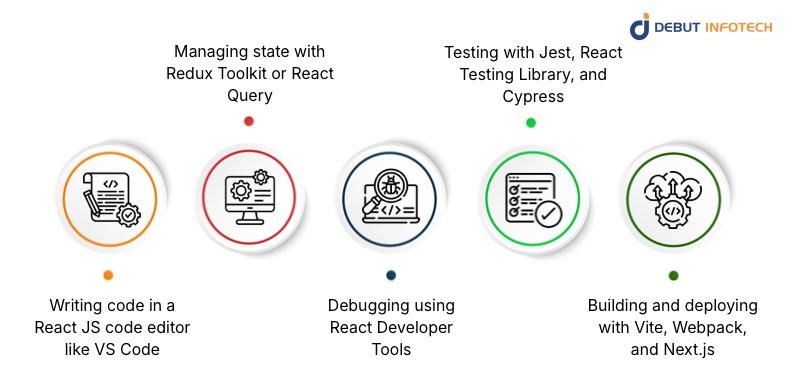
When combined, these tools form a cohesive development pipeline. A typical workflow might include:
The answer depends on project goals. For small projects, simpler setups work well. For enterprise applications, a full stack of react js developer tools is essential.
In most cases, the best tools are those that integrate well with each other, support team collaboration, and scale as the application grows.
This brings the question Is React a Development Tool? React itself is a JavaScript library, not a complete development tool. It focuses on building user interfaces. The surrounding ecosystem of tools is what transforms React into a full development environment.
Understanding this distinction helps teams choose the right supporting tools and avoid overloading projects with unnecessary complexity.
Selecting tools is not about trends. It is about aligning technology with business goals. Factors such as team size, application complexity, and long-term maintenance all influence tool choices.
For organizations offering web development services, choosing reliable ReactJS development tools directly impacts delivery speed and code quality.
At Debut Infotech, we help businesses design, build, and scale React applications using proven tooling and best practices. As a trusted React JS development company, we focus on selecting tools that align with business needs rather than following hype.
We work with clients across industries to assemble efficient tech stacks for web development, optimize performance, and reduce development risk. Our experience with React.js development companies and enterprise teams enables us to support both startups and large organizations.
React development in 2026 is defined by its ecosystem. The library alone is powerful, but the tools around it enable real-world success. From debugging and testing to automation and performance optimization, the right tools shape how efficiently teams build and maintain applications.
At Debut Infotech, we believe that strong tooling is the foundation of sustainable software. Whether you are planning a new project or improving an existing one, understanding and adopting the right ReactJS development tools will help you build faster, scale smarter, and deliver better user experiences.
If you are looking to hire React.js developers or partner with a team that understands both technology and business, choosing the right tools is the first step toward long-term success.
A. React JS development tools support the entire application lifecycle. They help developers write code, manage state, debug components, run tests, and deploy applications efficiently. These tools improve productivity, reduce errors, and make large React projects easier to maintain.
A. Some of the top tools for React.js developers include Visual Studio Code, React Developer Tools, Redux Toolkit, React Query, Jest, React Testing Library, Cypress, Vite, Webpack, and Next.js. Each tool serves a specific purpose within the development workflow.
A. Yes. Reactjs dev tools are widely used in enterprise environments. When combined properly, they support scalability, performance optimization, and long-term maintenance, making them suitable for complex applications built by large teams.
A. Visual Studio Code is the most commonly used React JS code editor. It offers strong support for JSX, extensions for linting and formatting, and seamless integration with many react js developer tools.
A. Jest and React Testing Library are the most reliable reactjs unit testing tools. Jest handles test execution and mocking, while React Testing Library focuses on testing user-facing behavior rather than implementation details.
A. No. React is a JavaScript library for building user interfaces. It becomes a complete development environment only when combined with developer tools for React JS, such as build systems, testing frameworks, and debugging tools.
A. Using the right tools helps reduce development time, prevent bugs, and simplify maintenance. This directly lowers web application development cost by minimizing rework, improving code quality, and enabling faster feature delivery.

Our Latest Insights
USA

2501 Chatham, Rd Suite R Springfield, IL 62704
+1-708-515-4004
info@debutinfotech.com
UK

7 Pound Close, Yarnton, Oxfordshire, OX51QG
+44-770-304-0079
info@debutinfotech.com
Canada

154 Eden Oak Trail, Kitchener, ON N2A 0H9
+1-708-515-4004
info@debutinfotech.com
INDIA

Sector 101-A, Plot No: I-42, IT City Rd, JLPL Industrial Area, Mohali, PB 140306
9888402396
info@debutinfotech.com